Event submissions
Published
This submission belongs to the session Session D. Phytochemistry, Phytoremediation, and Plants in Urban Ecosystems of the event The 3rd International Electronic Conference on Plant Sciences
Published date
19 Jan, 2024
Academic Editor
'%3e%3cpath%20d='M12.6657%2010.9104C12.4185%2010.325%2012.0599%209.79327%2011.6097%209.34482C11.1609%208.89508%2010.6293%208.5365%2010.0442%208.28888C10.0389%208.28626%2010.0337%208.28495%2010.0285%208.28233C10.8446%207.69279%2011.3752%206.73249%2011.3752%205.64904C11.3752%203.8542%209.92103%202.39999%208.1262%202.39999C6.33136%202.39999%204.87715%203.8542%204.87715%205.64904C4.87715%206.73249%205.40774%207.69279%206.22393%208.28364C6.21869%208.28626%206.21345%208.28757%206.20821%208.29019C5.62129%208.5378%205.09463%208.89284%204.64265%209.34613C4.1929%209.79493%203.83432%2010.3266%203.58671%2010.9117C3.34345%2011.4845%203.21226%2012.0987%203.20023%2012.7209C3.19988%2012.7349%203.20233%2012.7488%203.20744%2012.7619C3.21255%2012.7749%203.22022%2012.7867%203.22998%2012.7968C3.23975%2012.8068%203.25142%2012.8147%203.26431%2012.8202C3.2772%2012.8256%203.29105%2012.8284%203.30504%2012.8284H4.09109C4.14874%2012.8284%204.19459%2012.7825%204.1959%2012.7262C4.2221%2011.7148%204.62823%2010.7676%205.34617%2010.0497C6.08899%209.30683%207.0755%208.89808%208.1262%208.89808C9.17689%208.89808%2010.1634%209.30683%2010.9062%2010.0497C11.6242%2010.7676%2012.0303%2011.7148%2012.0565%2012.7262C12.0578%2012.7838%2012.1037%2012.8284%2012.1613%2012.8284H12.9474C12.9613%2012.8284%2012.9752%2012.8256%2012.9881%2012.8202C13.001%2012.8147%2013.0126%2012.8068%2013.0224%2012.7968C13.0322%2012.7867%2013.0398%2012.7749%2013.0449%2012.7619C13.0501%2012.7488%2013.0525%2012.7349%2013.0522%2012.7209C13.0391%2012.0947%2012.9094%2011.4855%2012.6657%2010.9104ZM8.1262%207.9024C7.52486%207.9024%206.9589%207.6679%206.53312%207.24211C6.10733%206.81633%205.87283%206.25037%205.87283%205.64904C5.87283%205.0477%206.10733%204.48174%206.53312%204.05596C6.9589%203.63018%207.52486%203.39567%208.1262%203.39567C8.72753%203.39567%209.29349%203.63018%209.71927%204.05596C10.1451%204.48174%2010.3796%205.0477%2010.3796%205.64904C10.3796%206.25037%2010.1451%206.81633%209.71927%207.24211C9.29349%207.6679%208.72753%207.9024%208.1262%207.9024Z'%20fill='%235D1EE1'/%3e%3c/g%3e%3c/svg%3e) Suresh Awale
Suresh AwaleCitation
Leonardo Bisson, Gianluca Zorzi, Carolina Ramos, Fabio Pinzauti, Fabio Pietrolucci, Valentina Dusi, Stefano Negri, Mauro Commisso, Linda Avesani, Flavia Guzzo, Valorisation of the Italian biodiversity: specialised metabolism in the Rosid clade, in Proceedings of The 3rd International Electronic Conference on Plant Sciences, 15 January–17 January 2024, MDPI: Basel, Switzerland
Share
Email
Facebook
Twitter
LinkedIn
Valorisation of the Italian biodiversity: specialised metabolism in the Rosid clade
'%3e%3cpath%20d='M12.6647%2010.9104C12.4176%2010.325%2012.0589%209.7933%2011.6088%209.34485C11.16%208.89511%2010.6283%208.53653%2010.0432%208.28891C10.038%208.28629%2010.0327%208.28498%2010.0275%208.28236C10.8437%207.69282%2011.3743%206.73252%2011.3743%205.64907C11.3743%203.85423%209.92005%202.40002%208.12522%202.40002C6.33038%202.40002%204.87618%203.85423%204.87618%205.64907C4.87618%206.73252%205.40677%207.69282%206.22296%208.28367C6.21772%208.28629%206.21248%208.2876%206.20724%208.29022C5.62031%208.53783%205.09365%208.89287%204.64167%209.34616C4.19192%209.79496%203.83334%2010.3266%203.58573%2010.9117C3.34247%2011.4846%203.21128%2012.0987%203.19925%2012.721C3.1989%2012.735%203.20135%2012.7489%203.20646%2012.7619C3.21157%2012.7749%203.21924%2012.7868%203.22901%2012.7968C3.23877%2012.8068%203.25045%2012.8148%203.26334%2012.8202C3.27623%2012.8256%203.29007%2012.8284%203.30406%2012.8284H4.09012C4.14776%2012.8284%204.19362%2012.7825%204.19493%2012.7262C4.22113%2011.7148%204.62726%2010.7676%205.34519%2010.0497C6.08802%209.30686%207.07452%208.89811%208.12522%208.89811C9.17592%208.89811%2010.1624%209.30686%2010.9052%2010.0497C11.6232%2010.7676%2012.0293%2011.7148%2012.0555%2012.7262C12.0568%2012.7839%2012.1027%2012.8284%2012.1603%2012.8284H12.9464C12.9604%2012.8284%2012.9742%2012.8256%2012.9871%2012.8202C13%2012.8148%2013.0117%2012.8068%2013.0214%2012.7968C13.0312%2012.7868%2013.0389%2012.7749%2013.044%2012.7619C13.0491%2012.7489%2013.0515%2012.735%2013.0512%2012.721C13.0381%2012.0947%2012.9084%2011.4856%2012.6647%2010.9104ZM8.12522%207.90243C7.52388%207.90243%206.95792%207.66793%206.53214%207.24215C6.10636%206.81636%205.87185%206.2504%205.87185%205.64907C5.87185%205.04773%206.10636%204.48177%206.53214%204.05599C6.95792%203.63021%207.52388%203.3957%208.12522%203.3957C8.72655%203.3957%209.29252%203.63021%209.7183%204.05599C10.1441%204.48177%2010.3786%205.04773%2010.3786%205.64907C10.3786%206.2504%2010.1441%206.81636%209.7183%207.24215C9.29252%207.66793%208.72655%207.90243%208.12522%207.90243Z'%20fill='%235D1EE1'/%3e%3c/g%3e%3c/svg%3e)
Leonardo Bisson 1,2
Gianluca Zorzi 1,2
Carolina Ramos 1
Fabio Pinzauti 1,2
Fabio Pietrolucci 1,2
Valentina Dusi 1,2

Stefano Negri 1,2

Mauro Commisso 1,2

Linda Avesani 1,2
Flavia Guzzo 1,2
1. Department of Biotechnology, University of Verona, Verona, 37134, Italy
2. National Biodiversity Future Center (NBFC), Palermo, 90133, Italy
Abstract
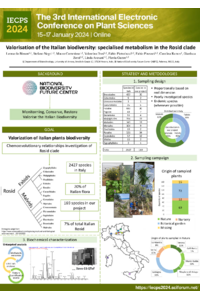
The prosperity and survival of living organisms depend on their ability to adapt to their environment. Plants are exposed to abiotic and biotic stimuli by producing phytochemicals classified as secondary/specialised metabolites. To date, more than 400,000 different specialised metabolites have been identified in plants, and this number might be greatly underestimated since only a few species have been analysed so far. The largest part of the world global flora, which includes more than 400,000 vascular species and 20,000 bryophytes, is still chemically underexplored, constituting a precious source of novel secondary metabolites. This project aims to valorise the Italian biodiversity flora by using a bioprospection strategy on the Rosid cluster, in order to gain insights on how plant secondary/specialised metabolic pathways have spread, evolved, and diversified within this clade. The Italian flora include more than 12,000 species and 2427 species belonging to the Rosid clade, representing 20% of the total. Rosid clade can be further split in two main branches, as suggested by the recent APGIV classification. In Italy, most of the species belong to the Malvids crown clade, representing the 54.3% of total Rosid, whereas Fabids include less species (45,0%). Based on these data, we decided to sample 169 Rosid species (102 belonging to the first branch and 65 belonging to the second one). Bioprospection has been performed by sampling plants in nature, in botanical gardens, and in nurseries. In particular, bioprospection in nature was carried out in Sicily (Palermo’s zone), Sardinia (Sassari’s zone), Lombardy (Pavia’s and Mantova’s zone), and different areas of Veneto, such as Verona, Padua, Altopiando of Asiago, Monte Baldo, and Monti Berici. Untargeted metabolomics analysis based on UPLC-HRMS is still in progress.
Keywords
Biodiversity
UPLC-HRMS
Rosids
Specialised matabolites
Poster
Poster_IECPS2024_LBisson.pdf
Response of psammophyte Alyssum desertorum Stapf to soil flooding
In vivo experiments on the flow of mycotoxins in plants