Event submissions
Published
This submission belongs to the session Session D. Phytochemistry, Phytoremediation, and Plants in Urban Ecosystems of the event The 3rd International Electronic Conference on Plant Sciences
Published date
19 Jan, 2024
Academic Editor
'%3e%3cpath%20d='M12.6657%2010.9104C12.4185%2010.325%2012.0599%209.79327%2011.6097%209.34482C11.1609%208.89508%2010.6293%208.5365%2010.0442%208.28888C10.0389%208.28626%2010.0337%208.28495%2010.0285%208.28233C10.8446%207.69279%2011.3752%206.73249%2011.3752%205.64904C11.3752%203.8542%209.92103%202.39999%208.1262%202.39999C6.33136%202.39999%204.87715%203.8542%204.87715%205.64904C4.87715%206.73249%205.40774%207.69279%206.22393%208.28364C6.21869%208.28626%206.21345%208.28757%206.20821%208.29019C5.62129%208.5378%205.09463%208.89284%204.64265%209.34613C4.1929%209.79493%203.83432%2010.3266%203.58671%2010.9117C3.34345%2011.4845%203.21226%2012.0987%203.20023%2012.7209C3.19988%2012.7349%203.20233%2012.7488%203.20744%2012.7619C3.21255%2012.7749%203.22022%2012.7867%203.22998%2012.7968C3.23975%2012.8068%203.25142%2012.8147%203.26431%2012.8202C3.2772%2012.8256%203.29105%2012.8284%203.30504%2012.8284H4.09109C4.14874%2012.8284%204.19459%2012.7825%204.1959%2012.7262C4.2221%2011.7148%204.62823%2010.7676%205.34617%2010.0497C6.08899%209.30683%207.0755%208.89808%208.1262%208.89808C9.17689%208.89808%2010.1634%209.30683%2010.9062%2010.0497C11.6242%2010.7676%2012.0303%2011.7148%2012.0565%2012.7262C12.0578%2012.7838%2012.1037%2012.8284%2012.1613%2012.8284H12.9474C12.9613%2012.8284%2012.9752%2012.8256%2012.9881%2012.8202C13.001%2012.8147%2013.0126%2012.8068%2013.0224%2012.7968C13.0322%2012.7867%2013.0398%2012.7749%2013.0449%2012.7619C13.0501%2012.7488%2013.0525%2012.7349%2013.0522%2012.7209C13.0391%2012.0947%2012.9094%2011.4855%2012.6657%2010.9104ZM8.1262%207.9024C7.52486%207.9024%206.9589%207.6679%206.53312%207.24211C6.10733%206.81633%205.87283%206.25037%205.87283%205.64904C5.87283%205.0477%206.10733%204.48174%206.53312%204.05596C6.9589%203.63018%207.52486%203.39567%208.1262%203.39567C8.72753%203.39567%209.29349%203.63018%209.71927%204.05596C10.1451%204.48174%2010.3796%205.0477%2010.3796%205.64904C10.3796%206.25037%2010.1451%206.81633%209.71927%207.24211C9.29349%207.6679%208.72753%207.9024%208.1262%207.9024Z'%20fill='%235D1EE1'/%3e%3c/g%3e%3c/svg%3e) Suresh Awale
Suresh AwaleCitation
Roxana Reyes Ríos, Brandon Gómez-Noriega, Giovani Martínez-Hernández, Aldo Franscesco Serrano-Villalobos, Dolores Vargas-Alvaréz, Antonio Juan Cortez-Guzman, Antifungal activity of ethanol extract of thyme (Thymus vulgaris) and almond (Terminalia catappa) against ATCC strains of Candida albicans, in Proceedings of The 3rd International Electronic Conference on Plant Sciences, 15 January–17 January 2024, MDPI: Basel, Switzerland
Share
Email
Facebook
Twitter
LinkedIn
Antifungal activity of ethanol extract of thyme (Thymus vulgaris) and almond (Terminalia catappa) against ATCC strains of Candida albicans
'%3e%3cpath%20d='M12.6647%2010.9104C12.4176%2010.325%2012.0589%209.7933%2011.6088%209.34485C11.16%208.89511%2010.6283%208.53653%2010.0432%208.28891C10.038%208.28629%2010.0327%208.28498%2010.0275%208.28236C10.8437%207.69282%2011.3743%206.73252%2011.3743%205.64907C11.3743%203.85423%209.92005%202.40002%208.12522%202.40002C6.33038%202.40002%204.87618%203.85423%204.87618%205.64907C4.87618%206.73252%205.40677%207.69282%206.22296%208.28367C6.21772%208.28629%206.21248%208.2876%206.20724%208.29022C5.62031%208.53783%205.09365%208.89287%204.64167%209.34616C4.19192%209.79496%203.83334%2010.3266%203.58573%2010.9117C3.34247%2011.4846%203.21128%2012.0987%203.19925%2012.721C3.1989%2012.735%203.20135%2012.7489%203.20646%2012.7619C3.21157%2012.7749%203.21924%2012.7868%203.22901%2012.7968C3.23877%2012.8068%203.25045%2012.8148%203.26334%2012.8202C3.27623%2012.8256%203.29007%2012.8284%203.30406%2012.8284H4.09012C4.14776%2012.8284%204.19362%2012.7825%204.19493%2012.7262C4.22113%2011.7148%204.62726%2010.7676%205.34519%2010.0497C6.08802%209.30686%207.07452%208.89811%208.12522%208.89811C9.17592%208.89811%2010.1624%209.30686%2010.9052%2010.0497C11.6232%2010.7676%2012.0293%2011.7148%2012.0555%2012.7262C12.0568%2012.7839%2012.1027%2012.8284%2012.1603%2012.8284H12.9464C12.9604%2012.8284%2012.9742%2012.8256%2012.9871%2012.8202C13%2012.8148%2013.0117%2012.8068%2013.0214%2012.7968C13.0312%2012.7868%2013.0389%2012.7749%2013.044%2012.7619C13.0491%2012.7489%2013.0515%2012.735%2013.0512%2012.721C13.0381%2012.0947%2012.9084%2011.4856%2012.6647%2010.9104ZM8.12522%207.90243C7.52388%207.90243%206.95792%207.66793%206.53214%207.24215C6.10636%206.81636%205.87185%206.2504%205.87185%205.64907C5.87185%205.04773%206.10636%204.48177%206.53214%204.05599C6.95792%203.63021%207.52388%203.3957%208.12522%203.3957C8.72655%203.3957%209.29252%203.63021%209.7183%204.05599C10.1441%204.48177%2010.3786%205.04773%2010.3786%205.64907C10.3786%206.2504%2010.1441%206.81636%209.7183%207.24215C9.29252%207.66793%208.72655%207.90243%208.12522%207.90243Z'%20fill='%235D1EE1'/%3e%3c/g%3e%3c/svg%3e)
Roxana Reyes Ríos 1
Brandon Gómez-Noriega 2
Giovani Martínez-Hernández 2
Aldo Franscesco Serrano-Villalobos 2
Dolores Vargas-Alvaréz 3
Antonio Juan Cortez-Guzman 3
1. Universidad Autónoma de Guerrero
2. Faculty of Natural Sciences
3. Faculty Biological Chemical Sciences
Abstract
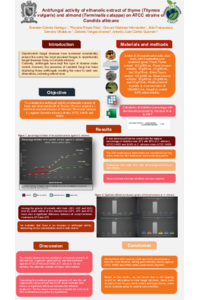
In this investigation, the in vitro effectiveness of ethanol extracts from fresh and dried leaves of almond (Terminalia catappa L.) and the aerial part of thyme (Thymus vulgaris L.) was evaluated against ATCC strains of Candida albicans. (the most prevalent fungus in opportunistic fungal diseases today). The use of herbal remedies to combat this fungal infection is the objective of this study, aiming to identify potential active compounds for future drugs. Extracts of thyme and almond were used against ATCC 14053 and ATCC 24433 strains of Candida albicans to observe the antifungal activity of thyme and almond. A total of 20 experimental units were used, with 5 replications per treatment group. Fresh thyme extract: 125 g/500 mL. Fresh almond extracts: 10 g/90 mL, 20 g/80 mL, and 30 g/70 mL. Dried thyme extract: 125 g/500 mL. Dried almond extracts: 10 g/90 mL, 20 g/80 mL, and 30 g/70 mL. Positive control: Nystatin at a concentration of 100,000 U/mL. Negative control: 0.9% saline solution. The inhibition percentage of the 8 treatments was determined in both strains, with notable results for almond Treatment 3 (AF3) (30 g/70 mL) resulted in an 83.1% inhibition rate against the ATCC 24433 strain and 81.9% against ATCC 14053; treatment 2 (AS2) (20 g/80 mL) and treatment 3 (AS3) (30 g/70 mL) resulted in a 70.6% inhibition rate against ATCC 14053; and treatment 3 (AS3) (30 g/70 mL) yielded a 78.3% inhibition rate. On the other hand, thyme had different results. Treatment (TS) (125 g/500 mL) exhibited29.4% inhibition against ATCC 24433 and treatment (TF) (125 g/500 mL)exhibited 28.6% inhibition against ATCC 14053. Based on the results, we can assert that in the ongoing search for alternatives to treat fungal infections, plants such as almond and thyme, which exhibit antifungal activity, stand out as a natural option to combat such infections.
Keywords
Antifungal activity
Thymus vulgaris
Terminalia catappa
Candida albicans
Poster
Antifungal activity of ethanolic extract of thyme (Thymus vulgaris) and almond (Terminalia catappa) on ATCC strains of Candida albicans.pdf
Effect of Salicylic Acid priming on the expression of Susceptible genes in Zingiber–Pythium interactions
Species richness distribution and endemism of butterworts (Pinguicula: Lentibulariaceae) in America