Event submissions
Published
This submission belongs to the session Session F. Plant Molecular Biology and Plant Genetics, Genomics and Biotechnology of the event The 3rd International Electronic Conference on Plant Sciences
Published date
19 Jan, 2024
Academic Editor
'%3e%3cpath%20d='M12.6657%2010.9104C12.4185%2010.325%2012.0599%209.79327%2011.6097%209.34482C11.1609%208.89508%2010.6293%208.5365%2010.0442%208.28888C10.0389%208.28626%2010.0337%208.28495%2010.0285%208.28233C10.8446%207.69279%2011.3752%206.73249%2011.3752%205.64904C11.3752%203.8542%209.92103%202.39999%208.1262%202.39999C6.33136%202.39999%204.87715%203.8542%204.87715%205.64904C4.87715%206.73249%205.40774%207.69279%206.22393%208.28364C6.21869%208.28626%206.21345%208.28757%206.20821%208.29019C5.62129%208.5378%205.09463%208.89284%204.64265%209.34613C4.1929%209.79493%203.83432%2010.3266%203.58671%2010.9117C3.34345%2011.4845%203.21226%2012.0987%203.20023%2012.7209C3.19988%2012.7349%203.20233%2012.7488%203.20744%2012.7619C3.21255%2012.7749%203.22022%2012.7867%203.22998%2012.7968C3.23975%2012.8068%203.25142%2012.8147%203.26431%2012.8202C3.2772%2012.8256%203.29105%2012.8284%203.30504%2012.8284H4.09109C4.14874%2012.8284%204.19459%2012.7825%204.1959%2012.7262C4.2221%2011.7148%204.62823%2010.7676%205.34617%2010.0497C6.08899%209.30683%207.0755%208.89808%208.1262%208.89808C9.17689%208.89808%2010.1634%209.30683%2010.9062%2010.0497C11.6242%2010.7676%2012.0303%2011.7148%2012.0565%2012.7262C12.0578%2012.7838%2012.1037%2012.8284%2012.1613%2012.8284H12.9474C12.9613%2012.8284%2012.9752%2012.8256%2012.9881%2012.8202C13.001%2012.8147%2013.0126%2012.8068%2013.0224%2012.7968C13.0322%2012.7867%2013.0398%2012.7749%2013.0449%2012.7619C13.0501%2012.7488%2013.0525%2012.7349%2013.0522%2012.7209C13.0391%2012.0947%2012.9094%2011.4855%2012.6657%2010.9104ZM8.1262%207.9024C7.52486%207.9024%206.9589%207.6679%206.53312%207.24211C6.10733%206.81633%205.87283%206.25037%205.87283%205.64904C5.87283%205.0477%206.10733%204.48174%206.53312%204.05596C6.9589%203.63018%207.52486%203.39567%208.1262%203.39567C8.72753%203.39567%209.29349%203.63018%209.71927%204.05596C10.1451%204.48174%2010.3796%205.0477%2010.3796%205.64904C10.3796%206.25037%2010.1451%206.81633%209.71927%207.24211C9.29349%207.6679%208.72753%207.9024%208.1262%207.9024Z'%20fill='%235D1EE1'/%3e%3c/g%3e%3c/svg%3e) Pandiyan Muthuramalingam
Pandiyan MuthuramalingamCitation
Bruno Miguel Ferreira Casimiro, Jorge Canhoto, Paula Veríssimo, Sandra Correia, Optimization of enzymatic production in tamarillo (Solanum betaceum Cav.) cell suspension cultures using chemical elicitation, in Proceedings of The 3rd International Electronic Conference on Plant Sciences, 15 January–17 January 2024, MDPI: Basel, Switzerland
Share
Email
Facebook
Twitter
LinkedIn
Optimization of enzymatic production in tamarillo (Solanum betaceum Cav.) cell suspension cultures using chemical elicitation

Bruno Miguel Ferreira Casimiro 1

Jorge Canhoto 1
'%3e%3cpath%20d='M12.6647%2010.9104C12.4176%2010.325%2012.0589%209.7933%2011.6088%209.34485C11.16%208.89511%2010.6283%208.53653%2010.0432%208.28891C10.038%208.28629%2010.0327%208.28498%2010.0275%208.28236C10.8437%207.69282%2011.3743%206.73252%2011.3743%205.64907C11.3743%203.85423%209.92005%202.40002%208.12522%202.40002C6.33038%202.40002%204.87618%203.85423%204.87618%205.64907C4.87618%206.73252%205.40677%207.69282%206.22296%208.28367C6.21772%208.28629%206.21248%208.2876%206.20724%208.29022C5.62031%208.53783%205.09365%208.89287%204.64167%209.34616C4.19192%209.79496%203.83334%2010.3266%203.58573%2010.9117C3.34247%2011.4846%203.21128%2012.0987%203.19925%2012.721C3.1989%2012.735%203.20135%2012.7489%203.20646%2012.7619C3.21157%2012.7749%203.21924%2012.7868%203.22901%2012.7968C3.23877%2012.8068%203.25045%2012.8148%203.26334%2012.8202C3.27623%2012.8256%203.29007%2012.8284%203.30406%2012.8284H4.09012C4.14776%2012.8284%204.19362%2012.7825%204.19493%2012.7262C4.22113%2011.7148%204.62726%2010.7676%205.34519%2010.0497C6.08802%209.30686%207.07452%208.89811%208.12522%208.89811C9.17592%208.89811%2010.1624%209.30686%2010.9052%2010.0497C11.6232%2010.7676%2012.0293%2011.7148%2012.0555%2012.7262C12.0568%2012.7839%2012.1027%2012.8284%2012.1603%2012.8284H12.9464C12.9604%2012.8284%2012.9742%2012.8256%2012.9871%2012.8202C13%2012.8148%2013.0117%2012.8068%2013.0214%2012.7968C13.0312%2012.7868%2013.0389%2012.7749%2013.044%2012.7619C13.0491%2012.7489%2013.0515%2012.735%2013.0512%2012.721C13.0381%2012.0947%2012.9084%2011.4856%2012.6647%2010.9104ZM8.12522%207.90243C7.52388%207.90243%206.95792%207.66793%206.53214%207.24215C6.10636%206.81636%205.87185%206.2504%205.87185%205.64907C5.87185%205.04773%206.10636%204.48177%206.53214%204.05599C6.95792%203.63021%207.52388%203.3957%208.12522%203.3957C8.72655%203.3957%209.29252%203.63021%209.7183%204.05599C10.1441%204.48177%2010.3786%205.04773%2010.3786%205.64907C10.3786%206.2504%2010.1441%206.81636%209.7183%207.24215C9.29252%207.66793%208.72655%207.90243%208.12522%207.90243Z'%20fill='%235D1EE1'/%3e%3c/g%3e%3c/svg%3e)
Paula Veríssimo 2
Sandra Correia 1,3
1. University of Coimbra, Centre for Functional Ecology, TERRA Associate Laboratory, Department of Life Sciences
2. Centre for Neuroscience and Cell Biology, University of Coimbra, Faculty of Medicine, Polo I, 1st floor, 3004–504, Coimbra, Portugal
3. InnovPlantProtect CoLAB, Estrada de Gil Vaz, 7350-478 Elvas, Portugal
Abstract
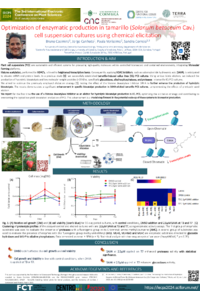
Plant cell suspensions (PCSs) are sustainable and efficient systems for producing high-quality molecules characterized by rapid growth and protein consistency within controlled bioreactors and contained environments. Integrating molecular farming platforms, these systems address contamination issues associated with viral or bacterial toxins. Nonetheless, challenges persist, including scalability for mass production in specific systems and a limited diversity of PCS cultures, which hinders the exploration of novel compounds with biological interest.
Histone acetylation is closely linked to heightened transcription levels. Consequently, the application of histone deacetylase inhibitors, such as suberoylanilide hydroxamic acid (SAHA), is anticipated to elevate mRNA and protein levels. In a previous study (doi: 10.3390/plants12010190), we successfully established tamarillo-induced callus line (ICL) PCS cultures. Using various biotic elicitors, we induced the production of hydrolytic biocatalysts and low molecular weight peptides (>20 kDa), specifically glycosidases, alkaline phosphatases, and proteases, in tamarillo ICL PCS cultures.
In the present work, we aimed to optimize the previously employed elicitation strategy, specifically testing the effect of the histone deacetylase inhibitor SAHA to further enhance the production of hydrolytic biocatalysts. The results demonstrated a significant enhancement in specific biocatalyst production in SAHA-elicited tamarillo PCS cultures, complementing the effects of previously used elicitors.
This study reports, for the first time, the use of a histone deacetylase inhibitor as an elicitor for hydrolytic biocatalyst production in ICL PCS, optimizing the elicitation strategy and contributing to overcoming the typical low-yield biocatalyst production of PCS. This advancement is a crucial step forward in the potential scale-up of these systems for bioreactor production.
Keywords
Cell suspension cultures
molecular farming
deacetylase inhibitors
scale-up production
hydrolytic biocatalyst production
Solanum betaceum
Poster
poster 3rd International Electronic Conference on Plant Sciences.pdf
Species richness distribution and endemism of butterworts (Pinguicula: Lentibulariaceae) in America
A new soilless cultivation system for tomato production in southern Italy