Event submissions
Published
This submission belongs to the session Session A. Plant Physiology Signaling and Communication of the event The 3rd International Electronic Conference on Plant Sciences
Published date
19 Jan, 2024
Academic Editor
'%3e%3cpath%20d='M12.6657%2010.9104C12.4185%2010.325%2012.0599%209.79327%2011.6097%209.34482C11.1609%208.89508%2010.6293%208.5365%2010.0442%208.28888C10.0389%208.28626%2010.0337%208.28495%2010.0285%208.28233C10.8446%207.69279%2011.3752%206.73249%2011.3752%205.64904C11.3752%203.8542%209.92103%202.39999%208.1262%202.39999C6.33136%202.39999%204.87715%203.8542%204.87715%205.64904C4.87715%206.73249%205.40774%207.69279%206.22393%208.28364C6.21869%208.28626%206.21345%208.28757%206.20821%208.29019C5.62129%208.5378%205.09463%208.89284%204.64265%209.34613C4.1929%209.79493%203.83432%2010.3266%203.58671%2010.9117C3.34345%2011.4845%203.21226%2012.0987%203.20023%2012.7209C3.19988%2012.7349%203.20233%2012.7488%203.20744%2012.7619C3.21255%2012.7749%203.22022%2012.7867%203.22998%2012.7968C3.23975%2012.8068%203.25142%2012.8147%203.26431%2012.8202C3.2772%2012.8256%203.29105%2012.8284%203.30504%2012.8284H4.09109C4.14874%2012.8284%204.19459%2012.7825%204.1959%2012.7262C4.2221%2011.7148%204.62823%2010.7676%205.34617%2010.0497C6.08899%209.30683%207.0755%208.89808%208.1262%208.89808C9.17689%208.89808%2010.1634%209.30683%2010.9062%2010.0497C11.6242%2010.7676%2012.0303%2011.7148%2012.0565%2012.7262C12.0578%2012.7838%2012.1037%2012.8284%2012.1613%2012.8284H12.9474C12.9613%2012.8284%2012.9752%2012.8256%2012.9881%2012.8202C13.001%2012.8147%2013.0126%2012.8068%2013.0224%2012.7968C13.0322%2012.7867%2013.0398%2012.7749%2013.0449%2012.7619C13.0501%2012.7488%2013.0525%2012.7349%2013.0522%2012.7209C13.0391%2012.0947%2012.9094%2011.4855%2012.6657%2010.9104ZM8.1262%207.9024C7.52486%207.9024%206.9589%207.6679%206.53312%207.24211C6.10733%206.81633%205.87283%206.25037%205.87283%205.64904C5.87283%205.0477%206.10733%204.48174%206.53312%204.05596C6.9589%203.63018%207.52486%203.39567%208.1262%203.39567C8.72753%203.39567%209.29349%203.63018%209.71927%204.05596C10.1451%204.48174%2010.3796%205.0477%2010.3796%205.64904C10.3796%206.25037%2010.1451%206.81633%209.71927%207.24211C9.29349%207.6679%208.72753%207.9024%208.1262%207.9024Z'%20fill='%235D1EE1'/%3e%3c/g%3e%3c/svg%3e) Enrico Doria
Enrico DoriaCitation
Yi-Chien Lu, Rong-Show Shen, Ting-Hsuan Huang, Effects of paclobutrazol on reproductive and vegetative growth traits in Phalaenopsis Join Grace 'TH288-4', in Proceedings of The 3rd International Electronic Conference on Plant Sciences, 15 January–17 January 2024, MDPI: Basel, Switzerland
Share
Email
Facebook
Twitter
LinkedIn
Effects of paclobutrazol on reproductive and vegetative growth traits in Phalaenopsis Join Grace 'TH288-4'
'%3e%3cpath%20d='M12.6647%2010.9104C12.4176%2010.325%2012.0589%209.7933%2011.6088%209.34485C11.16%208.89511%2010.6283%208.53653%2010.0432%208.28891C10.038%208.28629%2010.0327%208.28498%2010.0275%208.28236C10.8437%207.69282%2011.3743%206.73252%2011.3743%205.64907C11.3743%203.85423%209.92005%202.40002%208.12522%202.40002C6.33038%202.40002%204.87618%203.85423%204.87618%205.64907C4.87618%206.73252%205.40677%207.69282%206.22296%208.28367C6.21772%208.28629%206.21248%208.2876%206.20724%208.29022C5.62031%208.53783%205.09365%208.89287%204.64167%209.34616C4.19192%209.79496%203.83334%2010.3266%203.58573%2010.9117C3.34247%2011.4846%203.21128%2012.0987%203.19925%2012.721C3.1989%2012.735%203.20135%2012.7489%203.20646%2012.7619C3.21157%2012.7749%203.21924%2012.7868%203.22901%2012.7968C3.23877%2012.8068%203.25045%2012.8148%203.26334%2012.8202C3.27623%2012.8256%203.29007%2012.8284%203.30406%2012.8284H4.09012C4.14776%2012.8284%204.19362%2012.7825%204.19493%2012.7262C4.22113%2011.7148%204.62726%2010.7676%205.34519%2010.0497C6.08802%209.30686%207.07452%208.89811%208.12522%208.89811C9.17592%208.89811%2010.1624%209.30686%2010.9052%2010.0497C11.6232%2010.7676%2012.0293%2011.7148%2012.0555%2012.7262C12.0568%2012.7839%2012.1027%2012.8284%2012.1603%2012.8284H12.9464C12.9604%2012.8284%2012.9742%2012.8256%2012.9871%2012.8202C13%2012.8148%2013.0117%2012.8068%2013.0214%2012.7968C13.0312%2012.7868%2013.0389%2012.7749%2013.044%2012.7619C13.0491%2012.7489%2013.0515%2012.735%2013.0512%2012.721C13.0381%2012.0947%2012.9084%2011.4856%2012.6647%2010.9104ZM8.12522%207.90243C7.52388%207.90243%206.95792%207.66793%206.53214%207.24215C6.10636%206.81636%205.87185%206.2504%205.87185%205.64907C5.87185%205.04773%206.10636%204.48177%206.53214%204.05599C6.95792%203.63021%207.52388%203.3957%208.12522%203.3957C8.72655%203.3957%209.29252%203.63021%209.7183%204.05599C10.1441%204.48177%2010.3786%205.04773%2010.3786%205.64907C10.3786%206.2504%2010.1441%206.81636%209.7183%207.24215C9.29252%207.66793%208.72655%207.90243%208.12522%207.90243Z'%20fill='%235D1EE1'/%3e%3c/g%3e%3c/svg%3e)
Yi-Chien Lu 1
Rong-Show Shen 1

Ting-Hsuan Huang 1
1. Department of Horticultural Science, National Chiayi University
Abstract
Phalaenopsis is the most popular potted plant worldwide. However, its typically long spikes often lead to increased shipping costs and risks. This study investigates the effectiveness of varying the concentration, timing, and frequency of paclobutrazol (PP333) applications on shortening the spike of Phalaenopsis Join Grace ‘TH288-4’. Concurrently, it also examines the potential for producing visually appealing, single-flower potted phalaenopsis products by truncation. Mature phalaenopsis plants were moved to a cool room at the seventh week to induce flowering. Three experimental groups were established based on different PP333 application schedules: the T2 group, a single application at the second week; the T2T3 group, applications at both the second and third weeks; and the T7T8 group, applications at the seventh and eighth weeks. The PP333 concentrations used were 0, 250, 500, 750, and 1000 mg·L-1, applied as foliar sprays. The results showed that the shortest spikes, measured from base to first flower, were observed in the T2 group with 750 and 1000 mg·L-1; the T2T3 group treated with 500, 750, and 1000 mg·L-1 PP333; and the T7T8 group treated with 1000 mg·L-1. These treatments resulted in spike lengths of 16.7-22.2 cm, which are 54-69% shorter than the control ones. PP333 application had minimal effects on spike diameter, pedicel length, flower width, length, and length/width ratio. Nevertheless, root diameter was thicker in plants treated with PP333 compared with the control plants. For producing single-flower phalaenopsis, a foliar spray of 750 mg·L-1 PP333 is recommended approximately four weeks before moving Phalaenopsis Join Grace ‘TH288-4’ to cooler conditions, followed by truncation while retaining only the first flower. This study establishes a PP333 treatment protocol for phalaenopsis, offering a strategy to effectively shorten the spikes.
Keywords
Plant growth retardants
Dwarf
Foliar spray
Spike-truncated
Singleflower phalaenopsis
Poster
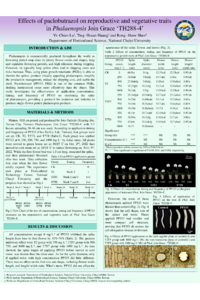
Poster-Effects of paclobutrazol on reproductive and vegetative traits in Phalaenopsis Join Grace ‘TH288-4’.pdf
Morphology and Inheritance of Wavy Flower Form in Periwinkle [Catharanthus roseus (L.) G. Don]
Does the accumulation of lipid droplets and carotenoids affect the viability of Dunaliella salina cells after cryopreservation?