Event submissions
Published
This submission belongs to the session Session A. Plant Physiology Signaling and Communication of the event The 3rd International Electronic Conference on Plant Sciences
Published date
19 Jan, 2024
Academic Editor
'%3e%3cpath%20d='M12.6657%2010.9104C12.4185%2010.325%2012.0599%209.79327%2011.6097%209.34482C11.1609%208.89508%2010.6293%208.5365%2010.0442%208.28888C10.0389%208.28626%2010.0337%208.28495%2010.0285%208.28233C10.8446%207.69279%2011.3752%206.73249%2011.3752%205.64904C11.3752%203.8542%209.92103%202.39999%208.1262%202.39999C6.33136%202.39999%204.87715%203.8542%204.87715%205.64904C4.87715%206.73249%205.40774%207.69279%206.22393%208.28364C6.21869%208.28626%206.21345%208.28757%206.20821%208.29019C5.62129%208.5378%205.09463%208.89284%204.64265%209.34613C4.1929%209.79493%203.83432%2010.3266%203.58671%2010.9117C3.34345%2011.4845%203.21226%2012.0987%203.20023%2012.7209C3.19988%2012.7349%203.20233%2012.7488%203.20744%2012.7619C3.21255%2012.7749%203.22022%2012.7867%203.22998%2012.7968C3.23975%2012.8068%203.25142%2012.8147%203.26431%2012.8202C3.2772%2012.8256%203.29105%2012.8284%203.30504%2012.8284H4.09109C4.14874%2012.8284%204.19459%2012.7825%204.1959%2012.7262C4.2221%2011.7148%204.62823%2010.7676%205.34617%2010.0497C6.08899%209.30683%207.0755%208.89808%208.1262%208.89808C9.17689%208.89808%2010.1634%209.30683%2010.9062%2010.0497C11.6242%2010.7676%2012.0303%2011.7148%2012.0565%2012.7262C12.0578%2012.7838%2012.1037%2012.8284%2012.1613%2012.8284H12.9474C12.9613%2012.8284%2012.9752%2012.8256%2012.9881%2012.8202C13.001%2012.8147%2013.0126%2012.8068%2013.0224%2012.7968C13.0322%2012.7867%2013.0398%2012.7749%2013.0449%2012.7619C13.0501%2012.7488%2013.0525%2012.7349%2013.0522%2012.7209C13.0391%2012.0947%2012.9094%2011.4855%2012.6657%2010.9104ZM8.1262%207.9024C7.52486%207.9024%206.9589%207.6679%206.53312%207.24211C6.10733%206.81633%205.87283%206.25037%205.87283%205.64904C5.87283%205.0477%206.10733%204.48174%206.53312%204.05596C6.9589%203.63018%207.52486%203.39567%208.1262%203.39567C8.72753%203.39567%209.29349%203.63018%209.71927%204.05596C10.1451%204.48174%2010.3796%205.0477%2010.3796%205.64904C10.3796%206.25037%2010.1451%206.81633%209.71927%207.24211C9.29349%207.6679%208.72753%207.9024%208.1262%207.9024Z'%20fill='%235D1EE1'/%3e%3c/g%3e%3c/svg%3e) Enrico Doria
Enrico DoriaCitation
Nicolò Iacuzzi, Federica Alaimo, Davide Farruggia, Pietro Bellitto, Claudio Leto, Salvatore La Bella, Effect of the Foliar Biostimulants on Yield and Quality of "Pizzutello" Tomato Sicilian Landrace Cultivated Without Irrigation, in Proceedings of The 3rd International Electronic Conference on Plant Sciences, 15 January–17 January 2024, MDPI: Basel, Switzerland
Share
Email
Facebook
Twitter
LinkedIn
Effect of the Foliar Biostimulants on Yield and Quality of "Pizzutello" Tomato Sicilian Landrace Cultivated Without Irrigation

Nicolò Iacuzzi 1
'%3e%3cpath%20d='M12.6647%2010.9104C12.4176%2010.325%2012.0589%209.7933%2011.6088%209.34485C11.16%208.89511%2010.6283%208.53653%2010.0432%208.28891C10.038%208.28629%2010.0327%208.28498%2010.0275%208.28236C10.8437%207.69282%2011.3743%206.73252%2011.3743%205.64907C11.3743%203.85423%209.92005%202.40002%208.12522%202.40002C6.33038%202.40002%204.87618%203.85423%204.87618%205.64907C4.87618%206.73252%205.40677%207.69282%206.22296%208.28367C6.21772%208.28629%206.21248%208.2876%206.20724%208.29022C5.62031%208.53783%205.09365%208.89287%204.64167%209.34616C4.19192%209.79496%203.83334%2010.3266%203.58573%2010.9117C3.34247%2011.4846%203.21128%2012.0987%203.19925%2012.721C3.1989%2012.735%203.20135%2012.7489%203.20646%2012.7619C3.21157%2012.7749%203.21924%2012.7868%203.22901%2012.7968C3.23877%2012.8068%203.25045%2012.8148%203.26334%2012.8202C3.27623%2012.8256%203.29007%2012.8284%203.30406%2012.8284H4.09012C4.14776%2012.8284%204.19362%2012.7825%204.19493%2012.7262C4.22113%2011.7148%204.62726%2010.7676%205.34519%2010.0497C6.08802%209.30686%207.07452%208.89811%208.12522%208.89811C9.17592%208.89811%2010.1624%209.30686%2010.9052%2010.0497C11.6232%2010.7676%2012.0293%2011.7148%2012.0555%2012.7262C12.0568%2012.7839%2012.1027%2012.8284%2012.1603%2012.8284H12.9464C12.9604%2012.8284%2012.9742%2012.8256%2012.9871%2012.8202C13%2012.8148%2013.0117%2012.8068%2013.0214%2012.7968C13.0312%2012.7868%2013.0389%2012.7749%2013.044%2012.7619C13.0491%2012.7489%2013.0515%2012.735%2013.0512%2012.721C13.0381%2012.0947%2012.9084%2011.4856%2012.6647%2010.9104ZM8.12522%207.90243C7.52388%207.90243%206.95792%207.66793%206.53214%207.24215C6.10636%206.81636%205.87185%206.2504%205.87185%205.64907C5.87185%205.04773%206.10636%204.48177%206.53214%204.05599C6.95792%203.63021%207.52388%203.3957%208.12522%203.3957C8.72655%203.3957%209.29252%203.63021%209.7183%204.05599C10.1441%204.48177%2010.3786%205.04773%2010.3786%205.64907C10.3786%206.2504%2010.1441%206.81636%209.7183%207.24215C9.29252%207.66793%208.72655%207.90243%208.12522%207.90243Z'%20fill='%235D1EE1'/%3e%3c/g%3e%3c/svg%3e)
Federica Alaimo 2

Davide Farruggia 2
Pietro Bellitto 2
Claudio Leto 2

Salvatore La Bella 2
1. Department of Agricultural, Food and Forest Sciences, Università degli Studi di Palermo, Viale delle Scienze 6 13, Building 4, 90128 Palermo, Italy
2. Department of Agricultural, Food and Forest Sciences, Università degli Studi di Palermo, Viale delle Scienze 13, Building 4, 90128 Palermo, Italy
Abstract
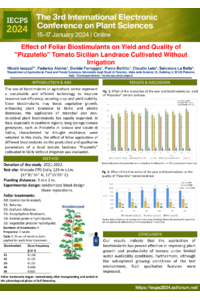
Biostimulants represent a sustainable and efficient technology that can be used in the agriculture sector to improve nutrient use efficiency and secure the yield stability of crops. The application of microbial and non-microbial plant biostimulants has rapidly expanded because these substances may boost vegetative growth and enhance tolerance to biotic and abiotic stress. Tomato (Solanum lycopersicum L.) is a summer crop, affected by drought stress during the cultivation cycle, in particular in the most sensitive periods, such as fruit setting and fruit development. In Italy, especially in southern regions, long-storage tomato genotypes tomato (es. Pizzutello di Sciacca e Locale di Salina) were selected. These genotypes have drought resistance characteristics. In this study, the effect of the foliar application of different biostimulants (betanina, seaweed extracts, vegetable protein hydrolysate, and animal protein hydrolysate) on the productive and qualitative parameters of a local tomato ecotype (Pizzutello) cultivated in Sicily without irrigation was evaluated. In plants treated with betanina (F1), the highest dry matter (9.9%) and solid soluble content (6.9 °Brix) were observed. Foliar treatment with A. nodosum (F3) and animal protein hydrolysate (F4) allowed the highest potassium values to be obtained, vegetal protein hydrolysate (F5) allowed the highest calcium value to be obtained, and betaine (F1) allowed the highest nitrate value to be obtained. In tomatoes obtained from untreated plants, the highest firmness was observed. The highest marketable yield (13.8 t ha-1) was obtained in plants treated with F5, with an increase of about 17% to control plants. The highest non-marketable yield was observed in control plants and in those treated with F1 (1.1 t ha-1). The results obtained indicate that the application of biostimulants has proved effective in improving the growth and productivity of the tomato in conditions of limited water availability. Furthermore, qualitative performances were improved, despite the severe water stress conditions to which the crop was subjected in the test environment.
Keywords
Tomato
Ecotype
Yield
Quality
Biostimulants
Drought Stress.
Poster
POSTER IECPS 2024.pdf
Impact of soil microbiota and tillage practices on the long-term sustainability of agroecosystems in climate change
Review: Arbuscular Mycorrhizal Fungi and Phosphorus Solubilizing Bacteria: Plausible Candidates or Striga hermonthica Management in Sorghum