Event submissions
Published
This submission belongs to the session Session A. Plant Physiology Signaling and Communication of the event The 3rd International Electronic Conference on Plant Sciences
Published date
19 Jan, 2024
Academic Editor
'%3e%3cpath%20d='M12.6657%2010.9104C12.4185%2010.325%2012.0599%209.79327%2011.6097%209.34482C11.1609%208.89508%2010.6293%208.5365%2010.0442%208.28888C10.0389%208.28626%2010.0337%208.28495%2010.0285%208.28233C10.8446%207.69279%2011.3752%206.73249%2011.3752%205.64904C11.3752%203.8542%209.92103%202.39999%208.1262%202.39999C6.33136%202.39999%204.87715%203.8542%204.87715%205.64904C4.87715%206.73249%205.40774%207.69279%206.22393%208.28364C6.21869%208.28626%206.21345%208.28757%206.20821%208.29019C5.62129%208.5378%205.09463%208.89284%204.64265%209.34613C4.1929%209.79493%203.83432%2010.3266%203.58671%2010.9117C3.34345%2011.4845%203.21226%2012.0987%203.20023%2012.7209C3.19988%2012.7349%203.20233%2012.7488%203.20744%2012.7619C3.21255%2012.7749%203.22022%2012.7867%203.22998%2012.7968C3.23975%2012.8068%203.25142%2012.8147%203.26431%2012.8202C3.2772%2012.8256%203.29105%2012.8284%203.30504%2012.8284H4.09109C4.14874%2012.8284%204.19459%2012.7825%204.1959%2012.7262C4.2221%2011.7148%204.62823%2010.7676%205.34617%2010.0497C6.08899%209.30683%207.0755%208.89808%208.1262%208.89808C9.17689%208.89808%2010.1634%209.30683%2010.9062%2010.0497C11.6242%2010.7676%2012.0303%2011.7148%2012.0565%2012.7262C12.0578%2012.7838%2012.1037%2012.8284%2012.1613%2012.8284H12.9474C12.9613%2012.8284%2012.9752%2012.8256%2012.9881%2012.8202C13.001%2012.8147%2013.0126%2012.8068%2013.0224%2012.7968C13.0322%2012.7867%2013.0398%2012.7749%2013.0449%2012.7619C13.0501%2012.7488%2013.0525%2012.7349%2013.0522%2012.7209C13.0391%2012.0947%2012.9094%2011.4855%2012.6657%2010.9104ZM8.1262%207.9024C7.52486%207.9024%206.9589%207.6679%206.53312%207.24211C6.10733%206.81633%205.87283%206.25037%205.87283%205.64904C5.87283%205.0477%206.10733%204.48174%206.53312%204.05596C6.9589%203.63018%207.52486%203.39567%208.1262%203.39567C8.72753%203.39567%209.29349%203.63018%209.71927%204.05596C10.1451%204.48174%2010.3796%205.0477%2010.3796%205.64904C10.3796%206.25037%2010.1451%206.81633%209.71927%207.24211C9.29349%207.6679%208.72753%207.9024%208.1262%207.9024Z'%20fill='%235D1EE1'/%3e%3c/g%3e%3c/svg%3e) Enrico Doria
Enrico DoriaCitation
Narayan Singh, Shalinder Kaur, Harminder Pal Singh, Daizy Rani Batish, The modulatory effect of Nitric oxide molecules on the heavy metal stress in Triticum aestivum, in Proceedings of The 3rd International Electronic Conference on Plant Sciences, 15 January–17 January 2024, MDPI: Basel, Switzerland
Share
Email
Facebook
Twitter
LinkedIn
The modulatory effect of Nitric oxide molecules on the heavy metal stress in Triticum aestivum
'%3e%3cpath%20d='M12.6647%2010.9104C12.4176%2010.325%2012.0589%209.7933%2011.6088%209.34485C11.16%208.89511%2010.6283%208.53653%2010.0432%208.28891C10.038%208.28629%2010.0327%208.28498%2010.0275%208.28236C10.8437%207.69282%2011.3743%206.73252%2011.3743%205.64907C11.3743%203.85423%209.92005%202.40002%208.12522%202.40002C6.33038%202.40002%204.87618%203.85423%204.87618%205.64907C4.87618%206.73252%205.40677%207.69282%206.22296%208.28367C6.21772%208.28629%206.21248%208.2876%206.20724%208.29022C5.62031%208.53783%205.09365%208.89287%204.64167%209.34616C4.19192%209.79496%203.83334%2010.3266%203.58573%2010.9117C3.34247%2011.4846%203.21128%2012.0987%203.19925%2012.721C3.1989%2012.735%203.20135%2012.7489%203.20646%2012.7619C3.21157%2012.7749%203.21924%2012.7868%203.22901%2012.7968C3.23877%2012.8068%203.25045%2012.8148%203.26334%2012.8202C3.27623%2012.8256%203.29007%2012.8284%203.30406%2012.8284H4.09012C4.14776%2012.8284%204.19362%2012.7825%204.19493%2012.7262C4.22113%2011.7148%204.62726%2010.7676%205.34519%2010.0497C6.08802%209.30686%207.07452%208.89811%208.12522%208.89811C9.17592%208.89811%2010.1624%209.30686%2010.9052%2010.0497C11.6232%2010.7676%2012.0293%2011.7148%2012.0555%2012.7262C12.0568%2012.7839%2012.1027%2012.8284%2012.1603%2012.8284H12.9464C12.9604%2012.8284%2012.9742%2012.8256%2012.9871%2012.8202C13%2012.8148%2013.0117%2012.8068%2013.0214%2012.7968C13.0312%2012.7868%2013.0389%2012.7749%2013.044%2012.7619C13.0491%2012.7489%2013.0515%2012.735%2013.0512%2012.721C13.0381%2012.0947%2012.9084%2011.4856%2012.6647%2010.9104ZM8.12522%207.90243C7.52388%207.90243%206.95792%207.66793%206.53214%207.24215C6.10636%206.81636%205.87185%206.2504%205.87185%205.64907C5.87185%205.04773%206.10636%204.48177%206.53214%204.05599C6.95792%203.63021%207.52388%203.3957%208.12522%203.3957C8.72655%203.3957%209.29252%203.63021%209.7183%204.05599C10.1441%204.48177%2010.3786%205.04773%2010.3786%205.64907C10.3786%206.2504%2010.1441%206.81636%209.7183%207.24215C9.29252%207.66793%208.72655%207.90243%208.12522%207.90243Z'%20fill='%235D1EE1'/%3e%3c/g%3e%3c/svg%3e)
Narayan Singh 1,2
Shalinder Kaur 2
Harminder Pal Singh 2
Daizy Rani Batish 2
1. Department of Botany, Sai School of Biosciences, Sri Sai University, Palampur, HP, India-17081
2. Department of Botany, Panjab University, Chandigarh, India-160014
Abstract
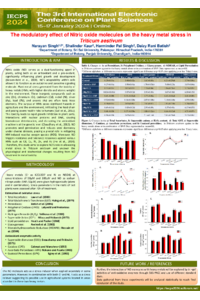
This study investigates the impact of nitric oxide (NO) on heavy metal (HM) stress in Triticum aestivum. For this, heavy metals (Cr as K2Cr2O7 and Ni as NiSO4) at concentrations of 50µM and 100µM and NO as sodium nitroprusside (SNP; 50µM) were given hydroponically (alone and in combination). Stress parameters in the roots of test plants were assessed after 72h of treatment. In response to HM treatment, the levels of ascorbic acid (a natural antioxidant) significantly declined (23.35±0.67 to 13.24±1.27 and 14.35±0.4 µM/g fresh weight within 72h for 100µM Cr and Ni, respectively). However, in the HM+SNP combination, levels were observed at 22.65±1.22 and 22.78±1.25 µM/g fresh weight, respectively (SNP alone= 21.952±0.403). HM exposure also led to increased levels of stress indicators such as H2O2 content, superoxide anions, and other stress markers (including total glutathione-S-transferase, peroxidases, polyphenol oxidases, lipoxygenases, monodehydroascorbate reductase, and malondialdehyde content). The NO demonstrated an alleviating effect when applied with HMs, lowering the levels of stress indicators. Antioxidative enzymes such as superoxide dismutase (~250%; SNP=113%), ascorbate peroxidases (~160%; SNP=2% decrease), and guaiacol peroxidase (~60%; SNP=7% decrease) showed increased activity, whereas catalase had reduced enzymatic activity (~296% in the case of Cr and ~307% for Ni; SNP had a 113% increase) in response to the HM stress. When SNP was supplied with HMs, significant positive changes in the above parameters were observed, indicating the protection it offers against heavy metal toxicity. Also, both heavy metals exhibited similar toxic effects on the test plants. Overall, in our study, the NO molecule acts as a stress inducer when applied separately in some parameters. However, in combination with both Cr and Ni, it acts as a stress reliever, suggesting its possible use in agricultural systems located in areas abundant in these two heavy metals.
Keywords
Nitric Oxide
Heavy metal stress
Antioxidants
Hydroponics
Poster
Dr Narayan Singh IECPS 24.pdf
An assessment of the chemical composition and physical parameters of Phaseolus vulgaris and Phaseolus lunatus beans
The effect of BAP concentration and salt strength of MS medium on the in vitro shoot growth and multiplication of Passiflora edulis var. Horana Gold