Event submissions
Published
This submission belongs to the session Session C. Plant Response to Stresses and Changing Environment of the event The 3rd International Electronic Conference on Plant Sciences
Published date
19 Jan, 2024
Academic Editor
'%3e%3cpath%20d='M12.6657%2010.9104C12.4185%2010.325%2012.0599%209.79327%2011.6097%209.34482C11.1609%208.89508%2010.6293%208.5365%2010.0442%208.28888C10.0389%208.28626%2010.0337%208.28495%2010.0285%208.28233C10.8446%207.69279%2011.3752%206.73249%2011.3752%205.64904C11.3752%203.8542%209.92103%202.39999%208.1262%202.39999C6.33136%202.39999%204.87715%203.8542%204.87715%205.64904C4.87715%206.73249%205.40774%207.69279%206.22393%208.28364C6.21869%208.28626%206.21345%208.28757%206.20821%208.29019C5.62129%208.5378%205.09463%208.89284%204.64265%209.34613C4.1929%209.79493%203.83432%2010.3266%203.58671%2010.9117C3.34345%2011.4845%203.21226%2012.0987%203.20023%2012.7209C3.19988%2012.7349%203.20233%2012.7488%203.20744%2012.7619C3.21255%2012.7749%203.22022%2012.7867%203.22998%2012.7968C3.23975%2012.8068%203.25142%2012.8147%203.26431%2012.8202C3.2772%2012.8256%203.29105%2012.8284%203.30504%2012.8284H4.09109C4.14874%2012.8284%204.19459%2012.7825%204.1959%2012.7262C4.2221%2011.7148%204.62823%2010.7676%205.34617%2010.0497C6.08899%209.30683%207.0755%208.89808%208.1262%208.89808C9.17689%208.89808%2010.1634%209.30683%2010.9062%2010.0497C11.6242%2010.7676%2012.0303%2011.7148%2012.0565%2012.7262C12.0578%2012.7838%2012.1037%2012.8284%2012.1613%2012.8284H12.9474C12.9613%2012.8284%2012.9752%2012.8256%2012.9881%2012.8202C13.001%2012.8147%2013.0126%2012.8068%2013.0224%2012.7968C13.0322%2012.7867%2013.0398%2012.7749%2013.0449%2012.7619C13.0501%2012.7488%2013.0525%2012.7349%2013.0522%2012.7209C13.0391%2012.0947%2012.9094%2011.4855%2012.6657%2010.9104ZM8.1262%207.9024C7.52486%207.9024%206.9589%207.6679%206.53312%207.24211C6.10733%206.81633%205.87283%206.25037%205.87283%205.64904C5.87283%205.0477%206.10733%204.48174%206.53312%204.05596C6.9589%203.63018%207.52486%203.39567%208.1262%203.39567C8.72753%203.39567%209.29349%203.63018%209.71927%204.05596C10.1451%204.48174%2010.3796%205.0477%2010.3796%205.64904C10.3796%206.25037%2010.1451%206.81633%209.71927%207.24211C9.29349%207.6679%208.72753%207.9024%208.1262%207.9024Z'%20fill='%235D1EE1'/%3e%3c/g%3e%3c/svg%3e) Maurizio Badiani
Maurizio BadianiCitation
F.M. Junkeer, G. D. A. Priyantha, W. D. P. Weerasinghe, D. M. R. G. Mayakaduwa, D. M. Withanawasam, R. A. N. M. S. Senanayake, Climate resilience in crop rice: advancing the germplasm for submergence tolerance, in Proceedings of The 3rd International Electronic Conference on Plant Sciences, 15 January–17 January 2024, MDPI: Basel, Switzerland
Share
Email
Facebook
Twitter
LinkedIn
Climate resilience in crop rice: advancing the germplasm for submergence tolerance
'%3e%3cpath%20d='M12.6647%2010.9104C12.4176%2010.325%2012.0589%209.7933%2011.6088%209.34485C11.16%208.89511%2010.6283%208.53653%2010.0432%208.28891C10.038%208.28629%2010.0327%208.28498%2010.0275%208.28236C10.8437%207.69282%2011.3743%206.73252%2011.3743%205.64907C11.3743%203.85423%209.92005%202.40002%208.12522%202.40002C6.33038%202.40002%204.87618%203.85423%204.87618%205.64907C4.87618%206.73252%205.40677%207.69282%206.22296%208.28367C6.21772%208.28629%206.21248%208.2876%206.20724%208.29022C5.62031%208.53783%205.09365%208.89287%204.64167%209.34616C4.19192%209.79496%203.83334%2010.3266%203.58573%2010.9117C3.34247%2011.4846%203.21128%2012.0987%203.19925%2012.721C3.1989%2012.735%203.20135%2012.7489%203.20646%2012.7619C3.21157%2012.7749%203.21924%2012.7868%203.22901%2012.7968C3.23877%2012.8068%203.25045%2012.8148%203.26334%2012.8202C3.27623%2012.8256%203.29007%2012.8284%203.30406%2012.8284H4.09012C4.14776%2012.8284%204.19362%2012.7825%204.19493%2012.7262C4.22113%2011.7148%204.62726%2010.7676%205.34519%2010.0497C6.08802%209.30686%207.07452%208.89811%208.12522%208.89811C9.17592%208.89811%2010.1624%209.30686%2010.9052%2010.0497C11.6232%2010.7676%2012.0293%2011.7148%2012.0555%2012.7262C12.0568%2012.7839%2012.1027%2012.8284%2012.1603%2012.8284H12.9464C12.9604%2012.8284%2012.9742%2012.8256%2012.9871%2012.8202C13%2012.8148%2013.0117%2012.8068%2013.0214%2012.7968C13.0312%2012.7868%2013.0389%2012.7749%2013.044%2012.7619C13.0491%2012.7489%2013.0515%2012.735%2013.0512%2012.721C13.0381%2012.0947%2012.9084%2011.4856%2012.6647%2010.9104ZM8.12522%207.90243C7.52388%207.90243%206.95792%207.66793%206.53214%207.24215C6.10636%206.81636%205.87185%206.2504%205.87185%205.64907C5.87185%205.04773%206.10636%204.48177%206.53214%204.05599C6.95792%203.63021%207.52388%203.3957%208.12522%203.3957C8.72655%203.3957%209.29252%203.63021%209.7183%204.05599C10.1441%204.48177%2010.3786%205.04773%2010.3786%205.64907C10.3786%206.2504%2010.1441%206.81636%209.7183%207.24215C9.29252%207.66793%208.72655%207.90243%208.12522%207.90243Z'%20fill='%235D1EE1'/%3e%3c/g%3e%3c/svg%3e)
F.M. Junkeer 1
G. D. A. Priyantha 2
W. D. P. Weerasinghe 2
D. M. R. G. Mayakaduwa 1
D. M. Withanawasam 2
R. A. N. M. S. Senanayake 3
1. Department of Plant Sciences, University of Colombo, Colombo 03, Sri Lanka
2. Regional Rice Research and Development Centre, Bombuwala, Sri Lanka
3. Rice Research and Development Institute, Bathalagoda, Ibbagamuwa, Sri Lanka
Abstract
Flash floods that occur during early seedling development lead to severe losses in rice crop cultivation. Therefore, the development of submergence-tolerant rice varieties is critically important to mitigate damage and ensure food security. The objective of this study was to assess the submergence tolerance of a new, improved collection of rice entries, using artificially induced complete submergence conditions during the vegetative phase. The artificial screening was carried out at the Regional Rice Research and Development Centre in Bombuwala, Sri Lanka. The study comprised two phases. In phase I, 138 rice entries were screened, including 104 international entries and 34 local entries. Twenty-one-day-old seedlings were subjected to submergence stress in concrete tanks filled with clean water (pH 7.1; EC 0.125 mScm-1; T 26.5 °C) to a depth of 1 m for a period of 18 days. Survival percentages of de-submerged plants were recorded following 7 days of recovery. According to the scoring system of the International Rice Research Institute, the selected (138) entries were classified into different categories, highly tolerant (12), tolerant (9), moderately tolerant (55), moderately susceptible (31), and susceptible (31), based on their responses to submergence stress. In phase II, nine entries were selected from the previous phase, representing highly tolerant, tolerant, moderately tolerant, and susceptible categories to investigate respective morphological, physiological, biochemical, and anatomical responses upon submergence stress. The highly tolerant entries exhibited an accumulation of chlorophyll (0.17-0.73 mgg-1) following submergence, while susceptible entries showed a degradation (0.23-1.03 mgg-1). Non-structural carbohydrates were accumulated (1.79-6.55 mgml-1) in both highly tolerant and tolerant entries, while degradation (2.25-4.46 mgml-1) was observed in the susceptible entries following submergence. Standard susceptible check IR 42 exhibited significantly higher (p ≤ 0.05) aerenchyma formation (34.6%) compared to highly tolerant (14.0-21.3%), tolerant (16.8-17.0%), and moderately tolerant (10.6-24.7%) groups. The evident physiological, biochemical, and anatomical responses provide crucial insights for further improving the rice crop for climate resilience.
Keywords
Rice breeding
Adaptation
Mitigation
Poster
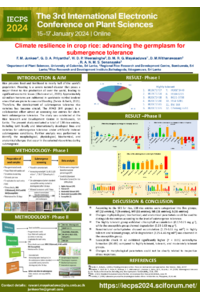
IECPS2024_sciforum-082755.pdf
Shifts in Arable Weeds Diversity and Community Structure in Response to Agricultural Intensification Practices: a Case Study from Northern Morocco
Synergistic effect between different plant growth-promoting bacteria and various nitrogen rates on production and quality of fennel grown in open field