Event submissions
Published
This submission belongs to the session Session E. Plant Nutrition and Plant–Soil–Microorganism Interactions of the event The 3rd International Electronic Conference on Plant Sciences
Published date
19 Jan, 2024
Academic Editor
'%3e%3cpath%20d='M12.6657%2010.9104C12.4185%2010.325%2012.0599%209.79327%2011.6097%209.34482C11.1609%208.89508%2010.6293%208.5365%2010.0442%208.28888C10.0389%208.28626%2010.0337%208.28495%2010.0285%208.28233C10.8446%207.69279%2011.3752%206.73249%2011.3752%205.64904C11.3752%203.8542%209.92103%202.39999%208.1262%202.39999C6.33136%202.39999%204.87715%203.8542%204.87715%205.64904C4.87715%206.73249%205.40774%207.69279%206.22393%208.28364C6.21869%208.28626%206.21345%208.28757%206.20821%208.29019C5.62129%208.5378%205.09463%208.89284%204.64265%209.34613C4.1929%209.79493%203.83432%2010.3266%203.58671%2010.9117C3.34345%2011.4845%203.21226%2012.0987%203.20023%2012.7209C3.19988%2012.7349%203.20233%2012.7488%203.20744%2012.7619C3.21255%2012.7749%203.22022%2012.7867%203.22998%2012.7968C3.23975%2012.8068%203.25142%2012.8147%203.26431%2012.8202C3.2772%2012.8256%203.29105%2012.8284%203.30504%2012.8284H4.09109C4.14874%2012.8284%204.19459%2012.7825%204.1959%2012.7262C4.2221%2011.7148%204.62823%2010.7676%205.34617%2010.0497C6.08899%209.30683%207.0755%208.89808%208.1262%208.89808C9.17689%208.89808%2010.1634%209.30683%2010.9062%2010.0497C11.6242%2010.7676%2012.0303%2011.7148%2012.0565%2012.7262C12.0578%2012.7838%2012.1037%2012.8284%2012.1613%2012.8284H12.9474C12.9613%2012.8284%2012.9752%2012.8256%2012.9881%2012.8202C13.001%2012.8147%2013.0126%2012.8068%2013.0224%2012.7968C13.0322%2012.7867%2013.0398%2012.7749%2013.0449%2012.7619C13.0501%2012.7488%2013.0525%2012.7349%2013.0522%2012.7209C13.0391%2012.0947%2012.9094%2011.4855%2012.6657%2010.9104ZM8.1262%207.9024C7.52486%207.9024%206.9589%207.6679%206.53312%207.24211C6.10733%206.81633%205.87283%206.25037%205.87283%205.64904C5.87283%205.0477%206.10733%204.48174%206.53312%204.05596C6.9589%203.63018%207.52486%203.39567%208.1262%203.39567C8.72753%203.39567%209.29349%203.63018%209.71927%204.05596C10.1451%204.48174%2010.3796%205.0477%2010.3796%205.64904C10.3796%206.25037%2010.1451%206.81633%209.71927%207.24211C9.29349%207.6679%208.72753%207.9024%208.1262%207.9024Z'%20fill='%235D1EE1'/%3e%3c/g%3e%3c/svg%3e) Xinhua He
Xinhua HeCitation
Beppe Benedetto Consentino, Lorena Vultaggio, Salvatore La Bella, Leo Sabatino, Lettuce performances as influenced by different nitrogen dosages and A. brasilense strains, in Proceedings of The 3rd International Electronic Conference on Plant Sciences, 15 January–17 January 2024, MDPI: Basel, Switzerland
Share
Email
Facebook
Twitter
LinkedIn
Lettuce performances as influenced by different nitrogen dosages and A. brasilense strains

Beppe Benedetto Consentino 1
'%3e%3cpath%20d='M12.6647%2010.9104C12.4176%2010.325%2012.0589%209.7933%2011.6088%209.34485C11.16%208.89511%2010.6283%208.53653%2010.0432%208.28891C10.038%208.28629%2010.0327%208.28498%2010.0275%208.28236C10.8437%207.69282%2011.3743%206.73252%2011.3743%205.64907C11.3743%203.85423%209.92005%202.40002%208.12522%202.40002C6.33038%202.40002%204.87618%203.85423%204.87618%205.64907C4.87618%206.73252%205.40677%207.69282%206.22296%208.28367C6.21772%208.28629%206.21248%208.2876%206.20724%208.29022C5.62031%208.53783%205.09365%208.89287%204.64167%209.34616C4.19192%209.79496%203.83334%2010.3266%203.58573%2010.9117C3.34247%2011.4846%203.21128%2012.0987%203.19925%2012.721C3.1989%2012.735%203.20135%2012.7489%203.20646%2012.7619C3.21157%2012.7749%203.21924%2012.7868%203.22901%2012.7968C3.23877%2012.8068%203.25045%2012.8148%203.26334%2012.8202C3.27623%2012.8256%203.29007%2012.8284%203.30406%2012.8284H4.09012C4.14776%2012.8284%204.19362%2012.7825%204.19493%2012.7262C4.22113%2011.7148%204.62726%2010.7676%205.34519%2010.0497C6.08802%209.30686%207.07452%208.89811%208.12522%208.89811C9.17592%208.89811%2010.1624%209.30686%2010.9052%2010.0497C11.6232%2010.7676%2012.0293%2011.7148%2012.0555%2012.7262C12.0568%2012.7839%2012.1027%2012.8284%2012.1603%2012.8284H12.9464C12.9604%2012.8284%2012.9742%2012.8256%2012.9871%2012.8202C13%2012.8148%2013.0117%2012.8068%2013.0214%2012.7968C13.0312%2012.7868%2013.0389%2012.7749%2013.044%2012.7619C13.0491%2012.7489%2013.0515%2012.735%2013.0512%2012.721C13.0381%2012.0947%2012.9084%2011.4856%2012.6647%2010.9104ZM8.12522%207.90243C7.52388%207.90243%206.95792%207.66793%206.53214%207.24215C6.10636%206.81636%205.87185%206.2504%205.87185%205.64907C5.87185%205.04773%206.10636%204.48177%206.53214%204.05599C6.95792%203.63021%207.52388%203.3957%208.12522%203.3957C8.72655%203.3957%209.29252%203.63021%209.7183%204.05599C10.1441%204.48177%2010.3786%205.04773%2010.3786%205.64907C10.3786%206.2504%2010.1441%206.81636%209.7183%207.24215C9.29252%207.66793%208.72655%207.90243%208.12522%207.90243Z'%20fill='%235D1EE1'/%3e%3c/g%3e%3c/svg%3e)
Lorena Vultaggio 1

Salvatore La Bella 1

Leo Sabatino 1
1. Department of Agricultural, food and Forest Sciences (SAAF), University of Palermo
Abstract
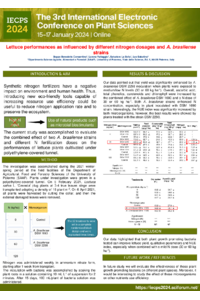
Nitrogen (N) supply is an imperative agricultural technique for enhancing and safeguarding yield of vegetable crops. However, synthetic N fertilizers have a negative impact on environment and human health. At this regard, introducing new eco-friendly tools capable of increasing resource use efficiency could be useful to reduce nitrogen application rate and to preserve the ecosystem. The current study was accomplished to evaluate the combined effect of two A. brasilense strains [(from the German collection of microorganisms (DSM)] (DSM 1690 and DSM 2298) and different N fertilization doses - administered using ammonium nitrate - (0, 30, 60 or 120 kg ha-1) on yield, dry matter content, ascorbic acid, total phenols, carotenoids, chlorophyll, nitrogen and nitrogen use efficiency (NUE) index of lettuce plants cultivated under polyethylene-covered tunnel. Our data pointed out that yield was significantly enhanced by A. brasilense DSM 2298 inoculation when plants were exposed to medium/low N levels (30 or 60 kg ha-1). Overall, ascorbic acid, total phenolics, carotenoids and chlorophyll were increased by the combined effect of A. brasilense DSM 1690 and a N dose of 30 or 60 kg ha-1. Both A. brasilense strains enhanced N concentration, especially in plant inoculated with DSM 1690 strain. Interestingly, the NUE index was significantly increased by both microorganisms, however, the best results were showed by plants treated with the strain DSM 2298. Our data highlighted that both plant growth promoting bacteria tested are able to improve lettuce yield, qualitative parameters and NUE index, especially when combined with a mild N dose (30 or 60 kg ha-1).
Keywords
'Canasta' lettuce
nutritional features
functional traits
plant growth promoting bacteria
nitrogen use efficiency
Poster
POSTER-CONSENTINO.pdf
Synergistic effect between different plant growth-promoting bacteria and various nitrogen rates on production and quality of fennel grown in open field
Proliferation of Rindera graeca hairy roots on polymeric scaffolds