Event submissions
Published
This submission belongs to the session Session D. Phytochemistry, Phytoremediation, and Plants in Urban Ecosystems of the event The 3rd International Electronic Conference on Plant Sciences
Published date
19 Jan, 2024
Academic Editor
'%3e%3cpath%20d='M12.6657%2010.9104C12.4185%2010.325%2012.0599%209.79327%2011.6097%209.34482C11.1609%208.89508%2010.6293%208.5365%2010.0442%208.28888C10.0389%208.28626%2010.0337%208.28495%2010.0285%208.28233C10.8446%207.69279%2011.3752%206.73249%2011.3752%205.64904C11.3752%203.8542%209.92103%202.39999%208.1262%202.39999C6.33136%202.39999%204.87715%203.8542%204.87715%205.64904C4.87715%206.73249%205.40774%207.69279%206.22393%208.28364C6.21869%208.28626%206.21345%208.28757%206.20821%208.29019C5.62129%208.5378%205.09463%208.89284%204.64265%209.34613C4.1929%209.79493%203.83432%2010.3266%203.58671%2010.9117C3.34345%2011.4845%203.21226%2012.0987%203.20023%2012.7209C3.19988%2012.7349%203.20233%2012.7488%203.20744%2012.7619C3.21255%2012.7749%203.22022%2012.7867%203.22998%2012.7968C3.23975%2012.8068%203.25142%2012.8147%203.26431%2012.8202C3.2772%2012.8256%203.29105%2012.8284%203.30504%2012.8284H4.09109C4.14874%2012.8284%204.19459%2012.7825%204.1959%2012.7262C4.2221%2011.7148%204.62823%2010.7676%205.34617%2010.0497C6.08899%209.30683%207.0755%208.89808%208.1262%208.89808C9.17689%208.89808%2010.1634%209.30683%2010.9062%2010.0497C11.6242%2010.7676%2012.0303%2011.7148%2012.0565%2012.7262C12.0578%2012.7838%2012.1037%2012.8284%2012.1613%2012.8284H12.9474C12.9613%2012.8284%2012.9752%2012.8256%2012.9881%2012.8202C13.001%2012.8147%2013.0126%2012.8068%2013.0224%2012.7968C13.0322%2012.7867%2013.0398%2012.7749%2013.0449%2012.7619C13.0501%2012.7488%2013.0525%2012.7349%2013.0522%2012.7209C13.0391%2012.0947%2012.9094%2011.4855%2012.6657%2010.9104ZM8.1262%207.9024C7.52486%207.9024%206.9589%207.6679%206.53312%207.24211C6.10733%206.81633%205.87283%206.25037%205.87283%205.64904C5.87283%205.0477%206.10733%204.48174%206.53312%204.05596C6.9589%203.63018%207.52486%203.39567%208.1262%203.39567C8.72753%203.39567%209.29349%203.63018%209.71927%204.05596C10.1451%204.48174%2010.3796%205.0477%2010.3796%205.64904C10.3796%206.25037%2010.1451%206.81633%209.71927%207.24211C9.29349%207.6679%208.72753%207.9024%208.1262%207.9024Z'%20fill='%235D1EE1'/%3e%3c/g%3e%3c/svg%3e) Suresh Awale
Suresh AwaleCitation
Vaide Sakalauskienė, Jonas Viškelis, Aiste Balciunaitiene, Sustainable green synthesis of silver nanoparticles from Hippophae rhamnoides and Viburnum opulus plant by-product extracts and their antimicrobial activity and photochemical analysis , in Proceedings of The 3rd International Electronic Conference on Plant Sciences, 15 January–17 January 2024, MDPI: Basel, Switzerland
Share
Email
Facebook
Twitter
LinkedIn
Sustainable green synthesis of silver nanoparticles from Hippophae rhamnoides and Viburnum opulus plant by-product extracts and their antimicrobial activity and photochemical analysis
'%3e%3cpath%20d='M12.6647%2010.9104C12.4176%2010.325%2012.0589%209.7933%2011.6088%209.34485C11.16%208.89511%2010.6283%208.53653%2010.0432%208.28891C10.038%208.28629%2010.0327%208.28498%2010.0275%208.28236C10.8437%207.69282%2011.3743%206.73252%2011.3743%205.64907C11.3743%203.85423%209.92005%202.40002%208.12522%202.40002C6.33038%202.40002%204.87618%203.85423%204.87618%205.64907C4.87618%206.73252%205.40677%207.69282%206.22296%208.28367C6.21772%208.28629%206.21248%208.2876%206.20724%208.29022C5.62031%208.53783%205.09365%208.89287%204.64167%209.34616C4.19192%209.79496%203.83334%2010.3266%203.58573%2010.9117C3.34247%2011.4846%203.21128%2012.0987%203.19925%2012.721C3.1989%2012.735%203.20135%2012.7489%203.20646%2012.7619C3.21157%2012.7749%203.21924%2012.7868%203.22901%2012.7968C3.23877%2012.8068%203.25045%2012.8148%203.26334%2012.8202C3.27623%2012.8256%203.29007%2012.8284%203.30406%2012.8284H4.09012C4.14776%2012.8284%204.19362%2012.7825%204.19493%2012.7262C4.22113%2011.7148%204.62726%2010.7676%205.34519%2010.0497C6.08802%209.30686%207.07452%208.89811%208.12522%208.89811C9.17592%208.89811%2010.1624%209.30686%2010.9052%2010.0497C11.6232%2010.7676%2012.0293%2011.7148%2012.0555%2012.7262C12.0568%2012.7839%2012.1027%2012.8284%2012.1603%2012.8284H12.9464C12.9604%2012.8284%2012.9742%2012.8256%2012.9871%2012.8202C13%2012.8148%2013.0117%2012.8068%2013.0214%2012.7968C13.0312%2012.7868%2013.0389%2012.7749%2013.044%2012.7619C13.0491%2012.7489%2013.0515%2012.735%2013.0512%2012.721C13.0381%2012.0947%2012.9084%2011.4856%2012.6647%2010.9104ZM8.12522%207.90243C7.52388%207.90243%206.95792%207.66793%206.53214%207.24215C6.10636%206.81636%205.87185%206.2504%205.87185%205.64907C5.87185%205.04773%206.10636%204.48177%206.53214%204.05599C6.95792%203.63021%207.52388%203.3957%208.12522%203.3957C8.72655%203.3957%209.29252%203.63021%209.7183%204.05599C10.1441%204.48177%2010.3786%205.04773%2010.3786%205.64907C10.3786%206.2504%2010.1441%206.81636%209.7183%207.24215C9.29252%207.66793%208.72655%207.90243%208.12522%207.90243Z'%20fill='%235D1EE1'/%3e%3c/g%3e%3c/svg%3e)
Vaide Sakalauskienė 1

Jonas Viškelis 1

Aiste Balciunaitiene 1
1. Lithuanian Research Centre for Agriculture and Forestry
Abstract
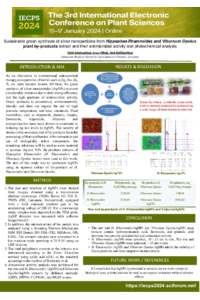
As an alternative to conventional antimicrobial therapy, nanoparticles of metals such asAg, Au, Zn, Ti, etc., have become known. Of these, the green synthesis of silver nanoparticles (AgNPs) received considerable attention due to their strong efficiency and the high spectrum of antimicrobial activity. Green synthesis is economical, environmentally friendly, and does not require the use of high pressure, temperature, and toxic chemicals. Plant metabolites, such as terpenoids, phenols, tannins, flavonoids, terpenoids, alkaloids, and polysaccharides, have been shown to contribute to reducing Ag ion levels in AgNPs. The novelty aspect of these studies is the secondary use of by-products from the processing of fruit and berries. After the extraction and use of biologically active compounds, the remaining substance will be used as a raw material to produce organic NPs. By-product extracts of Hippophae rhamnoides (H. rhamnoides) and Viburnum opulus berries were used in this work. The aim of this study was to synthesize AgNPs using an aqueous extract of by-products of H. rhamnoides and Viburnum opulus. The morphology of the synthesized AgNPs was carried out using SEM/EDS and TEM microscopy. Antioxidant activity analysis was performed for the raw and H. rhamnoides /AgNPs and Viburnum opulus/AgNPs extracts using different methods: ABTS, DPPH•, CUPRAC, and FRAP assays. Raw and H. rhamnoides /AgNPs were spherical, 10-25 nm in size, with total phenolic compound (TPC) content levels of 2288,83 mg GAE/100g and 1854,97 mg GAE/100g. Raw and Viburnum opulus/AgNPs were spherical, ~45 nm in size, with TPC content levels of 3396,90 mg GAE/100 g and 3016,83 mg GAE/100 g. It can be concluded that AgNPs synthesised in extracts have a wide variety of biological uses, and can be used as organic substances without adverse effects.
Keywords
green synthesis
silver nanoparticles
Hippophae rhamnoides
Viburnum opulus
plant by-products.
Poster
Vaide Sakalauskiene EN.pdf
Influence of he chitosan—xerogel ratio on rinderol production and biomass proliferation in transgenic root cultures of Rindera graeca
Breeding maize for heat and drought tolerance: a necessity, nowadays, in Romania