Event submissions
Published
This submission belongs to the session Session F. Plant Molecular Biology and Plant Genetics, Genomics and Biotechnology of the event The 3rd International Electronic Conference on Plant Sciences
Published date
19 Jan, 2024
Academic Editor
'%3e%3cpath%20d='M12.6657%2010.9104C12.4185%2010.325%2012.0599%209.79327%2011.6097%209.34482C11.1609%208.89508%2010.6293%208.5365%2010.0442%208.28888C10.0389%208.28626%2010.0337%208.28495%2010.0285%208.28233C10.8446%207.69279%2011.3752%206.73249%2011.3752%205.64904C11.3752%203.8542%209.92103%202.39999%208.1262%202.39999C6.33136%202.39999%204.87715%203.8542%204.87715%205.64904C4.87715%206.73249%205.40774%207.69279%206.22393%208.28364C6.21869%208.28626%206.21345%208.28757%206.20821%208.29019C5.62129%208.5378%205.09463%208.89284%204.64265%209.34613C4.1929%209.79493%203.83432%2010.3266%203.58671%2010.9117C3.34345%2011.4845%203.21226%2012.0987%203.20023%2012.7209C3.19988%2012.7349%203.20233%2012.7488%203.20744%2012.7619C3.21255%2012.7749%203.22022%2012.7867%203.22998%2012.7968C3.23975%2012.8068%203.25142%2012.8147%203.26431%2012.8202C3.2772%2012.8256%203.29105%2012.8284%203.30504%2012.8284H4.09109C4.14874%2012.8284%204.19459%2012.7825%204.1959%2012.7262C4.2221%2011.7148%204.62823%2010.7676%205.34617%2010.0497C6.08899%209.30683%207.0755%208.89808%208.1262%208.89808C9.17689%208.89808%2010.1634%209.30683%2010.9062%2010.0497C11.6242%2010.7676%2012.0303%2011.7148%2012.0565%2012.7262C12.0578%2012.7838%2012.1037%2012.8284%2012.1613%2012.8284H12.9474C12.9613%2012.8284%2012.9752%2012.8256%2012.9881%2012.8202C13.001%2012.8147%2013.0126%2012.8068%2013.0224%2012.7968C13.0322%2012.7867%2013.0398%2012.7749%2013.0449%2012.7619C13.0501%2012.7488%2013.0525%2012.7349%2013.0522%2012.7209C13.0391%2012.0947%2012.9094%2011.4855%2012.6657%2010.9104ZM8.1262%207.9024C7.52486%207.9024%206.9589%207.6679%206.53312%207.24211C6.10733%206.81633%205.87283%206.25037%205.87283%205.64904C5.87283%205.0477%206.10733%204.48174%206.53312%204.05596C6.9589%203.63018%207.52486%203.39567%208.1262%203.39567C8.72753%203.39567%209.29349%203.63018%209.71927%204.05596C10.1451%204.48174%2010.3796%205.0477%2010.3796%205.64904C10.3796%206.25037%2010.1451%206.81633%209.71927%207.24211C9.29349%207.6679%208.72753%207.9024%208.1262%207.9024Z'%20fill='%235D1EE1'/%3e%3c/g%3e%3c/svg%3e) Xinhua He
Xinhua HeCitation
Ilaria Brugellis, Silvia Assini, Marco Grassi, Piero Malcovati, Enhancing the Potential of Plant Microbial Fuel Cells: The Influence of Botanical Characteristics on Bioelectrical Performance, in Proceedings of The 3rd International Electronic Conference on Plant Sciences, 15 January–17 January 2024, MDPI: Basel, Switzerland
Share
Email
Facebook
Twitter
LinkedIn
Enhancing the Potential of Plant Microbial Fuel Cells: The Influence of Botanical Characteristics on Bioelectrical Performance
'%3e%3cpath%20d='M12.6647%2010.9104C12.4176%2010.325%2012.0589%209.7933%2011.6088%209.34485C11.16%208.89511%2010.6283%208.53653%2010.0432%208.28891C10.038%208.28629%2010.0327%208.28498%2010.0275%208.28236C10.8437%207.69282%2011.3743%206.73252%2011.3743%205.64907C11.3743%203.85423%209.92005%202.40002%208.12522%202.40002C6.33038%202.40002%204.87618%203.85423%204.87618%205.64907C4.87618%206.73252%205.40677%207.69282%206.22296%208.28367C6.21772%208.28629%206.21248%208.2876%206.20724%208.29022C5.62031%208.53783%205.09365%208.89287%204.64167%209.34616C4.19192%209.79496%203.83334%2010.3266%203.58573%2010.9117C3.34247%2011.4846%203.21128%2012.0987%203.19925%2012.721C3.1989%2012.735%203.20135%2012.7489%203.20646%2012.7619C3.21157%2012.7749%203.21924%2012.7868%203.22901%2012.7968C3.23877%2012.8068%203.25045%2012.8148%203.26334%2012.8202C3.27623%2012.8256%203.29007%2012.8284%203.30406%2012.8284H4.09012C4.14776%2012.8284%204.19362%2012.7825%204.19493%2012.7262C4.22113%2011.7148%204.62726%2010.7676%205.34519%2010.0497C6.08802%209.30686%207.07452%208.89811%208.12522%208.89811C9.17592%208.89811%2010.1624%209.30686%2010.9052%2010.0497C11.6232%2010.7676%2012.0293%2011.7148%2012.0555%2012.7262C12.0568%2012.7839%2012.1027%2012.8284%2012.1603%2012.8284H12.9464C12.9604%2012.8284%2012.9742%2012.8256%2012.9871%2012.8202C13%2012.8148%2013.0117%2012.8068%2013.0214%2012.7968C13.0312%2012.7868%2013.0389%2012.7749%2013.044%2012.7619C13.0491%2012.7489%2013.0515%2012.735%2013.0512%2012.721C13.0381%2012.0947%2012.9084%2011.4856%2012.6647%2010.9104ZM8.12522%207.90243C7.52388%207.90243%206.95792%207.66793%206.53214%207.24215C6.10636%206.81636%205.87185%206.2504%205.87185%205.64907C5.87185%205.04773%206.10636%204.48177%206.53214%204.05599C6.95792%203.63021%207.52388%203.3957%208.12522%203.3957C8.72655%203.3957%209.29252%203.63021%209.7183%204.05599C10.1441%204.48177%2010.3786%205.04773%2010.3786%205.64907C10.3786%206.2504%2010.1441%206.81636%209.7183%207.24215C9.29252%207.66793%208.72655%207.90243%208.12522%207.90243Z'%20fill='%235D1EE1'/%3e%3c/g%3e%3c/svg%3e)
Ilaria Brugellis 1

Silvia Assini 1
Marco Grassi 2

Piero Malcovati 2
1. Department of Earth and Environmental Science, University of Pavia
2. Department of Electrical Computer and Biomedical Engineering, University of Pavia
Abstract
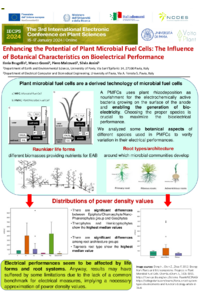
Plant microbial fuel cells (PMFCs) represent an innovative type of microbial fuel cell technology, utilizing plant rhizodeposition to fuel electrochemically active bacteria on the anode surface, thereby generating bioelectricity. This review delves into various botanical aspects of plant species employed in PMFCs, aiming to investigate whether their electrical performance varies based on distinct life forms and root systems.
For each plant species, we conducted a thorough investigation encompassing three key aspects: I) nomenclature; II) Raunkiær life form; and III) root architecture. To compile pertinent information, we conducted an exhaustive search for original articles detailing PMFC experiments, utilizing the Clarivate search tool. Every plant name and Raunkiær life form underwent rigorous verification against the POWO database and cross-referenced with the flora native to the species' origin. Root architecture was categorized into three main groups: 1) taproot; 2) adventitious; and 3) fibrous, as confirmed by the TRY Plant Trait Database.
Regarding the collection of electrical performance data, we excluded species under specific conditions: a) when only voltage or current values were provided; b) when average power and peak power values were exceedingly similar; and c) when power density values fell below 1 μW/m2 or exceeded 950 mW/m2. Ultimately, our study involved 46 plant species and 42 documents.
Our analysis unveiled noteworthy disparities, with the epiphyte/chamaephyte/nanophanerophyte group differing significantly from geophytes, and therophytes and hemicryptophytes exhibiting the highest median values. Additionally, we observed significant differences among the root architecture groups, with the taproot group registering the highest median value. These findings underscore the impact of plant life forms and root systems on electrical performance in PMFCs. Nevertheless, we acknowledge that our results may be subject to limitations due to the absence of a standardized benchmark for electrical measurements, necessitating approximations of power density values.
Keywords
Plant Microbial Fuel Cells
PMFC
life forms
root architecture
bioelectricity
Poster
poster IECPS2024.pdf
Evaluation of the biocidal effect of some plant extracts against Pseudomonas aeruginosa and selected microorganisms promoting plant growth (PGPM)
" Unraveling the Inter-specific hybrids of sugarcane for drought tolerant under the changing climates