Event submissions
Published
This submission belongs to the session Session D. Phytochemistry, Phytoremediation, and Plants in Urban Ecosystems of the event The 3rd International Electronic Conference on Plant Sciences
Published date
19 Jan, 2024
Academic Editor
'%3e%3cpath%20d='M12.6657%2010.9104C12.4185%2010.325%2012.0599%209.79327%2011.6097%209.34482C11.1609%208.89508%2010.6293%208.5365%2010.0442%208.28888C10.0389%208.28626%2010.0337%208.28495%2010.0285%208.28233C10.8446%207.69279%2011.3752%206.73249%2011.3752%205.64904C11.3752%203.8542%209.92103%202.39999%208.1262%202.39999C6.33136%202.39999%204.87715%203.8542%204.87715%205.64904C4.87715%206.73249%205.40774%207.69279%206.22393%208.28364C6.21869%208.28626%206.21345%208.28757%206.20821%208.29019C5.62129%208.5378%205.09463%208.89284%204.64265%209.34613C4.1929%209.79493%203.83432%2010.3266%203.58671%2010.9117C3.34345%2011.4845%203.21226%2012.0987%203.20023%2012.7209C3.19988%2012.7349%203.20233%2012.7488%203.20744%2012.7619C3.21255%2012.7749%203.22022%2012.7867%203.22998%2012.7968C3.23975%2012.8068%203.25142%2012.8147%203.26431%2012.8202C3.2772%2012.8256%203.29105%2012.8284%203.30504%2012.8284H4.09109C4.14874%2012.8284%204.19459%2012.7825%204.1959%2012.7262C4.2221%2011.7148%204.62823%2010.7676%205.34617%2010.0497C6.08899%209.30683%207.0755%208.89808%208.1262%208.89808C9.17689%208.89808%2010.1634%209.30683%2010.9062%2010.0497C11.6242%2010.7676%2012.0303%2011.7148%2012.0565%2012.7262C12.0578%2012.7838%2012.1037%2012.8284%2012.1613%2012.8284H12.9474C12.9613%2012.8284%2012.9752%2012.8256%2012.9881%2012.8202C13.001%2012.8147%2013.0126%2012.8068%2013.0224%2012.7968C13.0322%2012.7867%2013.0398%2012.7749%2013.0449%2012.7619C13.0501%2012.7488%2013.0525%2012.7349%2013.0522%2012.7209C13.0391%2012.0947%2012.9094%2011.4855%2012.6657%2010.9104ZM8.1262%207.9024C7.52486%207.9024%206.9589%207.6679%206.53312%207.24211C6.10733%206.81633%205.87283%206.25037%205.87283%205.64904C5.87283%205.0477%206.10733%204.48174%206.53312%204.05596C6.9589%203.63018%207.52486%203.39567%208.1262%203.39567C8.72753%203.39567%209.29349%203.63018%209.71927%204.05596C10.1451%204.48174%2010.3796%205.0477%2010.3796%205.64904C10.3796%206.25037%2010.1451%206.81633%209.71927%207.24211C9.29349%207.6679%208.72753%207.9024%208.1262%207.9024Z'%20fill='%235D1EE1'/%3e%3c/g%3e%3c/svg%3e) Suresh Awale
Suresh AwaleCitation
Othman EL FAQER, Zaynab OUADGHIRI, Abdelmoiz EL FAQER, Hicham WAHNOU, Samira RAIS, El Mostafa MTAIRAG, In vitro and in silico evaluation of the immunomodulatory effects of Laurus nobilis L. essential oil and eucalyptol on polymorphonuclear neutrophils, in Proceedings of The 3rd International Electronic Conference on Plant Sciences, 15 January–17 January 2024, MDPI: Basel, Switzerland
Share
Email
Facebook
Twitter
LinkedIn
In vitro and in silico evaluation of the immunomodulatory effects of Laurus nobilis L. essential oil and eucalyptol on polymorphonuclear neutrophils
'%3e%3cpath%20d='M12.6647%2010.9104C12.4176%2010.325%2012.0589%209.7933%2011.6088%209.34485C11.16%208.89511%2010.6283%208.53653%2010.0432%208.28891C10.038%208.28629%2010.0327%208.28498%2010.0275%208.28236C10.8437%207.69282%2011.3743%206.73252%2011.3743%205.64907C11.3743%203.85423%209.92005%202.40002%208.12522%202.40002C6.33038%202.40002%204.87618%203.85423%204.87618%205.64907C4.87618%206.73252%205.40677%207.69282%206.22296%208.28367C6.21772%208.28629%206.21248%208.2876%206.20724%208.29022C5.62031%208.53783%205.09365%208.89287%204.64167%209.34616C4.19192%209.79496%203.83334%2010.3266%203.58573%2010.9117C3.34247%2011.4846%203.21128%2012.0987%203.19925%2012.721C3.1989%2012.735%203.20135%2012.7489%203.20646%2012.7619C3.21157%2012.7749%203.21924%2012.7868%203.22901%2012.7968C3.23877%2012.8068%203.25045%2012.8148%203.26334%2012.8202C3.27623%2012.8256%203.29007%2012.8284%203.30406%2012.8284H4.09012C4.14776%2012.8284%204.19362%2012.7825%204.19493%2012.7262C4.22113%2011.7148%204.62726%2010.7676%205.34519%2010.0497C6.08802%209.30686%207.07452%208.89811%208.12522%208.89811C9.17592%208.89811%2010.1624%209.30686%2010.9052%2010.0497C11.6232%2010.7676%2012.0293%2011.7148%2012.0555%2012.7262C12.0568%2012.7839%2012.1027%2012.8284%2012.1603%2012.8284H12.9464C12.9604%2012.8284%2012.9742%2012.8256%2012.9871%2012.8202C13%2012.8148%2013.0117%2012.8068%2013.0214%2012.7968C13.0312%2012.7868%2013.0389%2012.7749%2013.044%2012.7619C13.0491%2012.7489%2013.0515%2012.735%2013.0512%2012.721C13.0381%2012.0947%2012.9084%2011.4856%2012.6647%2010.9104ZM8.12522%207.90243C7.52388%207.90243%206.95792%207.66793%206.53214%207.24215C6.10636%206.81636%205.87185%206.2504%205.87185%205.64907C5.87185%205.04773%206.10636%204.48177%206.53214%204.05599C6.95792%203.63021%207.52388%203.3957%208.12522%203.3957C8.72655%203.3957%209.29252%203.63021%209.7183%204.05599C10.1441%204.48177%2010.3786%205.04773%2010.3786%205.64907C10.3786%206.2504%2010.1441%206.81636%209.7183%207.24215C9.29252%207.66793%208.72655%207.90243%208.12522%207.90243Z'%20fill='%235D1EE1'/%3e%3c/g%3e%3c/svg%3e)
Othman EL FAQER 1
Zaynab OUADGHIRI 1
Abdelmoiz EL FAQER 2
Hicham WAHNOU 1
Samira RAIS 1,3
El Mostafa MTAIRAG 1
1. Immunology and Biodiversity Laboratory, Faculty of Sciences Ain Chock, Hassan II University
2. Team of Microbiology and Molecular Biology, Plant and Microbial Biotechnology, Biodiversity and Environment Research Center, Faculty of Sciences, Mohammed V University
3. Department of Biology, Faculty of Science Ben M’Sick, Hassan II University
Abstract
The exaggerated activation of Polymorphonuclear neutrophils (PMNs) can lead to a harmful cycle of persistent inflammation. This study aims to investigate the in vitro and in silico immunomodulatory effects of Laurus nobilis essential oil (LEO) and its main compound, eucalyptol, on PMNs functions involved in inflammatory processes. The immunomodulation effects of LEO and eucalyptol have been studied on both fMLP-PMNs-stimulated degranulation and oxidative burst, in addition to their antioxidant, anti-hemolytic and antiplatelet aggregation activities. We also performed an in silico analysis for LEO and eucalyptol to evaluate their potential inhibitory pathways. Firstly, we showed that LEO and eucalyptol have immunomodulatory activities on PMNs functions. Thus, LEO and eucalyptol inhibit, in a dose-dependent manner, fMLP-induced degranulation of PMNs with maximal percentages of inhibition of 50.44 % and 74.69 %, respectively, and in the same way, reduce oxidative burst with maximal percentages of inhibition of 61.07 % and 51.29 %, respectively (p < 0.001). Secondly, in silico docking of LEO studies showed that its selected major compounds (eucalyptol, α-terpinyl acetate, and β-phellandrene) have an energy change ranging between – 4.2 and – 7.4 kcal/mol on NADPH oxidase, its subunits, and PKC. In addition, LEO and eucalyptol were found to possess significant antioxidant activity with various IC50 and protective capabilities against H2O2-induced hemolysis in erythrocytes (p < 0.001), and also inhibited collagen-induced platelet aggregation. The collective findings of this research shed light on the immunomodulatory effects on PMNs functions by LEO and eucalyptol that provide new insights for studying the mechanism pathways of Laurus nobilis L., particularly in the modulation of innate immunity and inflammatory responses
Keywords
Polymorphonuclear neutrophils
Immunomodulatory
Degranulation
Oxidative burst
Laurus nobilis L.
Poster
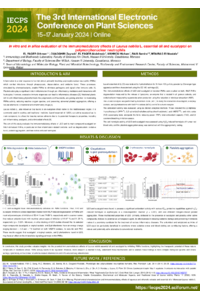
Poster IECPS 2024.pdf
Zingiber Officinale antioxidant activity and immunomodulatory effects on human polymorphonuclear neutrophils.
Enhancing fertility in acid Luvisol and sunflower (Helianthus annuus L.) yield with fly bioash application