Event submissions
Published
This submission belongs to the session Session D. Phytochemistry, Phytoremediation, and Plants in Urban Ecosystems of the event The 3rd International Electronic Conference on Plant Sciences
Published date
19 Jan, 2024
Academic Editor
'%3e%3cpath%20d='M12.6657%2010.9104C12.4185%2010.325%2012.0599%209.79327%2011.6097%209.34482C11.1609%208.89508%2010.6293%208.5365%2010.0442%208.28888C10.0389%208.28626%2010.0337%208.28495%2010.0285%208.28233C10.8446%207.69279%2011.3752%206.73249%2011.3752%205.64904C11.3752%203.8542%209.92103%202.39999%208.1262%202.39999C6.33136%202.39999%204.87715%203.8542%204.87715%205.64904C4.87715%206.73249%205.40774%207.69279%206.22393%208.28364C6.21869%208.28626%206.21345%208.28757%206.20821%208.29019C5.62129%208.5378%205.09463%208.89284%204.64265%209.34613C4.1929%209.79493%203.83432%2010.3266%203.58671%2010.9117C3.34345%2011.4845%203.21226%2012.0987%203.20023%2012.7209C3.19988%2012.7349%203.20233%2012.7488%203.20744%2012.7619C3.21255%2012.7749%203.22022%2012.7867%203.22998%2012.7968C3.23975%2012.8068%203.25142%2012.8147%203.26431%2012.8202C3.2772%2012.8256%203.29105%2012.8284%203.30504%2012.8284H4.09109C4.14874%2012.8284%204.19459%2012.7825%204.1959%2012.7262C4.2221%2011.7148%204.62823%2010.7676%205.34617%2010.0497C6.08899%209.30683%207.0755%208.89808%208.1262%208.89808C9.17689%208.89808%2010.1634%209.30683%2010.9062%2010.0497C11.6242%2010.7676%2012.0303%2011.7148%2012.0565%2012.7262C12.0578%2012.7838%2012.1037%2012.8284%2012.1613%2012.8284H12.9474C12.9613%2012.8284%2012.9752%2012.8256%2012.9881%2012.8202C13.001%2012.8147%2013.0126%2012.8068%2013.0224%2012.7968C13.0322%2012.7867%2013.0398%2012.7749%2013.0449%2012.7619C13.0501%2012.7488%2013.0525%2012.7349%2013.0522%2012.7209C13.0391%2012.0947%2012.9094%2011.4855%2012.6657%2010.9104ZM8.1262%207.9024C7.52486%207.9024%206.9589%207.6679%206.53312%207.24211C6.10733%206.81633%205.87283%206.25037%205.87283%205.64904C5.87283%205.0477%206.10733%204.48174%206.53312%204.05596C6.9589%203.63018%207.52486%203.39567%208.1262%203.39567C8.72753%203.39567%209.29349%203.63018%209.71927%204.05596C10.1451%204.48174%2010.3796%205.0477%2010.3796%205.64904C10.3796%206.25037%2010.1451%206.81633%209.71927%207.24211C9.29349%207.6679%208.72753%207.9024%208.1262%207.9024Z'%20fill='%235D1EE1'/%3e%3c/g%3e%3c/svg%3e) Suresh Awale
Suresh AwaleCitation
Nishtha Paul, Narayan Singh, GC–MS profiling, assessment of antioxidant and anti-bacterial activity of the essential oil of Cestrum nocturnum, and Formulation and Evaluation of Herbal Toothpaste, in Proceedings of The 3rd International Electronic Conference on Plant Sciences, 15 January–17 January 2024, MDPI: Basel, Switzerland
Share
Email
Facebook
Twitter
LinkedIn
GC–MS profiling, assessment of antioxidant and anti-bacterial activity of the essential oil of Cestrum nocturnum, and Formulation and Evaluation of Herbal Toothpaste
'%3e%3cpath%20d='M12.6647%2010.9104C12.4176%2010.325%2012.0589%209.7933%2011.6088%209.34485C11.16%208.89511%2010.6283%208.53653%2010.0432%208.28891C10.038%208.28629%2010.0327%208.28498%2010.0275%208.28236C10.8437%207.69282%2011.3743%206.73252%2011.3743%205.64907C11.3743%203.85423%209.92005%202.40002%208.12522%202.40002C6.33038%202.40002%204.87618%203.85423%204.87618%205.64907C4.87618%206.73252%205.40677%207.69282%206.22296%208.28367C6.21772%208.28629%206.21248%208.2876%206.20724%208.29022C5.62031%208.53783%205.09365%208.89287%204.64167%209.34616C4.19192%209.79496%203.83334%2010.3266%203.58573%2010.9117C3.34247%2011.4846%203.21128%2012.0987%203.19925%2012.721C3.1989%2012.735%203.20135%2012.7489%203.20646%2012.7619C3.21157%2012.7749%203.21924%2012.7868%203.22901%2012.7968C3.23877%2012.8068%203.25045%2012.8148%203.26334%2012.8202C3.27623%2012.8256%203.29007%2012.8284%203.30406%2012.8284H4.09012C4.14776%2012.8284%204.19362%2012.7825%204.19493%2012.7262C4.22113%2011.7148%204.62726%2010.7676%205.34519%2010.0497C6.08802%209.30686%207.07452%208.89811%208.12522%208.89811C9.17592%208.89811%2010.1624%209.30686%2010.9052%2010.0497C11.6232%2010.7676%2012.0293%2011.7148%2012.0555%2012.7262C12.0568%2012.7839%2012.1027%2012.8284%2012.1603%2012.8284H12.9464C12.9604%2012.8284%2012.9742%2012.8256%2012.9871%2012.8202C13%2012.8148%2013.0117%2012.8068%2013.0214%2012.7968C13.0312%2012.7868%2013.0389%2012.7749%2013.044%2012.7619C13.0491%2012.7489%2013.0515%2012.735%2013.0512%2012.721C13.0381%2012.0947%2012.9084%2011.4856%2012.6647%2010.9104ZM8.12522%207.90243C7.52388%207.90243%206.95792%207.66793%206.53214%207.24215C6.10636%206.81636%205.87185%206.2504%205.87185%205.64907C5.87185%205.04773%206.10636%204.48177%206.53214%204.05599C6.95792%203.63021%207.52388%203.3957%208.12522%203.3957C8.72655%203.3957%209.29252%203.63021%209.7183%204.05599C10.1441%204.48177%2010.3786%205.04773%2010.3786%205.64907C10.3786%206.2504%2010.1441%206.81636%209.7183%207.24215C9.29252%207.66793%208.72655%207.90243%208.12522%207.90243Z'%20fill='%235D1EE1'/%3e%3c/g%3e%3c/svg%3e)
Nishtha Paul 1
Narayan Singh 2
1. Chandigarh University, Gharuan, Mohali, Punjab
2. Department of Botany, Sai School of Biosciences, Sri Sai University, Palampur, Himachal Pradesh, India-176081
Abstract
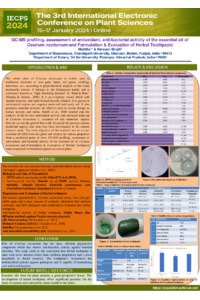
The main objective of this research was to extract essential oil (EO) from a plant named Cestrum nocturnum and to analyze its various properties from a medicinal point of view. Gas Chromatography–Mass Spectrometry (GC–MS) profiling of oil revealed the presence of 18 components amongst which Diethylphthalate (31.88%), α-terpineol (31.52%), benzylacetate (11.61%), γ-terpineol (9.78%), and linalool (2.63%) made up the bulk of the composition. The 1,1-diphenyl-2-picrylhydrazyl (DPPH) technique (ascorbic acid as positive control) was used to assess the samples' potential as antioxidants by inhibiting free radicals. The IC50 value of C. nocturnum's oil was assessed to be 15.78±0.510 μl/ml. The EO at various concentrations (6.25μl/ml-100μl/ml) was further evaluated for its anti-bacterial activity against the bacterial strains of Clostridium botulinum, Klebsiella pneumoniae, Proteus mirabilis, and Shigella flexneri. The oil exhibited maximum growth inhibition against C. botulinum (zone of inhibition (ZOI) =38.1±0.15mm) followed by K. pneumoniae (33.9±0.25mm), S. flexneri (30.8±0.2mm), and P. mirabilis (24.3±0.5mm). As the oil has a significant antibacterial property, it was used to prepare a formulation of herbal toothpaste for maintaining oral hygiene and preventing tooth decay. Different aspects of the formulated herbal toothpaste, such as homogeneity, spreadability, foaming power, stability, pH, moisture, volatile matter, and others, were evaluated and found to be similar to the commercial toothpaste available on the market. Herbal toothpaste was checked for its antibacterial activity against tooth-decaying bacteria, i.e., Porphyromonas gingivalis. The formulation showed a considerable inhibitory effect with a ZOI=40.05±0.12mm at a MIC of 25 μg/mL, which was higher than the commercial dabur toothpaste (ZOI 34±0.17mm at a MIC of 25μg/mL) as well as amoxicillin (positive control; 38±0.20mm). Therefore, our study suggested that the herbal formulation from the C. nocturnum oil can be commercialized as a toothpaste to prevent gingivitis.
Keywords
Cestrum nocturnum
essential oil
antioxidant
anti-bacterial
formulation of herbal toothpaste
Poster
Nishtha (Cestrum) (1).pdf
Dissecting the Sinapis alba L. defense transcriptome, a potential donor of resistance to Alternaria blight
Nitrogen fertilization for the management of powdery mildew of barley caused by Blumeria graminis f. sp. hordei