Event submissions
Events2nd Conference on Future Challenges in Sustainable Urban Planning & Territorial Management
Published
This submission belongs to the session CP. City planning of the event 2nd Conference on Future Challenges in Sustainable Urban Planning & Territorial Management
Published date
31 Jan, 2024
Academic Editor
'%3e%3cpath%20d='M12.6657%2010.9104C12.4185%2010.325%2012.0599%209.79327%2011.6097%209.34482C11.1609%208.89508%2010.6293%208.5365%2010.0442%208.28888C10.0389%208.28626%2010.0337%208.28495%2010.0285%208.28233C10.8446%207.69279%2011.3752%206.73249%2011.3752%205.64904C11.3752%203.8542%209.92103%202.39999%208.1262%202.39999C6.33136%202.39999%204.87715%203.8542%204.87715%205.64904C4.87715%206.73249%205.40774%207.69279%206.22393%208.28364C6.21869%208.28626%206.21345%208.28757%206.20821%208.29019C5.62129%208.5378%205.09463%208.89284%204.64265%209.34613C4.1929%209.79493%203.83432%2010.3266%203.58671%2010.9117C3.34345%2011.4845%203.21226%2012.0987%203.20023%2012.7209C3.19988%2012.7349%203.20233%2012.7488%203.20744%2012.7619C3.21255%2012.7749%203.22022%2012.7867%203.22998%2012.7968C3.23975%2012.8068%203.25142%2012.8147%203.26431%2012.8202C3.2772%2012.8256%203.29105%2012.8284%203.30504%2012.8284H4.09109C4.14874%2012.8284%204.19459%2012.7825%204.1959%2012.7262C4.2221%2011.7148%204.62823%2010.7676%205.34617%2010.0497C6.08899%209.30683%207.0755%208.89808%208.1262%208.89808C9.17689%208.89808%2010.1634%209.30683%2010.9062%2010.0497C11.6242%2010.7676%2012.0303%2011.7148%2012.0565%2012.7262C12.0578%2012.7838%2012.1037%2012.8284%2012.1613%2012.8284H12.9474C12.9613%2012.8284%2012.9752%2012.8256%2012.9881%2012.8202C13.001%2012.8147%2013.0126%2012.8068%2013.0224%2012.7968C13.0322%2012.7867%2013.0398%2012.7749%2013.0449%2012.7619C13.0501%2012.7488%2013.0525%2012.7349%2013.0522%2012.7209C13.0391%2012.0947%2012.9094%2011.4855%2012.6657%2010.9104ZM8.1262%207.9024C7.52486%207.9024%206.9589%207.6679%206.53312%207.24211C6.10733%206.81633%205.87283%206.25037%205.87283%205.64904C5.87283%205.0477%206.10733%204.48174%206.53312%204.05596C6.9589%203.63018%207.52486%203.39567%208.1262%203.39567C8.72753%203.39567%209.29349%203.63018%209.71927%204.05596C10.1451%204.48174%2010.3796%205.0477%2010.3796%205.64904C10.3796%206.25037%2010.1451%206.81633%209.71927%207.24211C9.29349%207.6679%208.72753%207.9024%208.1262%207.9024Z'%20fill='%235D1EE1'/%3e%3c/g%3e%3c/svg%3e) Salvador Garcia-Ayllon
Salvador Garcia-AyllonCitation
Giulia Xisto, Roberto Schoproni Bichueti, Jordana Marques Kneipp, Clandia Maffini Gomes, Walter Leal, GLOBAL SMART CITIES AND THE CONDITIONS FOR URBAN ATTRACTIVENESS, in Proceedings of 2nd Conference on Future Challenges in Sustainable Urban Planning & Territorial Management, 29 January–31 January 2024, MDPI: Basel, Switzerland
Share
Email
Facebook
Twitter
LinkedIn
GLOBAL SMART CITIES AND THE CONDITIONS FOR URBAN ATTRACTIVENESS
'%3e%3cpath%20d='M12.6647%2010.9104C12.4176%2010.325%2012.0589%209.7933%2011.6088%209.34485C11.16%208.89511%2010.6283%208.53653%2010.0432%208.28891C10.038%208.28629%2010.0327%208.28498%2010.0275%208.28236C10.8437%207.69282%2011.3743%206.73252%2011.3743%205.64907C11.3743%203.85423%209.92005%202.40002%208.12522%202.40002C6.33038%202.40002%204.87618%203.85423%204.87618%205.64907C4.87618%206.73252%205.40677%207.69282%206.22296%208.28367C6.21772%208.28629%206.21248%208.2876%206.20724%208.29022C5.62031%208.53783%205.09365%208.89287%204.64167%209.34616C4.19192%209.79496%203.83334%2010.3266%203.58573%2010.9117C3.34247%2011.4846%203.21128%2012.0987%203.19925%2012.721C3.1989%2012.735%203.20135%2012.7489%203.20646%2012.7619C3.21157%2012.7749%203.21924%2012.7868%203.22901%2012.7968C3.23877%2012.8068%203.25045%2012.8148%203.26334%2012.8202C3.27623%2012.8256%203.29007%2012.8284%203.30406%2012.8284H4.09012C4.14776%2012.8284%204.19362%2012.7825%204.19493%2012.7262C4.22113%2011.7148%204.62726%2010.7676%205.34519%2010.0497C6.08802%209.30686%207.07452%208.89811%208.12522%208.89811C9.17592%208.89811%2010.1624%209.30686%2010.9052%2010.0497C11.6232%2010.7676%2012.0293%2011.7148%2012.0555%2012.7262C12.0568%2012.7839%2012.1027%2012.8284%2012.1603%2012.8284H12.9464C12.9604%2012.8284%2012.9742%2012.8256%2012.9871%2012.8202C13%2012.8148%2013.0117%2012.8068%2013.0214%2012.7968C13.0312%2012.7868%2013.0389%2012.7749%2013.044%2012.7619C13.0491%2012.7489%2013.0515%2012.735%2013.0512%2012.721C13.0381%2012.0947%2012.9084%2011.4856%2012.6647%2010.9104ZM8.12522%207.90243C7.52388%207.90243%206.95792%207.66793%206.53214%207.24215C6.10636%206.81636%205.87185%206.2504%205.87185%205.64907C5.87185%205.04773%206.10636%204.48177%206.53214%204.05599C6.95792%203.63021%207.52388%203.3957%208.12522%203.3957C8.72655%203.3957%209.29252%203.63021%209.7183%204.05599C10.1441%204.48177%2010.3786%205.04773%2010.3786%205.64907C10.3786%206.2504%2010.1441%206.81636%209.7183%207.24215C9.29252%207.66793%208.72655%207.90243%208.12522%207.90243Z'%20fill='%235D1EE1'/%3e%3c/g%3e%3c/svg%3e)
Giulia Xisto 1

Roberto Schoproni Bichueti 1

Jordana Marques Kneipp 1
Clandia Maffini Gomes 2

Walter Leal 3,4
1. Federal University of Santa Maria - UFSM
2. Federal University of Rio Grande - FURG
3. Hamburg University of Applied Sciences - HAW Hamburg
4. Manchester Metropolitan University
Abstract
Smart cities have been conquering more space into debates about city management and have been treated as attractive cities to talents, tourists, visitors, and investors due to the alliance between innovation, environmental quality, and social and cultural inclusion, in a context of open governance and connectivity to the global economy, aiming to provide a better quality of life to citizens. Therefore, it can be understood that smart cities are connected to urban attractiveness. Given this context, this study aimed to verify the relation between the degree of intelligence and the level of urban attractiveness in global smart cities in the rankings Cities in Motion (IESE), Global 150 Cities Index (AIRINC), and Destinations (Euromonitor). Knowing that the levels of urban attractiveness may have different perspectives and can be measured in many ways, we chose to relate the degree of cities’ intelligence to their lifestyle and consumption and then the level of cities’ intelligence to the flow of people. This is a quantitative and descriptive study since it used descriptive statistics through least-squares partial regression. Our findings showed a strong positive correlation between the cities’ levels of intelligence, lifestyle, and consumption. Nonetheless, the relation between the level of intelligence and the flow of people was not confirmed in these cities. It can be observed that such flow can create challenges to a smart city, such as the disordered occupation of spaces, practices of land misuse, consumption patterns, among others.
Keywords
Smart cities
Urban attractiveness
City planning
Poster
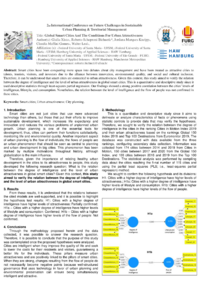
Poster Global Smart Cities And The Conditions For Urban Attractiveness .pdf
Geography of Land Markets in Spatio-temporal Perspective: The Case of Residential Land in Hawassa City, Ethiopia
Changing urban mobility habits in São Paulo: An analysis from 2017 to 2022