Event submissions
Published
This submission belongs to the session Session G. Cancer Therapy of the event The 4th International Electronic Conference on Cancers
Published date
27 Mar, 2024
Academic Editor
'%3e%3cpath%20d='M12.6657%2010.9104C12.4185%2010.325%2012.0599%209.79327%2011.6097%209.34482C11.1609%208.89508%2010.6293%208.5365%2010.0442%208.28888C10.0389%208.28626%2010.0337%208.28495%2010.0285%208.28233C10.8446%207.69279%2011.3752%206.73249%2011.3752%205.64904C11.3752%203.8542%209.92103%202.39999%208.1262%202.39999C6.33136%202.39999%204.87715%203.8542%204.87715%205.64904C4.87715%206.73249%205.40774%207.69279%206.22393%208.28364C6.21869%208.28626%206.21345%208.28757%206.20821%208.29019C5.62129%208.5378%205.09463%208.89284%204.64265%209.34613C4.1929%209.79493%203.83432%2010.3266%203.58671%2010.9117C3.34345%2011.4845%203.21226%2012.0987%203.20023%2012.7209C3.19988%2012.7349%203.20233%2012.7488%203.20744%2012.7619C3.21255%2012.7749%203.22022%2012.7867%203.22998%2012.7968C3.23975%2012.8068%203.25142%2012.8147%203.26431%2012.8202C3.2772%2012.8256%203.29105%2012.8284%203.30504%2012.8284H4.09109C4.14874%2012.8284%204.19459%2012.7825%204.1959%2012.7262C4.2221%2011.7148%204.62823%2010.7676%205.34617%2010.0497C6.08899%209.30683%207.0755%208.89808%208.1262%208.89808C9.17689%208.89808%2010.1634%209.30683%2010.9062%2010.0497C11.6242%2010.7676%2012.0303%2011.7148%2012.0565%2012.7262C12.0578%2012.7838%2012.1037%2012.8284%2012.1613%2012.8284H12.9474C12.9613%2012.8284%2012.9752%2012.8256%2012.9881%2012.8202C13.001%2012.8147%2013.0126%2012.8068%2013.0224%2012.7968C13.0322%2012.7867%2013.0398%2012.7749%2013.0449%2012.7619C13.0501%2012.7488%2013.0525%2012.7349%2013.0522%2012.7209C13.0391%2012.0947%2012.9094%2011.4855%2012.6657%2010.9104ZM8.1262%207.9024C7.52486%207.9024%206.9589%207.6679%206.53312%207.24211C6.10733%206.81633%205.87283%206.25037%205.87283%205.64904C5.87283%205.0477%206.10733%204.48174%206.53312%204.05596C6.9589%203.63018%207.52486%203.39567%208.1262%203.39567C8.72753%203.39567%209.29349%203.63018%209.71927%204.05596C10.1451%204.48174%2010.3796%205.0477%2010.3796%205.64904C10.3796%206.25037%2010.1451%206.81633%209.71927%207.24211C9.29349%207.6679%208.72753%207.9024%208.1262%207.9024Z'%20fill='%235D1EE1'/%3e%3c/g%3e%3c/svg%3e) Ulrich Pfeffer
Ulrich PfefferCitation
MADHUMETHRA R G, Latha S, Selvamani P, OPTIMIZATION AND DEVELOPMENT OF MAGNETICALLY TRIGGERED LETROZOLE NANOLIPOSOMES FOR BREAST CANCER TARGETING, in Proceedings of The 4th International Electronic Conference on Cancers, 6 March–8 March 2024, MDPI: Basel, Switzerland
Share
Email
Facebook
Twitter
LinkedIn
OPTIMIZATION AND DEVELOPMENT OF MAGNETICALLY TRIGGERED LETROZOLE NANOLIPOSOMES FOR BREAST CANCER TARGETING
'%3e%3cpath%20d='M12.6647%2010.9104C12.4176%2010.325%2012.0589%209.7933%2011.6088%209.34485C11.16%208.89511%2010.6283%208.53653%2010.0432%208.28891C10.038%208.28629%2010.0327%208.28498%2010.0275%208.28236C10.8437%207.69282%2011.3743%206.73252%2011.3743%205.64907C11.3743%203.85423%209.92005%202.40002%208.12522%202.40002C6.33038%202.40002%204.87618%203.85423%204.87618%205.64907C4.87618%206.73252%205.40677%207.69282%206.22296%208.28367C6.21772%208.28629%206.21248%208.2876%206.20724%208.29022C5.62031%208.53783%205.09365%208.89287%204.64167%209.34616C4.19192%209.79496%203.83334%2010.3266%203.58573%2010.9117C3.34247%2011.4846%203.21128%2012.0987%203.19925%2012.721C3.1989%2012.735%203.20135%2012.7489%203.20646%2012.7619C3.21157%2012.7749%203.21924%2012.7868%203.22901%2012.7968C3.23877%2012.8068%203.25045%2012.8148%203.26334%2012.8202C3.27623%2012.8256%203.29007%2012.8284%203.30406%2012.8284H4.09012C4.14776%2012.8284%204.19362%2012.7825%204.19493%2012.7262C4.22113%2011.7148%204.62726%2010.7676%205.34519%2010.0497C6.08802%209.30686%207.07452%208.89811%208.12522%208.89811C9.17592%208.89811%2010.1624%209.30686%2010.9052%2010.0497C11.6232%2010.7676%2012.0293%2011.7148%2012.0555%2012.7262C12.0568%2012.7839%2012.1027%2012.8284%2012.1603%2012.8284H12.9464C12.9604%2012.8284%2012.9742%2012.8256%2012.9871%2012.8202C13%2012.8148%2013.0117%2012.8068%2013.0214%2012.7968C13.0312%2012.7868%2013.0389%2012.7749%2013.044%2012.7619C13.0491%2012.7489%2013.0515%2012.735%2013.0512%2012.721C13.0381%2012.0947%2012.9084%2011.4856%2012.6647%2010.9104ZM8.12522%207.90243C7.52388%207.90243%206.95792%207.66793%206.53214%207.24215C6.10636%206.81636%205.87185%206.2504%205.87185%205.64907C5.87185%205.04773%206.10636%204.48177%206.53214%204.05599C6.95792%203.63021%207.52388%203.3957%208.12522%203.3957C8.72655%203.3957%209.29252%203.63021%209.7183%204.05599C10.1441%204.48177%2010.3786%205.04773%2010.3786%205.64907C10.3786%206.2504%2010.1441%206.81636%209.7183%207.24215C9.29252%207.66793%208.72655%207.90243%208.12522%207.90243Z'%20fill='%235D1EE1'/%3e%3c/g%3e%3c/svg%3e)
MADHUMETHRA R G 1
Latha S 1
Selvamani P 1
1. Department of Pharmaceutical Technology, Anna University, BIT Campus, University College of Engineering, Tiruchirappalli, TamilNadu, India - 620024.
Abstract
ABSTRACT
BACKGROUND:
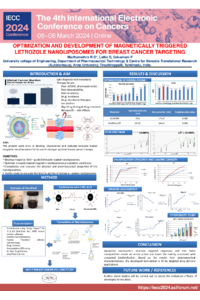
Breast cancer is one of the most frequently diagnosed cancers and is the leading cause of death among women worldwide. Breast cancers are most common among women and they represent the second most common cancer condition. Moreover, breast cancers account for14% of all cancers in women. The development of magnetic nanoliposomes as carrier-loaded drug delivery system promotes the active-site-targeted delivery of drug molecules with increased biocompatibility and reduced toxicity and side-effects.
AIM:
The research work aims to develop and characterize magnetically letrozole nanoliposomes used for breast cancer targeting.
METHODOLOGY:
The thin film hydration method is carried out in preparation of letrozole nanoliposomes. Citric-acid-coated magnetic nanoparticles are synthesized via the chemical co-precipitation method. The formulated nanosuspension is characterized through initial characterization studies.
RESULTS:
The characterization studies show that various physical, chemical, and morphological integrity of nanoliposomal suspension. In vitro characterization studies reported that the average hydrodynamic size of LET-MNLs was 89.23 nm with a charge of -24mV and apolydispersity index of 0.395. The drug loading and encapsulation efficiency of the prepared formulation were studied at various stages to confirm the conjugation of letrozole with the magnetic nanoliposomal system, and the highest encapsulation efficiency was found to be 76.83%.
CONCLUSION:
Liposomal nanocarriers promote targeted responses and iron oxide nanoparticles create an onsite action and lower the toxicity associated with unwanted biodistribution. Based on the results from pharmaceutical characterizations, the developed formulation is fit for targeted drug delivery applications. Further in vitro and in vivo studies will be carried out to assess the anticancer efficacy of developed formulation.
Keywords
Targated drug delivery
Nanoliposomes
Breast Cancer
Iron oxide nanoparticles
Letrozole.
Poster
sciforum-085396.pdf
Desmoplastic fibroma of the mandible: case report
Two novel miRNAs encoded by oncogene MSI1