Event submissions
Published
This submission belongs to the session Session E. Molecular Cancer Biology of the event The 4th International Electronic Conference on Cancers
Published date
27 Mar, 2024
Academic Editor
'%3e%3cpath%20d='M12.6657%2010.9104C12.4185%2010.325%2012.0599%209.79327%2011.6097%209.34482C11.1609%208.89508%2010.6293%208.5365%2010.0442%208.28888C10.0389%208.28626%2010.0337%208.28495%2010.0285%208.28233C10.8446%207.69279%2011.3752%206.73249%2011.3752%205.64904C11.3752%203.8542%209.92103%202.39999%208.1262%202.39999C6.33136%202.39999%204.87715%203.8542%204.87715%205.64904C4.87715%206.73249%205.40774%207.69279%206.22393%208.28364C6.21869%208.28626%206.21345%208.28757%206.20821%208.29019C5.62129%208.5378%205.09463%208.89284%204.64265%209.34613C4.1929%209.79493%203.83432%2010.3266%203.58671%2010.9117C3.34345%2011.4845%203.21226%2012.0987%203.20023%2012.7209C3.19988%2012.7349%203.20233%2012.7488%203.20744%2012.7619C3.21255%2012.7749%203.22022%2012.7867%203.22998%2012.7968C3.23975%2012.8068%203.25142%2012.8147%203.26431%2012.8202C3.2772%2012.8256%203.29105%2012.8284%203.30504%2012.8284H4.09109C4.14874%2012.8284%204.19459%2012.7825%204.1959%2012.7262C4.2221%2011.7148%204.62823%2010.7676%205.34617%2010.0497C6.08899%209.30683%207.0755%208.89808%208.1262%208.89808C9.17689%208.89808%2010.1634%209.30683%2010.9062%2010.0497C11.6242%2010.7676%2012.0303%2011.7148%2012.0565%2012.7262C12.0578%2012.7838%2012.1037%2012.8284%2012.1613%2012.8284H12.9474C12.9613%2012.8284%2012.9752%2012.8256%2012.9881%2012.8202C13.001%2012.8147%2013.0126%2012.8068%2013.0224%2012.7968C13.0322%2012.7867%2013.0398%2012.7749%2013.0449%2012.7619C13.0501%2012.7488%2013.0525%2012.7349%2013.0522%2012.7209C13.0391%2012.0947%2012.9094%2011.4855%2012.6657%2010.9104ZM8.1262%207.9024C7.52486%207.9024%206.9589%207.6679%206.53312%207.24211C6.10733%206.81633%205.87283%206.25037%205.87283%205.64904C5.87283%205.0477%206.10733%204.48174%206.53312%204.05596C6.9589%203.63018%207.52486%203.39567%208.1262%203.39567C8.72753%203.39567%209.29349%203.63018%209.71927%204.05596C10.1451%204.48174%2010.3796%205.0477%2010.3796%205.64904C10.3796%206.25037%2010.1451%206.81633%209.71927%207.24211C9.29349%207.6679%208.72753%207.9024%208.1262%207.9024Z'%20fill='%235D1EE1'/%3e%3c/g%3e%3c/svg%3e) Angeliki Magklara
Angeliki MagklaraCitation
Liana Lachinani, Mahboobeh Forouzanfar, Kianoush Dormiani, Bahram Mohammad Soltani, Kamran Dolatshahi, Sayyed Mohammadreza Hakimian, Sadat Dokanehiifard, Mohammad Hossein Nasr-Esfahani, Two novel miRNAs encoded by oncogene MSI1, in Proceedings of The 4th International Electronic Conference on Cancers, 6 March–8 March 2024, MDPI: Basel, Switzerland
Share
Email
Facebook
Twitter
LinkedIn
Two novel miRNAs encoded by oncogene MSI1
'%3e%3cpath%20d='M12.6647%2010.9104C12.4176%2010.325%2012.0589%209.7933%2011.6088%209.34485C11.16%208.89511%2010.6283%208.53653%2010.0432%208.28891C10.038%208.28629%2010.0327%208.28498%2010.0275%208.28236C10.8437%207.69282%2011.3743%206.73252%2011.3743%205.64907C11.3743%203.85423%209.92005%202.40002%208.12522%202.40002C6.33038%202.40002%204.87618%203.85423%204.87618%205.64907C4.87618%206.73252%205.40677%207.69282%206.22296%208.28367C6.21772%208.28629%206.21248%208.2876%206.20724%208.29022C5.62031%208.53783%205.09365%208.89287%204.64167%209.34616C4.19192%209.79496%203.83334%2010.3266%203.58573%2010.9117C3.34247%2011.4846%203.21128%2012.0987%203.19925%2012.721C3.1989%2012.735%203.20135%2012.7489%203.20646%2012.7619C3.21157%2012.7749%203.21924%2012.7868%203.22901%2012.7968C3.23877%2012.8068%203.25045%2012.8148%203.26334%2012.8202C3.27623%2012.8256%203.29007%2012.8284%203.30406%2012.8284H4.09012C4.14776%2012.8284%204.19362%2012.7825%204.19493%2012.7262C4.22113%2011.7148%204.62726%2010.7676%205.34519%2010.0497C6.08802%209.30686%207.07452%208.89811%208.12522%208.89811C9.17592%208.89811%2010.1624%209.30686%2010.9052%2010.0497C11.6232%2010.7676%2012.0293%2011.7148%2012.0555%2012.7262C12.0568%2012.7839%2012.1027%2012.8284%2012.1603%2012.8284H12.9464C12.9604%2012.8284%2012.9742%2012.8256%2012.9871%2012.8202C13%2012.8148%2013.0117%2012.8068%2013.0214%2012.7968C13.0312%2012.7868%2013.0389%2012.7749%2013.044%2012.7619C13.0491%2012.7489%2013.0515%2012.735%2013.0512%2012.721C13.0381%2012.0947%2012.9084%2011.4856%2012.6647%2010.9104ZM8.12522%207.90243C7.52388%207.90243%206.95792%207.66793%206.53214%207.24215C6.10636%206.81636%205.87185%206.2504%205.87185%205.64907C5.87185%205.04773%206.10636%204.48177%206.53214%204.05599C6.95792%203.63021%207.52388%203.3957%208.12522%203.3957C8.72655%203.3957%209.29252%203.63021%209.7183%204.05599C10.1441%204.48177%2010.3786%205.04773%2010.3786%205.64907C10.3786%206.2504%2010.1441%206.81636%209.7183%207.24215C9.29252%207.66793%208.72655%207.90243%208.12522%207.90243Z'%20fill='%235D1EE1'/%3e%3c/g%3e%3c/svg%3e)
Liana Lachinani 1
Mahboobeh Forouzanfar 1
Kianoush Dormiani 1
Bahram Mohammad Soltani 2
Kamran Dolatshahi 3
Sayyed Mohammadreza Hakimian 4,5
Sadat Dokanehiifard 6
Mohammad Hossein Nasr-Esfahani 1
1. Department of Animal Biotechnology, Cell Science Research Center, Royan Institute for Biotechnology, ACECR, Isfahan, Iran
2. Department of Genetics, Faculty of Biological Sciences, Tarbiat Modares University, Tehran, Iran
3. Department of Medicine, Najafabad Branch, Islamic Azad University, Najafabad, Iran
4. Poursina Hakim Digestive Diseases Research Center, Isfahan University of Medical Sciences, Isfahan, Iran
5. Ordibehesht Breast Clinic, Isfahan, Iran
6. Department of Human Genetics, Sylvester Comprehensive Cancer Center, University of Miami Miller School of Medicine, Biomedical Research Building, Miami, FL, USA
Abstract
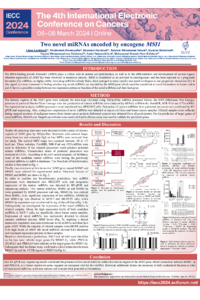
Introduction: The RNA-binding protein Musashi1 (MSI1), well known for its increased expression level in several malignancies, has been reported as a prognostic biomarker. Since miRNAs are among the very stable non-coding RNAs in body fluids and are considered to be more efficient biomarkers in several biological processes, we were interested to find out if any novel miRNAs are encoded by MSI1 genes, which could be considered as novel biomarkers in future studies. Both experimental and computation-based methods were used to find the most reliable structures.
Methods: Several types of bioinformatics software were used to predict novel miRNA precursors based on RNA secondary structure criteria and evaluate the probability of producing mature miRNAs using Drosha/Dicer processing. For experimental confirmation, candidate miRNA precursors were transfected into HEK293T cells and their ability to produce mature miRNAs was assessed via RT-qPCR and sequencing. Additionally, we analyzed the endogenous expression of miRNAs in cancer cell lines and breast cancer samples.
Results: Two structures within the intron 4 of the MSI1 gene, named MSM2 and MSM3, which possessed the most characteristics of miRNA precursors, were selected for further studies. In HEK293T cells, the MSM3 precursor generated two mature miRNAs, MSM3-3p and MSM3-5p, while MSM2 generated only one mature miRNA, MSM2-5p. The significant endogenous expression of MSM2-5p and MSM3-3p was detected in MCF-7 and SH-SY5Y cell lines, but not the MSM3-5p. Interestingly, the expression of novel miRNAs was only detected in breast clinical samples with increased expression levels of MSI1.
Conclusion: Our RT-qPCR and sequencing results confirmed the presence of two novel miRNAs within the intronic region of the MSI1 gene. The expression of these novel miRNAs was confirmed in cancer cell lines and breast cancer samples. However, additional studies are necessary to fully understand the precise roles of these novel miRNAs in various cancers and assess their potential as biomarkers.
Keywords
MSI1
novel miRNAs
breast cancer
bioinformatics
Poster
poster Liana.pdf
OPTIMIZATION AND DEVELOPMENT OF MAGNETICALLY TRIGGERED LETROZOLE NANOLIPOSOMES FOR BREAST CANCER TARGETING
Role of Oxidative/Nitrosative Stress in the Development and Progression of Clear Cell Renal Cell Carcinoma