Event submissions
Published
This submission belongs to the session Session G. Cancer Therapy of the event The 4th International Electronic Conference on Cancers
Published date
27 Mar, 2024
Academic Editor
'%3e%3cpath%20d='M12.6657%2010.9104C12.4185%2010.325%2012.0599%209.79327%2011.6097%209.34482C11.1609%208.89508%2010.6293%208.5365%2010.0442%208.28888C10.0389%208.28626%2010.0337%208.28495%2010.0285%208.28233C10.8446%207.69279%2011.3752%206.73249%2011.3752%205.64904C11.3752%203.8542%209.92103%202.39999%208.1262%202.39999C6.33136%202.39999%204.87715%203.8542%204.87715%205.64904C4.87715%206.73249%205.40774%207.69279%206.22393%208.28364C6.21869%208.28626%206.21345%208.28757%206.20821%208.29019C5.62129%208.5378%205.09463%208.89284%204.64265%209.34613C4.1929%209.79493%203.83432%2010.3266%203.58671%2010.9117C3.34345%2011.4845%203.21226%2012.0987%203.20023%2012.7209C3.19988%2012.7349%203.20233%2012.7488%203.20744%2012.7619C3.21255%2012.7749%203.22022%2012.7867%203.22998%2012.7968C3.23975%2012.8068%203.25142%2012.8147%203.26431%2012.8202C3.2772%2012.8256%203.29105%2012.8284%203.30504%2012.8284H4.09109C4.14874%2012.8284%204.19459%2012.7825%204.1959%2012.7262C4.2221%2011.7148%204.62823%2010.7676%205.34617%2010.0497C6.08899%209.30683%207.0755%208.89808%208.1262%208.89808C9.17689%208.89808%2010.1634%209.30683%2010.9062%2010.0497C11.6242%2010.7676%2012.0303%2011.7148%2012.0565%2012.7262C12.0578%2012.7838%2012.1037%2012.8284%2012.1613%2012.8284H12.9474C12.9613%2012.8284%2012.9752%2012.8256%2012.9881%2012.8202C13.001%2012.8147%2013.0126%2012.8068%2013.0224%2012.7968C13.0322%2012.7867%2013.0398%2012.7749%2013.0449%2012.7619C13.0501%2012.7488%2013.0525%2012.7349%2013.0522%2012.7209C13.0391%2012.0947%2012.9094%2011.4855%2012.6657%2010.9104ZM8.1262%207.9024C7.52486%207.9024%206.9589%207.6679%206.53312%207.24211C6.10733%206.81633%205.87283%206.25037%205.87283%205.64904C5.87283%205.0477%206.10733%204.48174%206.53312%204.05596C6.9589%203.63018%207.52486%203.39567%208.1262%203.39567C8.72753%203.39567%209.29349%203.63018%209.71927%204.05596C10.1451%204.48174%2010.3796%205.0477%2010.3796%205.64904C10.3796%206.25037%2010.1451%206.81633%209.71927%207.24211C9.29349%207.6679%208.72753%207.9024%208.1262%207.9024Z'%20fill='%235D1EE1'/%3e%3c/g%3e%3c/svg%3e) Ulrich Pfeffer
Ulrich PfefferCitation
RenXian XIE, JiaYang Lu, QingXin Cai, Tong Chen, HongXin Huang, JianZhou Chen, ChuangZhen CHEN, Thyroid-sparing volume-modulated arc therapy (TS VMAT)in patients with non-distant metastatic nasopharyngeal carcinoma: a feasibility study, in Proceedings of The 4th International Electronic Conference on Cancers, 6 March–8 March 2024, MDPI: Basel, Switzerland
Share
Email
Facebook
Twitter
LinkedIn
Thyroid-sparing volume-modulated arc therapy (TS VMAT)in patients with non-distant metastatic nasopharyngeal carcinoma: a feasibility study
'%3e%3cpath%20d='M12.6647%2010.9104C12.4176%2010.325%2012.0589%209.7933%2011.6088%209.34485C11.16%208.89511%2010.6283%208.53653%2010.0432%208.28891C10.038%208.28629%2010.0327%208.28498%2010.0275%208.28236C10.8437%207.69282%2011.3743%206.73252%2011.3743%205.64907C11.3743%203.85423%209.92005%202.40002%208.12522%202.40002C6.33038%202.40002%204.87618%203.85423%204.87618%205.64907C4.87618%206.73252%205.40677%207.69282%206.22296%208.28367C6.21772%208.28629%206.21248%208.2876%206.20724%208.29022C5.62031%208.53783%205.09365%208.89287%204.64167%209.34616C4.19192%209.79496%203.83334%2010.3266%203.58573%2010.9117C3.34247%2011.4846%203.21128%2012.0987%203.19925%2012.721C3.1989%2012.735%203.20135%2012.7489%203.20646%2012.7619C3.21157%2012.7749%203.21924%2012.7868%203.22901%2012.7968C3.23877%2012.8068%203.25045%2012.8148%203.26334%2012.8202C3.27623%2012.8256%203.29007%2012.8284%203.30406%2012.8284H4.09012C4.14776%2012.8284%204.19362%2012.7825%204.19493%2012.7262C4.22113%2011.7148%204.62726%2010.7676%205.34519%2010.0497C6.08802%209.30686%207.07452%208.89811%208.12522%208.89811C9.17592%208.89811%2010.1624%209.30686%2010.9052%2010.0497C11.6232%2010.7676%2012.0293%2011.7148%2012.0555%2012.7262C12.0568%2012.7839%2012.1027%2012.8284%2012.1603%2012.8284H12.9464C12.9604%2012.8284%2012.9742%2012.8256%2012.9871%2012.8202C13%2012.8148%2013.0117%2012.8068%2013.0214%2012.7968C13.0312%2012.7868%2013.0389%2012.7749%2013.044%2012.7619C13.0491%2012.7489%2013.0515%2012.735%2013.0512%2012.721C13.0381%2012.0947%2012.9084%2011.4856%2012.6647%2010.9104ZM8.12522%207.90243C7.52388%207.90243%206.95792%207.66793%206.53214%207.24215C6.10636%206.81636%205.87185%206.2504%205.87185%205.64907C5.87185%205.04773%206.10636%204.48177%206.53214%204.05599C6.95792%203.63021%207.52388%203.3957%208.12522%203.3957C8.72655%203.3957%209.29252%203.63021%209.7183%204.05599C10.1441%204.48177%2010.3786%205.04773%2010.3786%205.64907C10.3786%206.2504%2010.1441%206.81636%209.7183%207.24215C9.29252%207.66793%208.72655%207.90243%208.12522%207.90243Z'%20fill='%235D1EE1'/%3e%3c/g%3e%3c/svg%3e)
RenXian XIE 1
JiaYang Lu 1
QingXin Cai 1
Tong Chen 1
HongXin Huang 1
JianZhou Chen 1
ChuangZhen CHEN 1
1. Department of Radiation Oncology, Cancer Hospital of Shantou University Medical College, Shantou, P.R. China.
Abstract
Introduction
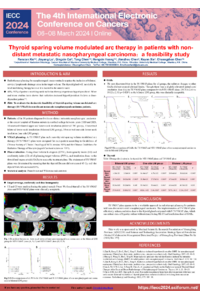
Radiotherapy is an important treatment for nasopharyngeal carcinoma (NPC), but it can cause damage to other normal organs while improving the survival rate of patients. The most common of these is an imbalance of thyroid hormones caused by radiation damage to the thyroid gland, which affects many important functions of the body, such as regulating body temperature, metabolism, cholesterol levels, and growth. Moreover, there is no further research exploring whether we can minimize the radiation dose to the thyroid using volumetric-modulated arc therapy (VMAT) as the treatment for non-distant metastatic NPC. This study aimed to assess the feasibility of thyroid-sparing volumetric-modulated arc therapy (TS VMAT) in patients with non-distant metastatic NPC.
Methods
This dosimetric feasibility study included 30 patients with non-distant metastatic NPC who were treated with radiotherapy at the Affiliated Cancer Hospital of Shantou University Medical College between 2020 and 2023. Computed tomography datasets of 30 patients and inverse-planning VMAT with Eclipse version 15.6 treatment planning systems were used to generate thyroid-sparing volume-modulated arc therapy (TS VMAT) plans and non-thyroid-sparing volume-modulated arc therapy (NTS VMAT) plans. These patients were divided into 3 groups, including the bilateral upper neck irradiation group (bilateral UNI group), the one-side lower neck irradiation group (one-side LNI group), and the bilateral lower neck iradiation group (bilateral LNl group) with 10 patients in each group. All target volumes and organs at risk (OARs) were delineated by the radiation oncologists, according to Guidelines of Chinese Society of Clinical Oncology (CSCO, version 2023) and the Chinese Guidelines for Radiation Therapy of Nasopharyngeal Carcinoma (version 2022). The two radiotherapy plans were evaluated using dose volume histograms, homogeneity index (HI) and conformity index (CI) of all PTVs, and irradiation doses to the thyroid and other OARs.
Results
There were no statistically significant differences in HI and CI between two plans in all groups. In comparison to the NTS VMAT plans, there was a significant reduction in radiation dose to thyroid in TS VMAT plans of all groups, both in terms of the mean dose (Dmean), the minimum dose (Dmin), and the volume irradiated with 40 Gy or more (V40). For the protection of OARs, TS VMAT plans in the bilateral UNI group showed lower radiation dosages to left parotids (30.63±3.07 vs 30.41±3.08, p=0.025*) and left eyeballs (23.63±9.66 vs 21.78±9.05, p=0.006*), and the irradiation doses to other OARs had no significant differences between the two plans in all groups, such as brainstem PRV, brainstem, spinal cord PRV, lens, optic nerves, pituitary, oral cavity, and larynx.
Conclusions
The use of TS VMAT plans appears to be a viable approach in radiotherapy planning for patients with non-distant metastatic NPC. TS VMAT plans effectively reduce radiation dose to the thyroid gland compared with NTS VMAT plans, thus mitigating patients’ risks of developing hypothyroidism without exacerbating the homogeneity index (HI), conformity index (CI), and the irradiation doses to OARs. The encouraging results of our study need to be further validated by clinical trials with larger sample sizes to establish a clear advantage in the protection of thyroid function in NPC patients treated with TS VMAT plans.
Keywords
nasopharyngeal carcinoma
volumetric modulated arc therapy (VMAT)
thyroid
hypothyroidism
radiotherapy
dosimetric feasibility
Poster
Thyroid-sparing volume-modulated arc therapy (TS VMAT)in patients with non-distant metastatic nasopharyngeal carcinoma a feasibility study.pdf
SYNTHESIS AND PRELIMINARY INVESTIGATION OF METAL NANOPARTICLES FROM THE STEM EXTRACT OF BACOPA sp. FOR THE TREATMENT OF LUNG CANCER
Comparative Study of Long-Term Efficacy and Safety of neoadjuvant chemotherapy before radical surgery versus concurrent chemoradiotherapy for FIGO 2018 stage IB3/IIA2 cervical squamous cell carcinoma: a propensity score-matched analysis