Event submissions
Published
This submission belongs to the session Session E. Molecular Cancer Biology of the event The 4th International Electronic Conference on Cancers
Published date
27 Mar, 2024
Academic Editor
'%3e%3cpath%20d='M12.6657%2010.9104C12.4185%2010.325%2012.0599%209.79327%2011.6097%209.34482C11.1609%208.89508%2010.6293%208.5365%2010.0442%208.28888C10.0389%208.28626%2010.0337%208.28495%2010.0285%208.28233C10.8446%207.69279%2011.3752%206.73249%2011.3752%205.64904C11.3752%203.8542%209.92103%202.39999%208.1262%202.39999C6.33136%202.39999%204.87715%203.8542%204.87715%205.64904C4.87715%206.73249%205.40774%207.69279%206.22393%208.28364C6.21869%208.28626%206.21345%208.28757%206.20821%208.29019C5.62129%208.5378%205.09463%208.89284%204.64265%209.34613C4.1929%209.79493%203.83432%2010.3266%203.58671%2010.9117C3.34345%2011.4845%203.21226%2012.0987%203.20023%2012.7209C3.19988%2012.7349%203.20233%2012.7488%203.20744%2012.7619C3.21255%2012.7749%203.22022%2012.7867%203.22998%2012.7968C3.23975%2012.8068%203.25142%2012.8147%203.26431%2012.8202C3.2772%2012.8256%203.29105%2012.8284%203.30504%2012.8284H4.09109C4.14874%2012.8284%204.19459%2012.7825%204.1959%2012.7262C4.2221%2011.7148%204.62823%2010.7676%205.34617%2010.0497C6.08899%209.30683%207.0755%208.89808%208.1262%208.89808C9.17689%208.89808%2010.1634%209.30683%2010.9062%2010.0497C11.6242%2010.7676%2012.0303%2011.7148%2012.0565%2012.7262C12.0578%2012.7838%2012.1037%2012.8284%2012.1613%2012.8284H12.9474C12.9613%2012.8284%2012.9752%2012.8256%2012.9881%2012.8202C13.001%2012.8147%2013.0126%2012.8068%2013.0224%2012.7968C13.0322%2012.7867%2013.0398%2012.7749%2013.0449%2012.7619C13.0501%2012.7488%2013.0525%2012.7349%2013.0522%2012.7209C13.0391%2012.0947%2012.9094%2011.4855%2012.6657%2010.9104ZM8.1262%207.9024C7.52486%207.9024%206.9589%207.6679%206.53312%207.24211C6.10733%206.81633%205.87283%206.25037%205.87283%205.64904C5.87283%205.0477%206.10733%204.48174%206.53312%204.05596C6.9589%203.63018%207.52486%203.39567%208.1262%203.39567C8.72753%203.39567%209.29349%203.63018%209.71927%204.05596C10.1451%204.48174%2010.3796%205.0477%2010.3796%205.64904C10.3796%206.25037%2010.1451%206.81633%209.71927%207.24211C9.29349%207.6679%208.72753%207.9024%208.1262%207.9024Z'%20fill='%235D1EE1'/%3e%3c/g%3e%3c/svg%3e) Stephen Geoffrey Ward
Stephen Geoffrey WardCitation
Elena Filippova, Svetlana Lukina, Irina Pronina, Alexey Burdenny, Tatiana Kazubskaya, Vitaly Loginov, Eleonora Braga, ABERRANTLY EXPRESSED LONG NON-CODING RNAs AND mRNAs IN BREAST CANCER AND THEIR INTERACTION, in Proceedings of The 4th International Electronic Conference on Cancers, 6 March–8 March 2024, MDPI: Basel, Switzerland
Share
Email
Facebook
Twitter
LinkedIn
ABERRANTLY EXPRESSED LONG NON-CODING RNAs AND mRNAs IN BREAST CANCER AND THEIR INTERACTION
'%3e%3cpath%20d='M12.6647%2010.9104C12.4176%2010.325%2012.0589%209.7933%2011.6088%209.34485C11.16%208.89511%2010.6283%208.53653%2010.0432%208.28891C10.038%208.28629%2010.0327%208.28498%2010.0275%208.28236C10.8437%207.69282%2011.3743%206.73252%2011.3743%205.64907C11.3743%203.85423%209.92005%202.40002%208.12522%202.40002C6.33038%202.40002%204.87618%203.85423%204.87618%205.64907C4.87618%206.73252%205.40677%207.69282%206.22296%208.28367C6.21772%208.28629%206.21248%208.2876%206.20724%208.29022C5.62031%208.53783%205.09365%208.89287%204.64167%209.34616C4.19192%209.79496%203.83334%2010.3266%203.58573%2010.9117C3.34247%2011.4846%203.21128%2012.0987%203.19925%2012.721C3.1989%2012.735%203.20135%2012.7489%203.20646%2012.7619C3.21157%2012.7749%203.21924%2012.7868%203.22901%2012.7968C3.23877%2012.8068%203.25045%2012.8148%203.26334%2012.8202C3.27623%2012.8256%203.29007%2012.8284%203.30406%2012.8284H4.09012C4.14776%2012.8284%204.19362%2012.7825%204.19493%2012.7262C4.22113%2011.7148%204.62726%2010.7676%205.34519%2010.0497C6.08802%209.30686%207.07452%208.89811%208.12522%208.89811C9.17592%208.89811%2010.1624%209.30686%2010.9052%2010.0497C11.6232%2010.7676%2012.0293%2011.7148%2012.0555%2012.7262C12.0568%2012.7839%2012.1027%2012.8284%2012.1603%2012.8284H12.9464C12.9604%2012.8284%2012.9742%2012.8256%2012.9871%2012.8202C13%2012.8148%2013.0117%2012.8068%2013.0214%2012.7968C13.0312%2012.7868%2013.0389%2012.7749%2013.044%2012.7619C13.0491%2012.7489%2013.0515%2012.735%2013.0512%2012.721C13.0381%2012.0947%2012.9084%2011.4856%2012.6647%2010.9104ZM8.12522%207.90243C7.52388%207.90243%206.95792%207.66793%206.53214%207.24215C6.10636%206.81636%205.87185%206.2504%205.87185%205.64907C5.87185%205.04773%206.10636%204.48177%206.53214%204.05599C6.95792%203.63021%207.52388%203.3957%208.12522%203.3957C8.72655%203.3957%209.29252%203.63021%209.7183%204.05599C10.1441%204.48177%2010.3786%205.04773%2010.3786%205.64907C10.3786%206.2504%2010.1441%206.81636%209.7183%207.24215C9.29252%207.66793%208.72655%207.90243%208.12522%207.90243Z'%20fill='%235D1EE1'/%3e%3c/g%3e%3c/svg%3e)
Elena Filippova 1
Svetlana Lukina 1
Irina Pronina 1

Alexey Burdenny 1
Tatiana Kazubskaya 2
Vitaly Loginov 1
Eleonora Braga 1
1. Institute of General Pathology and Pathophysiology, 125315, Moscow, Russia
2. N.N. Blokhin National Medical Research Center of Oncology, the Ministry of Health of Russia, 115478, Moscow, Russia
Abstract
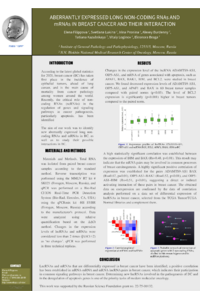
According to the latest global statistics for 2020, breast cancer (BC) has taken first place in the incidence of epithelial tumors, ahead of lung cancer, and is the main cause of mortality from cancer pathology among women around the world. Recently, the critical role of non-coding RNAs (ncRNAs) in the regulation of genes and signaling pathways in cancer pathogenesis, particularly apoptosis, has been identified.
The aim of our work was to identify new aberrantly expressed long non-coding RNAs and mRNAs in BC, as well as to study their possible interactions in BC.
Materials and Methods. Total RNA was isolated from paired breast cancer samples according to the standard method. Reverse transcription was performed using the MMLV RT kit # SK021 (Evrogen, Moscow, Russia), and qPCR was performed on a Bio-Rad CFX96 Real-Time PCR Detection System (Bio-Rad, Hercules, CA, USA) using the qPCRmix kit -HS SYBR (Evrogen, Moscow, Russia) according to the manufacturer's protocol. Data were analyzed using relative quantification based on the ΔΔCt method. Changes in the expression levels of lncRNAs and mRNAs were considered less than 2 times (|ΔΔCt|≤2) as ‘no changes’. qPCR was performed in three technical replicas.
Results. Changes in the expression level of the lncRNA ADAMTS9-AS1, OIP5-AS1, and mRNA of genes associated with apoptosis, such as APAF1, BAX, BAK1, BIM, and BCL2, were studied in breast cancer. We found decreased expression levels of ADAMTS9-AS1, OIP5-AS1, and APAF1 and BAX in 60 breast tumor samples compared with paired norms (p<0.05). The level of BCL2 expression is significantly (p<0.001) higher in breast tumors compared to the paired norm. A high statistically significant correlation was established between the expression of BIM and BAX (Rs=0.48, p=0.01). This result may indicate that the mRNA pairs may be involved in common processes of breast carcinogenesis. A highly significant positive correlation of expression was established for the pairs ADAMTS9-AS1–BAX (Rs=0.67, p=0.01), OIP5-AS1–BAK1 (Rs=0.52, p<0.01), and OIP5-AS1–BIM (Rs =0.51, p<0.01), suggesting a direct or indirect activating interaction of these pairs in breast cancer. The obtained data on coexpression are confirmed by the data obtained from correlation analysis carried out on a dataset showing differential expression levels of lncRNAs in breast cancer, selected from and complementary to the TCGA Tumor/TCGA Normal libraries.
Conclusions. LncRNAs and mRNAs that are differentially expressed in breast cancer have been identified; a positive correlation has been established in mRNA-mRNA and mRNA-lncRNA pairs in breast cancer, which indicates their participation in common signaling pathways in breast cancer. Determining new lncRNAs involved in the pathogenesis of BC and in the deregulation of apoptosis genes is one of the priority tasks of modern molecular oncology.
This work was supported by the Russian Science Foundation grant no. 22-75-00132.
Keywords
long non-coding RNAs
mRNAs
breast cancer
apoptosis
epigenetic regulation
Poster
Poster_FilippovaEA.pdf
The role of Exostosin Glycosyltransferase 1 (EXT1) in ovarian cancer
A BONE MARROW BIOPSY REVEALING AN EXCEPTIONAL COMPLICATION OF MULTIPLE MYELOMA.