Event submissions
Published
This submission belongs to the session Session H. Cancer Pathophysiology of the event The 4th International Electronic Conference on Cancers
Published date
27 Mar, 2024
Academic Editor
'%3e%3cpath%20d='M12.6657%2010.9104C12.4185%2010.325%2012.0599%209.79327%2011.6097%209.34482C11.1609%208.89508%2010.6293%208.5365%2010.0442%208.28888C10.0389%208.28626%2010.0337%208.28495%2010.0285%208.28233C10.8446%207.69279%2011.3752%206.73249%2011.3752%205.64904C11.3752%203.8542%209.92103%202.39999%208.1262%202.39999C6.33136%202.39999%204.87715%203.8542%204.87715%205.64904C4.87715%206.73249%205.40774%207.69279%206.22393%208.28364C6.21869%208.28626%206.21345%208.28757%206.20821%208.29019C5.62129%208.5378%205.09463%208.89284%204.64265%209.34613C4.1929%209.79493%203.83432%2010.3266%203.58671%2010.9117C3.34345%2011.4845%203.21226%2012.0987%203.20023%2012.7209C3.19988%2012.7349%203.20233%2012.7488%203.20744%2012.7619C3.21255%2012.7749%203.22022%2012.7867%203.22998%2012.7968C3.23975%2012.8068%203.25142%2012.8147%203.26431%2012.8202C3.2772%2012.8256%203.29105%2012.8284%203.30504%2012.8284H4.09109C4.14874%2012.8284%204.19459%2012.7825%204.1959%2012.7262C4.2221%2011.7148%204.62823%2010.7676%205.34617%2010.0497C6.08899%209.30683%207.0755%208.89808%208.1262%208.89808C9.17689%208.89808%2010.1634%209.30683%2010.9062%2010.0497C11.6242%2010.7676%2012.0303%2011.7148%2012.0565%2012.7262C12.0578%2012.7838%2012.1037%2012.8284%2012.1613%2012.8284H12.9474C12.9613%2012.8284%2012.9752%2012.8256%2012.9881%2012.8202C13.001%2012.8147%2013.0126%2012.8068%2013.0224%2012.7968C13.0322%2012.7867%2013.0398%2012.7749%2013.0449%2012.7619C13.0501%2012.7488%2013.0525%2012.7349%2013.0522%2012.7209C13.0391%2012.0947%2012.9094%2011.4855%2012.6657%2010.9104ZM8.1262%207.9024C7.52486%207.9024%206.9589%207.6679%206.53312%207.24211C6.10733%206.81633%205.87283%206.25037%205.87283%205.64904C5.87283%205.0477%206.10733%204.48174%206.53312%204.05596C6.9589%203.63018%207.52486%203.39567%208.1262%203.39567C8.72753%203.39567%209.29349%203.63018%209.71927%204.05596C10.1451%204.48174%2010.3796%205.0477%2010.3796%205.64904C10.3796%206.25037%2010.1451%206.81633%209.71927%207.24211C9.29349%207.6679%208.72753%207.9024%208.1262%207.9024Z'%20fill='%235D1EE1'/%3e%3c/g%3e%3c/svg%3e) Nicola Amodio
Nicola AmodioCitation
Salvatore Audia, Carolina Brescia, Francesco Gigliotti, Federica Scaglione, Alessia Pugliano, Davide Mannarino, Maria Eugenia Gallo Cantafio, Nicola Amodio, Rosario Amato, Atypical immunogenetic and molecular characteristics of a 15-Years-Old male affected by ETP-ALL (Early T-precursor acute lymphoblastic leukemia), in Proceedings of The 4th International Electronic Conference on Cancers, 6 March–8 March 2024, MDPI: Basel, Switzerland
Share
Email
Facebook
Twitter
LinkedIn
Atypical immunogenetic and molecular characteristics of a 15-Years-Old male affected by ETP-ALL (Early T-precursor acute lymphoblastic leukemia)
'%3e%3cpath%20d='M12.6647%2010.9104C12.4176%2010.325%2012.0589%209.7933%2011.6088%209.34485C11.16%208.89511%2010.6283%208.53653%2010.0432%208.28891C10.038%208.28629%2010.0327%208.28498%2010.0275%208.28236C10.8437%207.69282%2011.3743%206.73252%2011.3743%205.64907C11.3743%203.85423%209.92005%202.40002%208.12522%202.40002C6.33038%202.40002%204.87618%203.85423%204.87618%205.64907C4.87618%206.73252%205.40677%207.69282%206.22296%208.28367C6.21772%208.28629%206.21248%208.2876%206.20724%208.29022C5.62031%208.53783%205.09365%208.89287%204.64167%209.34616C4.19192%209.79496%203.83334%2010.3266%203.58573%2010.9117C3.34247%2011.4846%203.21128%2012.0987%203.19925%2012.721C3.1989%2012.735%203.20135%2012.7489%203.20646%2012.7619C3.21157%2012.7749%203.21924%2012.7868%203.22901%2012.7968C3.23877%2012.8068%203.25045%2012.8148%203.26334%2012.8202C3.27623%2012.8256%203.29007%2012.8284%203.30406%2012.8284H4.09012C4.14776%2012.8284%204.19362%2012.7825%204.19493%2012.7262C4.22113%2011.7148%204.62726%2010.7676%205.34519%2010.0497C6.08802%209.30686%207.07452%208.89811%208.12522%208.89811C9.17592%208.89811%2010.1624%209.30686%2010.9052%2010.0497C11.6232%2010.7676%2012.0293%2011.7148%2012.0555%2012.7262C12.0568%2012.7839%2012.1027%2012.8284%2012.1603%2012.8284H12.9464C12.9604%2012.8284%2012.9742%2012.8256%2012.9871%2012.8202C13%2012.8148%2013.0117%2012.8068%2013.0214%2012.7968C13.0312%2012.7868%2013.0389%2012.7749%2013.044%2012.7619C13.0491%2012.7489%2013.0515%2012.735%2013.0512%2012.721C13.0381%2012.0947%2012.9084%2011.4856%2012.6647%2010.9104ZM8.12522%207.90243C7.52388%207.90243%206.95792%207.66793%206.53214%207.24215C6.10636%206.81636%205.87185%206.2504%205.87185%205.64907C5.87185%205.04773%206.10636%204.48177%206.53214%204.05599C6.95792%203.63021%207.52388%203.3957%208.12522%203.3957C8.72655%203.3957%209.29252%203.63021%209.7183%204.05599C10.1441%204.48177%2010.3786%205.04773%2010.3786%205.64907C10.3786%206.2504%2010.1441%206.81636%209.7183%207.24215C9.29252%207.66793%208.72655%207.90243%208.12522%207.90243Z'%20fill='%235D1EE1'/%3e%3c/g%3e%3c/svg%3e)
Salvatore Audia 1
Carolina Brescia 2
Francesco Gigliotti 3
Federica Scaglione 4
Alessia Pugliano 4
Davide Mannarino 4
Maria Eugenia Gallo Cantafio 5

Nicola Amodio 5
Rosario Amato 2
1. Immuno-Genetics Lab, Department of Health Science, Medical School, University “Magna Graecia”of Catanzaro, Catanzaro, Italy
2. Immuno-Genetics Lab, Department of Health Science, Medical School, University “Magna Graecia”of Catanzaro, Catanzaro, Italy
3. Department of pediatric oncohematology, "Renato Dulbecco" university hospital company, Catanzaro.
4. Immuno-Genetics Lab, Department of Health Science, Medical School, University “Magna Graecia”of Catanzaro, Catanzaro, Italy
5. Department of Experimental and Clinical Medicine, Magna Graecia University of Catanzaro, 88100 Catanzaro, Italy.
Abstract
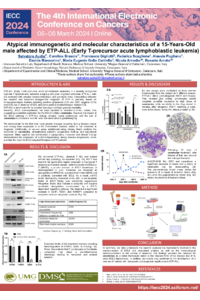
ETP-ALL (early T-cell precursor acute lymphoblastic leukemia) is a high-risk subtype of early T-cell leukemia. The distinctive immunophenotype of ETP-ALL is characterized by CD1a-, CD8-, CD5-, or weak-positive <75%. The complex karyotype and genomic instability are well-known characteristics of ETP-ALL. Throughout all disease stages, we examined the karyotypes, protein expressions, immunophenotypes, and gene expression profiles. The relapse's karyotype analysis reveals new mutations not found during diagnosis, some of which are unprecedented in any ETP-ALL case reported in the literature. Alterations are present in chromosomes 4, 6, 16, and 18 (BCL-2 locus). Immunophenotype analysis shows drastic changes from diagnosis to relapse in ETP-ALL, including CD56 switch and unusual CD5 and CD8 switches. After comparing the patient's relapse-stage marrow with the healthy subject's control marrow and the non-ETP ALL subject at the same stage, protein analysis showed the IL23R-SGK1-RANBP1 asset is overexpressed, along with MARCH5 and BLC-2. Additionally, the expression of BIM, a negative regulator of BCL-2, decreases, as well as Mitofusin-2 (MFN2), which plays a role in mitochondrial fusion and network maintenance. A test conducted on ex vivo blasts confirms that Venetoclax is sensitive at different levels during the relapse phase but not in the early stages. This confirms that disease-related genetic changes led to blast expansion, dependent on BCL2, and is associated with the feedback regulation of transcript expression. Throughout the disease progression, we examined bone marrow and peripheral blood smears. These prove the failures of all therapeutic lines and HSCT, as well as the knockdown of leukemic blasts and the resumption of bone marrow activity (measured by neutrophil levels) with venetoclax administration. In summary, ourunderstanding of the BCL2 pathway's impact in ETP-ALL is limited, and the occasional use of venetoclax is not yet standardized in guidelines. Our results highlight the importance of assessing BCL2 expression in refractory ETP-ALL cases.
Keywords
Pediatric Leukemia
ETP-ALL
BCL2
Venetoclax
SGK1
RANBP1
Poster
POSTER.pdf
Machine Learning Strategies for Drug Discovery in AML: Focus on RUNX1 Bioactivity
Deciphering the role of USP16 in lung cancer