Event submissions
Published
This submission belongs to the session Session G. Cancer Therapy of the event The 4th International Electronic Conference on Cancers
Published date
27 Mar, 2024
Academic Editor
'%3e%3cpath%20d='M12.6657%2010.9104C12.4185%2010.325%2012.0599%209.79327%2011.6097%209.34482C11.1609%208.89508%2010.6293%208.5365%2010.0442%208.28888C10.0389%208.28626%2010.0337%208.28495%2010.0285%208.28233C10.8446%207.69279%2011.3752%206.73249%2011.3752%205.64904C11.3752%203.8542%209.92103%202.39999%208.1262%202.39999C6.33136%202.39999%204.87715%203.8542%204.87715%205.64904C4.87715%206.73249%205.40774%207.69279%206.22393%208.28364C6.21869%208.28626%206.21345%208.28757%206.20821%208.29019C5.62129%208.5378%205.09463%208.89284%204.64265%209.34613C4.1929%209.79493%203.83432%2010.3266%203.58671%2010.9117C3.34345%2011.4845%203.21226%2012.0987%203.20023%2012.7209C3.19988%2012.7349%203.20233%2012.7488%203.20744%2012.7619C3.21255%2012.7749%203.22022%2012.7867%203.22998%2012.7968C3.23975%2012.8068%203.25142%2012.8147%203.26431%2012.8202C3.2772%2012.8256%203.29105%2012.8284%203.30504%2012.8284H4.09109C4.14874%2012.8284%204.19459%2012.7825%204.1959%2012.7262C4.2221%2011.7148%204.62823%2010.7676%205.34617%2010.0497C6.08899%209.30683%207.0755%208.89808%208.1262%208.89808C9.17689%208.89808%2010.1634%209.30683%2010.9062%2010.0497C11.6242%2010.7676%2012.0303%2011.7148%2012.0565%2012.7262C12.0578%2012.7838%2012.1037%2012.8284%2012.1613%2012.8284H12.9474C12.9613%2012.8284%2012.9752%2012.8256%2012.9881%2012.8202C13.001%2012.8147%2013.0126%2012.8068%2013.0224%2012.7968C13.0322%2012.7867%2013.0398%2012.7749%2013.0449%2012.7619C13.0501%2012.7488%2013.0525%2012.7349%2013.0522%2012.7209C13.0391%2012.0947%2012.9094%2011.4855%2012.6657%2010.9104ZM8.1262%207.9024C7.52486%207.9024%206.9589%207.6679%206.53312%207.24211C6.10733%206.81633%205.87283%206.25037%205.87283%205.64904C5.87283%205.0477%206.10733%204.48174%206.53312%204.05596C6.9589%203.63018%207.52486%203.39567%208.1262%203.39567C8.72753%203.39567%209.29349%203.63018%209.71927%204.05596C10.1451%204.48174%2010.3796%205.0477%2010.3796%205.64904C10.3796%206.25037%2010.1451%206.81633%209.71927%207.24211C9.29349%207.6679%208.72753%207.9024%208.1262%207.9024Z'%20fill='%235D1EE1'/%3e%3c/g%3e%3c/svg%3e) Ulrich Pfeffer
Ulrich PfefferCitation
Krishnanand Nagarajan, Latha Subbaiah, Selvamani Palanisamy, Exploring the Antimicrobial and Anticancer Potential of a Bioactive Peptide from T. radiatus: A Comprehensive Study, in Proceedings of The 4th International Electronic Conference on Cancers, 6 March–8 March 2024, MDPI: Basel, Switzerland
Share
Email
Facebook
Twitter
LinkedIn
Exploring the Antimicrobial and Anticancer Potential of a Bioactive Peptide from T. radiatus: A Comprehensive Study
'%3e%3cpath%20d='M12.6647%2010.9104C12.4176%2010.325%2012.0589%209.7933%2011.6088%209.34485C11.16%208.89511%2010.6283%208.53653%2010.0432%208.28891C10.038%208.28629%2010.0327%208.28498%2010.0275%208.28236C10.8437%207.69282%2011.3743%206.73252%2011.3743%205.64907C11.3743%203.85423%209.92005%202.40002%208.12522%202.40002C6.33038%202.40002%204.87618%203.85423%204.87618%205.64907C4.87618%206.73252%205.40677%207.69282%206.22296%208.28367C6.21772%208.28629%206.21248%208.2876%206.20724%208.29022C5.62031%208.53783%205.09365%208.89287%204.64167%209.34616C4.19192%209.79496%203.83334%2010.3266%203.58573%2010.9117C3.34247%2011.4846%203.21128%2012.0987%203.19925%2012.721C3.1989%2012.735%203.20135%2012.7489%203.20646%2012.7619C3.21157%2012.7749%203.21924%2012.7868%203.22901%2012.7968C3.23877%2012.8068%203.25045%2012.8148%203.26334%2012.8202C3.27623%2012.8256%203.29007%2012.8284%203.30406%2012.8284H4.09012C4.14776%2012.8284%204.19362%2012.7825%204.19493%2012.7262C4.22113%2011.7148%204.62726%2010.7676%205.34519%2010.0497C6.08802%209.30686%207.07452%208.89811%208.12522%208.89811C9.17592%208.89811%2010.1624%209.30686%2010.9052%2010.0497C11.6232%2010.7676%2012.0293%2011.7148%2012.0555%2012.7262C12.0568%2012.7839%2012.1027%2012.8284%2012.1603%2012.8284H12.9464C12.9604%2012.8284%2012.9742%2012.8256%2012.9871%2012.8202C13%2012.8148%2013.0117%2012.8068%2013.0214%2012.7968C13.0312%2012.7868%2013.0389%2012.7749%2013.044%2012.7619C13.0491%2012.7489%2013.0515%2012.735%2013.0512%2012.721C13.0381%2012.0947%2012.9084%2011.4856%2012.6647%2010.9104ZM8.12522%207.90243C7.52388%207.90243%206.95792%207.66793%206.53214%207.24215C6.10636%206.81636%205.87185%206.2504%205.87185%205.64907C5.87185%205.04773%206.10636%204.48177%206.53214%204.05599C6.95792%203.63021%207.52388%203.3957%208.12522%203.3957C8.72655%203.3957%209.29252%203.63021%209.7183%204.05599C10.1441%204.48177%2010.3786%205.04773%2010.3786%205.64907C10.3786%206.2504%2010.1441%206.81636%209.7183%207.24215C9.29252%207.66793%208.72655%207.90243%208.12522%207.90243Z'%20fill='%235D1EE1'/%3e%3c/g%3e%3c/svg%3e)
Krishnanand Nagarajan 1
Latha Subbaiah 1
Selvamani Palanisamy 1
1. Peptide Chemical Biology Laboratory, Department of Pharmaceutical Technology, University College of Engineering Bharathidasan Institute of Technology Campus Anna University, Tiruchirappalli - 620 024, Tamil Nadu, India
Abstract
Therapeutic peptides have emerged as a promising frontier in the development of anti-cancer agents, classified into three main groups: antimicrobial/pore-forming peptides, cell-permeable peptides, and tumor-targeting peptides. This classification, delineates the diverse cellular targets of these peptides, offering a comprehensive perspective on their potential applications in cancer treatment. Antimicrobial/pore-forming peptides (AMPs) represent a subset of these therapeutic peptides with natural occurrences across living organisms, integral to the innate immune defense mechanism. This study focuses on a bioassay-guided fractionation approach to purify a bioactive peptide (PAP) from the soft body tissue of marine gastropod T. radiatus, highlighting its multifaceted properties, utilizing sequential procedures such as ammonium sulfate precipitation, cation exchange chromatography, and gel filtration chromatography. The purified antibacterial peptide (PAP), exhibited exceptional efficacy against both Gram-positive and Gram-negative bacteria, particularly demonstrating sensitivity towards E. faecium, K. pneumoniae, and S. dysenteriae. Further characterization revealed PAP's stability across broad pH and temperature ranges, serum stability, and the ability to form membrane pores, as evidenced by SEM analysis. PAP displayed stability across diverse conditions and the ability to form membrane pores, suggesting a potent antimicrobial mechanism. Significantly, PAP demonstrated noteworthy anticancer activities by inhibiting proliferation in lung cancer cell lines (A549 and NCI-H460) in a concentration-dependent manner, while exhibiting non-cytotoxicity to normal cells. This selective anticancer effect was further evidenced by the promotion of angiogenesis in chick embryos. The amino acid sequence of PAP (MSMGSFGFALAVMVLAVLVASAAGAPNTNLVSSACNGNKIPSGNPFFNNLGALLVDLEK) and its three-helix structure with an extended loop were determined through MALDI-TOF-MS/MS analysis and in-silico modeling, respectively.
In conclusion, this research unveils the multifaceted nature of the bioactive peptide from T. radiatus, emphasizing its dual-action as a potent antimicrobial agent and a selective anticancer drug candidate. These findings underscore the potential therapeutic significance of marine peptides in addressing global health challenges, particularly in the context of antimicrobial resistance and cancer treatment.
Keywords
Therapeutic peptides
Antimicrobial
Pore-forming
Tumor-targeting
Bioassay-guided fractionation
Marine peptides
Poster
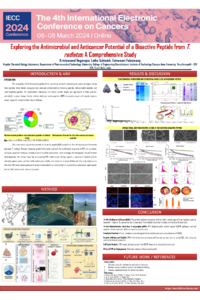
IECC 2024 Sciforum-085313.pdf
Infrared molecular responce of craniofacial squamous cell carcinoma - pilot study
Chordoma Treatment with Boron Neutron Capture Therapy (BNCT): Experimental Insights