Event submissions
Published
This submission belongs to the session Session G. Cancer Therapy of the event The 4th International Electronic Conference on Cancers
Published date
27 Mar, 2024
Academic Editor
'%3e%3cpath%20d='M12.6657%2010.9104C12.4185%2010.325%2012.0599%209.79327%2011.6097%209.34482C11.1609%208.89508%2010.6293%208.5365%2010.0442%208.28888C10.0389%208.28626%2010.0337%208.28495%2010.0285%208.28233C10.8446%207.69279%2011.3752%206.73249%2011.3752%205.64904C11.3752%203.8542%209.92103%202.39999%208.1262%202.39999C6.33136%202.39999%204.87715%203.8542%204.87715%205.64904C4.87715%206.73249%205.40774%207.69279%206.22393%208.28364C6.21869%208.28626%206.21345%208.28757%206.20821%208.29019C5.62129%208.5378%205.09463%208.89284%204.64265%209.34613C4.1929%209.79493%203.83432%2010.3266%203.58671%2010.9117C3.34345%2011.4845%203.21226%2012.0987%203.20023%2012.7209C3.19988%2012.7349%203.20233%2012.7488%203.20744%2012.7619C3.21255%2012.7749%203.22022%2012.7867%203.22998%2012.7968C3.23975%2012.8068%203.25142%2012.8147%203.26431%2012.8202C3.2772%2012.8256%203.29105%2012.8284%203.30504%2012.8284H4.09109C4.14874%2012.8284%204.19459%2012.7825%204.1959%2012.7262C4.2221%2011.7148%204.62823%2010.7676%205.34617%2010.0497C6.08899%209.30683%207.0755%208.89808%208.1262%208.89808C9.17689%208.89808%2010.1634%209.30683%2010.9062%2010.0497C11.6242%2010.7676%2012.0303%2011.7148%2012.0565%2012.7262C12.0578%2012.7838%2012.1037%2012.8284%2012.1613%2012.8284H12.9474C12.9613%2012.8284%2012.9752%2012.8256%2012.9881%2012.8202C13.001%2012.8147%2013.0126%2012.8068%2013.0224%2012.7968C13.0322%2012.7867%2013.0398%2012.7749%2013.0449%2012.7619C13.0501%2012.7488%2013.0525%2012.7349%2013.0522%2012.7209C13.0391%2012.0947%2012.9094%2011.4855%2012.6657%2010.9104ZM8.1262%207.9024C7.52486%207.9024%206.9589%207.6679%206.53312%207.24211C6.10733%206.81633%205.87283%206.25037%205.87283%205.64904C5.87283%205.0477%206.10733%204.48174%206.53312%204.05596C6.9589%203.63018%207.52486%203.39567%208.1262%203.39567C8.72753%203.39567%209.29349%203.63018%209.71927%204.05596C10.1451%204.48174%2010.3796%205.0477%2010.3796%205.64904C10.3796%206.25037%2010.1451%206.81633%209.71927%207.24211C9.29349%207.6679%208.72753%207.9024%208.1262%207.9024Z'%20fill='%235D1EE1'/%3e%3c/g%3e%3c/svg%3e) Ulrich Pfeffer
Ulrich PfefferCitation
Jia-Yang Lu, Jia-Huan Cai, He-Feng Guo, Xun Peng, Combining avoidance structure and jaw-tracking techniques to reduce the dose to lens in radiotherapy for sinonasal cancer, in Proceedings of The 4th International Electronic Conference on Cancers, 6 March–8 March 2024, MDPI: Basel, Switzerland
Share
Email
Facebook
Twitter
LinkedIn
Combining avoidance structure and jaw-tracking techniques to reduce the dose to lens in radiotherapy for sinonasal cancer
'%3e%3cpath%20d='M12.6647%2010.9104C12.4176%2010.325%2012.0589%209.7933%2011.6088%209.34485C11.16%208.89511%2010.6283%208.53653%2010.0432%208.28891C10.038%208.28629%2010.0327%208.28498%2010.0275%208.28236C10.8437%207.69282%2011.3743%206.73252%2011.3743%205.64907C11.3743%203.85423%209.92005%202.40002%208.12522%202.40002C6.33038%202.40002%204.87618%203.85423%204.87618%205.64907C4.87618%206.73252%205.40677%207.69282%206.22296%208.28367C6.21772%208.28629%206.21248%208.2876%206.20724%208.29022C5.62031%208.53783%205.09365%208.89287%204.64167%209.34616C4.19192%209.79496%203.83334%2010.3266%203.58573%2010.9117C3.34247%2011.4846%203.21128%2012.0987%203.19925%2012.721C3.1989%2012.735%203.20135%2012.7489%203.20646%2012.7619C3.21157%2012.7749%203.21924%2012.7868%203.22901%2012.7968C3.23877%2012.8068%203.25045%2012.8148%203.26334%2012.8202C3.27623%2012.8256%203.29007%2012.8284%203.30406%2012.8284H4.09012C4.14776%2012.8284%204.19362%2012.7825%204.19493%2012.7262C4.22113%2011.7148%204.62726%2010.7676%205.34519%2010.0497C6.08802%209.30686%207.07452%208.89811%208.12522%208.89811C9.17592%208.89811%2010.1624%209.30686%2010.9052%2010.0497C11.6232%2010.7676%2012.0293%2011.7148%2012.0555%2012.7262C12.0568%2012.7839%2012.1027%2012.8284%2012.1603%2012.8284H12.9464C12.9604%2012.8284%2012.9742%2012.8256%2012.9871%2012.8202C13%2012.8148%2013.0117%2012.8068%2013.0214%2012.7968C13.0312%2012.7868%2013.0389%2012.7749%2013.044%2012.7619C13.0491%2012.7489%2013.0515%2012.735%2013.0512%2012.721C13.0381%2012.0947%2012.9084%2011.4856%2012.6647%2010.9104ZM8.12522%207.90243C7.52388%207.90243%206.95792%207.66793%206.53214%207.24215C6.10636%206.81636%205.87185%206.2504%205.87185%205.64907C5.87185%205.04773%206.10636%204.48177%206.53214%204.05599C6.95792%203.63021%207.52388%203.3957%208.12522%203.3957C8.72655%203.3957%209.29252%203.63021%209.7183%204.05599C10.1441%204.48177%2010.3786%205.04773%2010.3786%205.64907C10.3786%206.2504%2010.1441%206.81636%209.7183%207.24215C9.29252%207.66793%208.72655%207.90243%208.12522%207.90243Z'%20fill='%235D1EE1'/%3e%3c/g%3e%3c/svg%3e)
Jia-Yang Lu 1
Jia-Huan Cai 1
He-Feng Guo 1
Xun Peng 1
1. Cancer Hospital of Shantou University Medical College
Abstract
Purpose
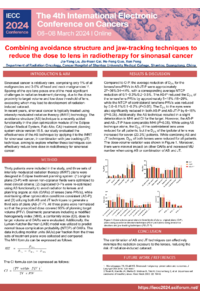
To assess the effectiveness of avoidance structure (AS) techniques, alone and in combination with jaw-tracking (JT) techniques, in the treatment of sinonasal cancer, with the aim of minimizing radiation exposure to the lens.
Methods
Thirty patients were included in the study, and three sets of intensity-modulated radiation therapy (IMRT) plans were designed in an Eclipse treatment planning system: (1) original plans (O-Ps) with seven non-coplanar fields were optimized to meet clinical criteria; (2) duplicated O-Ps were re-optimized using the AS technique (AS-P), specifically for lens structures while keeping other optimization conditions consistent; and (3) utilizing both AS and JT techniques to generate a third set of plans (AS-JT-P). Dosimetric parameters, including dose to target volume and organs at risk (OARs), were evaluated. Additionally, the Lyman—Kutcher—Burman (LKB) model was utilized to predict the normal tissue complication probability (NTCP) of OARs. The data from three sets of treatment plans were collected and compared.
Results
Compared to O-P, the average reduction of D2% for the lens in AS-JT-P was approximately 2-3 Gy, with a corresponding average NTCP reduction of 0.1-0.3%. The AS-P reduced the D2% of the contralateral lens by approximately 1Gy. The differences mentioned above were statistically significant (P<0.05). Additionally, the AS technique resulted in a slight deterioration in dose uniformity and conformity for the target volume, with minimal impact on other OARs.
Conclusions
The combination of AS and JT techniques can effectively minimize the radiation exposure to the lenses, reducing the risk of radiation-induced cataract. The use of AS and JT techniques is recommended in clinical practice for the treatment of sinonasal cancer.
Keywords
Intensity-modulated radiation therapy
sinonasal cancer
avoidance structure
jaw tracking
Poster
sciforum-085295_IECC2024.pdf
Design and Synthesis of Novel Triarylethylenes as Proteasomal Inhibitors and Anti-cancer Agents
Cancer Stem Cells as Potential Targets of Phytotoxic Alkaloids: Drug-likeness Prediction and Molecular Docking Studies.