Event submissions
Published
This submission belongs to the session Session G. Cancer Therapy of the event The 4th International Electronic Conference on Cancers
Published date
27 Mar, 2024
Academic Editor
'%3e%3cpath%20d='M12.6657%2010.9104C12.4185%2010.325%2012.0599%209.79327%2011.6097%209.34482C11.1609%208.89508%2010.6293%208.5365%2010.0442%208.28888C10.0389%208.28626%2010.0337%208.28495%2010.0285%208.28233C10.8446%207.69279%2011.3752%206.73249%2011.3752%205.64904C11.3752%203.8542%209.92103%202.39999%208.1262%202.39999C6.33136%202.39999%204.87715%203.8542%204.87715%205.64904C4.87715%206.73249%205.40774%207.69279%206.22393%208.28364C6.21869%208.28626%206.21345%208.28757%206.20821%208.29019C5.62129%208.5378%205.09463%208.89284%204.64265%209.34613C4.1929%209.79493%203.83432%2010.3266%203.58671%2010.9117C3.34345%2011.4845%203.21226%2012.0987%203.20023%2012.7209C3.19988%2012.7349%203.20233%2012.7488%203.20744%2012.7619C3.21255%2012.7749%203.22022%2012.7867%203.22998%2012.7968C3.23975%2012.8068%203.25142%2012.8147%203.26431%2012.8202C3.2772%2012.8256%203.29105%2012.8284%203.30504%2012.8284H4.09109C4.14874%2012.8284%204.19459%2012.7825%204.1959%2012.7262C4.2221%2011.7148%204.62823%2010.7676%205.34617%2010.0497C6.08899%209.30683%207.0755%208.89808%208.1262%208.89808C9.17689%208.89808%2010.1634%209.30683%2010.9062%2010.0497C11.6242%2010.7676%2012.0303%2011.7148%2012.0565%2012.7262C12.0578%2012.7838%2012.1037%2012.8284%2012.1613%2012.8284H12.9474C12.9613%2012.8284%2012.9752%2012.8256%2012.9881%2012.8202C13.001%2012.8147%2013.0126%2012.8068%2013.0224%2012.7968C13.0322%2012.7867%2013.0398%2012.7749%2013.0449%2012.7619C13.0501%2012.7488%2013.0525%2012.7349%2013.0522%2012.7209C13.0391%2012.0947%2012.9094%2011.4855%2012.6657%2010.9104ZM8.1262%207.9024C7.52486%207.9024%206.9589%207.6679%206.53312%207.24211C6.10733%206.81633%205.87283%206.25037%205.87283%205.64904C5.87283%205.0477%206.10733%204.48174%206.53312%204.05596C6.9589%203.63018%207.52486%203.39567%208.1262%203.39567C8.72753%203.39567%209.29349%203.63018%209.71927%204.05596C10.1451%204.48174%2010.3796%205.0477%2010.3796%205.64904C10.3796%206.25037%2010.1451%206.81633%209.71927%207.24211C9.29349%207.6679%208.72753%207.9024%208.1262%207.9024Z'%20fill='%235D1EE1'/%3e%3c/g%3e%3c/svg%3e) Ulrich Pfeffer
Ulrich PfefferCitation
Charles Okeke Nnadi, Simnom Hope Banda, Michael Uchechukwu Uzonwanne, Obinna Kenneth Didigwu, Cancer Stem Cells as Potential Targets of Phytotoxic Alkaloids: Drug-likeness Prediction and Molecular Docking Studies., in Proceedings of The 4th International Electronic Conference on Cancers, 6 March–8 March 2024, MDPI: Basel, Switzerland
Share
Email
Facebook
Twitter
LinkedIn
Cancer Stem Cells as Potential Targets of Phytotoxic Alkaloids: Drug-likeness Prediction and Molecular Docking Studies.

Charles Okeke Nnadi 1,2
'%3e%3cpath%20d='M12.6647%2010.9104C12.4176%2010.325%2012.0589%209.7933%2011.6088%209.34485C11.16%208.89511%2010.6283%208.53653%2010.0432%208.28891C10.038%208.28629%2010.0327%208.28498%2010.0275%208.28236C10.8437%207.69282%2011.3743%206.73252%2011.3743%205.64907C11.3743%203.85423%209.92005%202.40002%208.12522%202.40002C6.33038%202.40002%204.87618%203.85423%204.87618%205.64907C4.87618%206.73252%205.40677%207.69282%206.22296%208.28367C6.21772%208.28629%206.21248%208.2876%206.20724%208.29022C5.62031%208.53783%205.09365%208.89287%204.64167%209.34616C4.19192%209.79496%203.83334%2010.3266%203.58573%2010.9117C3.34247%2011.4846%203.21128%2012.0987%203.19925%2012.721C3.1989%2012.735%203.20135%2012.7489%203.20646%2012.7619C3.21157%2012.7749%203.21924%2012.7868%203.22901%2012.7968C3.23877%2012.8068%203.25045%2012.8148%203.26334%2012.8202C3.27623%2012.8256%203.29007%2012.8284%203.30406%2012.8284H4.09012C4.14776%2012.8284%204.19362%2012.7825%204.19493%2012.7262C4.22113%2011.7148%204.62726%2010.7676%205.34519%2010.0497C6.08802%209.30686%207.07452%208.89811%208.12522%208.89811C9.17592%208.89811%2010.1624%209.30686%2010.9052%2010.0497C11.6232%2010.7676%2012.0293%2011.7148%2012.0555%2012.7262C12.0568%2012.7839%2012.1027%2012.8284%2012.1603%2012.8284H12.9464C12.9604%2012.8284%2012.9742%2012.8256%2012.9871%2012.8202C13%2012.8148%2013.0117%2012.8068%2013.0214%2012.7968C13.0312%2012.7868%2013.0389%2012.7749%2013.044%2012.7619C13.0491%2012.7489%2013.0515%2012.735%2013.0512%2012.721C13.0381%2012.0947%2012.9084%2011.4856%2012.6647%2010.9104ZM8.12522%207.90243C7.52388%207.90243%206.95792%207.66793%206.53214%207.24215C6.10636%206.81636%205.87185%206.2504%205.87185%205.64907C5.87185%205.04773%206.10636%204.48177%206.53214%204.05599C6.95792%203.63021%207.52388%203.3957%208.12522%203.3957C8.72655%203.3957%209.29252%203.63021%209.7183%204.05599C10.1441%204.48177%2010.3786%205.04773%2010.3786%205.64907C10.3786%206.2504%2010.1441%206.81636%209.7183%207.24215C9.29252%207.66793%208.72655%207.90243%208.12522%207.90243Z'%20fill='%235D1EE1'/%3e%3c/g%3e%3c/svg%3e)
Simnom Hope Banda 2
Michael Uchechukwu Uzonwanne 2
Obinna Kenneth Didigwu 3
1. Department of Pharmaceutical and Medicinal Chemistry, Faculty of Pharmaceutical Sciences, University of Nigeria Nsukka, 410001 Enugu, Nigeria
2. Department of Pharmaceutical and Medicinal Chemistry, Faculty of Pharmacy, Madonna University, Elele Nigeria
3. Department of Pharmaceutical and Medicinal Chemistry, Faculty of Pharmaceutical Sciences, University of Nigeria Nsukka, 410001 Enugu State, Nigeria
Abstract
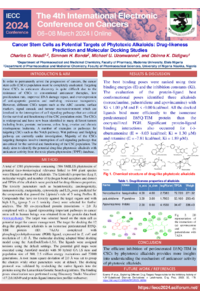
Targeting cancer stem cells (CSCs) in anticancer discovery is very difficult due to the resistance of CSCs to conventional drugs, their low proliferation rate, improved DNA damage repair, and the overexpression of anti-apoptotic proteins and multidrug resistance transporters. Different CSC targets, such as the ABC cassette, surface markers, signal cascade, and tumour microenvironment, are involved in the interruption of cell signaling pathways that are critical for the survival and functioning of the CSC population. The study aims to identify potential drug-like phytotoxic alkaloids with anticancer activity from the toxic plants-phytotoxins (TPPTs) database. A total of 1586 phytotoxins were filtered to obtain 653 alkaloids. Lipinski's properties and the TPSA of alkaloids were predicted for drug likeness and toxicity based on various organ endpoints. Compounds that obeyed Lipinski’s rule of five, with moderate or no toxicity and an LD50 of >2000 mg/kg, were selected. The 12 drug-like phytotoxic alkaloids obtained from the filtering were docked on an isomerase-perdeuterated E65Q-TIM protein (ID: 7AZA; resolution = 1.10 Å) cocrystallized with phosphoglycolohydroxamate. The best binding poses were ranked using their binding energies (E) and inhibition constants (Ki). An evaluation of the protein—ligand's best conformational poses allowed us to identify three alkaloids (norcoclaurine, palustridiene, and apovincamine) with Ki < 1.00 µM and E < -9.00 kcal/mol. All the docked ligands could bind more efficiently to the isomerase-perdeuterated E65Q-TIM protein than the co-crystallized phosphoglycolohydroxamate. Significant protein—ligand binding interactions also occurred for (-)-eburnamonine (E = -8.03 kcal/mol; Ki = 1.30 µM) and retamine (E = -7.81 kcal/mol; Ki = 1.89 µM). The efficient inhibition of perdeuterated E65Q-TIM in CSCs usingphytotoxic alkaloids provided more insights into understanding the mechanisms of the anticancer activity of phytotoxic alkaloids.
Keywords
cancer stem cells
phytotoxic alkaloids
molecular docking
drug-likeness
Poster
IECC2024-Nnadi CO.pdf
Combining avoidance structure and jaw-tracking techniques to reduce the dose to lens in radiotherapy for sinonasal cancer
Use of proton pump inhibitors and risk of gastric cancer in patients requiring gastric acid suppression