Event submissions
Published
This submission belongs to the session Session G. Cancer Therapy of the event The 4th International Electronic Conference on Cancers
Published date
27 Mar, 2024
Academic Editor
'%3e%3cpath%20d='M12.6657%2010.9104C12.4185%2010.325%2012.0599%209.79327%2011.6097%209.34482C11.1609%208.89508%2010.6293%208.5365%2010.0442%208.28888C10.0389%208.28626%2010.0337%208.28495%2010.0285%208.28233C10.8446%207.69279%2011.3752%206.73249%2011.3752%205.64904C11.3752%203.8542%209.92103%202.39999%208.1262%202.39999C6.33136%202.39999%204.87715%203.8542%204.87715%205.64904C4.87715%206.73249%205.40774%207.69279%206.22393%208.28364C6.21869%208.28626%206.21345%208.28757%206.20821%208.29019C5.62129%208.5378%205.09463%208.89284%204.64265%209.34613C4.1929%209.79493%203.83432%2010.3266%203.58671%2010.9117C3.34345%2011.4845%203.21226%2012.0987%203.20023%2012.7209C3.19988%2012.7349%203.20233%2012.7488%203.20744%2012.7619C3.21255%2012.7749%203.22022%2012.7867%203.22998%2012.7968C3.23975%2012.8068%203.25142%2012.8147%203.26431%2012.8202C3.2772%2012.8256%203.29105%2012.8284%203.30504%2012.8284H4.09109C4.14874%2012.8284%204.19459%2012.7825%204.1959%2012.7262C4.2221%2011.7148%204.62823%2010.7676%205.34617%2010.0497C6.08899%209.30683%207.0755%208.89808%208.1262%208.89808C9.17689%208.89808%2010.1634%209.30683%2010.9062%2010.0497C11.6242%2010.7676%2012.0303%2011.7148%2012.0565%2012.7262C12.0578%2012.7838%2012.1037%2012.8284%2012.1613%2012.8284H12.9474C12.9613%2012.8284%2012.9752%2012.8256%2012.9881%2012.8202C13.001%2012.8147%2013.0126%2012.8068%2013.0224%2012.7968C13.0322%2012.7867%2013.0398%2012.7749%2013.0449%2012.7619C13.0501%2012.7488%2013.0525%2012.7349%2013.0522%2012.7209C13.0391%2012.0947%2012.9094%2011.4855%2012.6657%2010.9104ZM8.1262%207.9024C7.52486%207.9024%206.9589%207.6679%206.53312%207.24211C6.10733%206.81633%205.87283%206.25037%205.87283%205.64904C5.87283%205.0477%206.10733%204.48174%206.53312%204.05596C6.9589%203.63018%207.52486%203.39567%208.1262%203.39567C8.72753%203.39567%209.29349%203.63018%209.71927%204.05596C10.1451%204.48174%2010.3796%205.0477%2010.3796%205.64904C10.3796%206.25037%2010.1451%206.81633%209.71927%207.24211C9.29349%207.6679%208.72753%207.9024%208.1262%207.9024Z'%20fill='%235D1EE1'/%3e%3c/g%3e%3c/svg%3e) Ulrich Pfeffer
Ulrich PfefferCitation
Sergio Raúl Zuñiga, Trinidad García-Iglesias, Monserrat Macías-Carballo, Juan Manuel Guzmán-Flores, Christian Martin Rodríguez-Razón, Pharmacological network study on the effect of Quercetin on gastric cancer using computerized databases, in Proceedings of The 4th International Electronic Conference on Cancers, 6 March–8 March 2024, MDPI: Basel, Switzerland
Share
Email
Facebook
Twitter
LinkedIn
Pharmacological network study on the effect of Quercetin on gastric cancer using computerized databases
'%3e%3cpath%20d='M12.6647%2010.9104C12.4176%2010.325%2012.0589%209.7933%2011.6088%209.34485C11.16%208.89511%2010.6283%208.53653%2010.0432%208.28891C10.038%208.28629%2010.0327%208.28498%2010.0275%208.28236C10.8437%207.69282%2011.3743%206.73252%2011.3743%205.64907C11.3743%203.85423%209.92005%202.40002%208.12522%202.40002C6.33038%202.40002%204.87618%203.85423%204.87618%205.64907C4.87618%206.73252%205.40677%207.69282%206.22296%208.28367C6.21772%208.28629%206.21248%208.2876%206.20724%208.29022C5.62031%208.53783%205.09365%208.89287%204.64167%209.34616C4.19192%209.79496%203.83334%2010.3266%203.58573%2010.9117C3.34247%2011.4846%203.21128%2012.0987%203.19925%2012.721C3.1989%2012.735%203.20135%2012.7489%203.20646%2012.7619C3.21157%2012.7749%203.21924%2012.7868%203.22901%2012.7968C3.23877%2012.8068%203.25045%2012.8148%203.26334%2012.8202C3.27623%2012.8256%203.29007%2012.8284%203.30406%2012.8284H4.09012C4.14776%2012.8284%204.19362%2012.7825%204.19493%2012.7262C4.22113%2011.7148%204.62726%2010.7676%205.34519%2010.0497C6.08802%209.30686%207.07452%208.89811%208.12522%208.89811C9.17592%208.89811%2010.1624%209.30686%2010.9052%2010.0497C11.6232%2010.7676%2012.0293%2011.7148%2012.0555%2012.7262C12.0568%2012.7839%2012.1027%2012.8284%2012.1603%2012.8284H12.9464C12.9604%2012.8284%2012.9742%2012.8256%2012.9871%2012.8202C13%2012.8148%2013.0117%2012.8068%2013.0214%2012.7968C13.0312%2012.7868%2013.0389%2012.7749%2013.044%2012.7619C13.0491%2012.7489%2013.0515%2012.735%2013.0512%2012.721C13.0381%2012.0947%2012.9084%2011.4856%2012.6647%2010.9104ZM8.12522%207.90243C7.52388%207.90243%206.95792%207.66793%206.53214%207.24215C6.10636%206.81636%205.87185%206.2504%205.87185%205.64907C5.87185%205.04773%206.10636%204.48177%206.53214%204.05599C6.95792%203.63021%207.52388%203.3957%208.12522%203.3957C8.72655%203.3957%209.29252%203.63021%209.7183%204.05599C10.1441%204.48177%2010.3786%205.04773%2010.3786%205.64907C10.3786%206.2504%2010.1441%206.81636%209.7183%207.24215C9.29252%207.66793%208.72655%207.90243%208.12522%207.90243Z'%20fill='%235D1EE1'/%3e%3c/g%3e%3c/svg%3e)
Sergio Raúl Zuñiga 1
Trinidad García-Iglesias 2
Monserrat Macías-Carballo 3
Juan Manuel Guzmán-Flores 4
Christian Martin Rodríguez-Razón 5
1. Universidad de Guadalajara
2. INICIA Instituto de Investigación de cáncer en la infancia y adolescencia. Departamento de fisiología del CUCS
3. Instituto de Investigación en Ciencias Médicas, Centro Universitario de los Altos, Universidad de Guadalajara
4. Instituto de Investigación en Biociencias, Centro Universitario de Los Altos, Universidad de Guadalajara, Tepatitlánn de Morelos, México
5. Laboratorio de experimentación animal (Bioterio), Departamento de Ciencias de la Salud, Centro Universitario de los Altos
Abstract
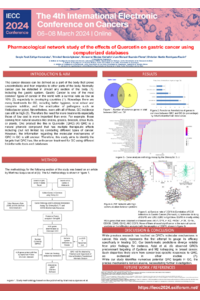
Gastric cancer (GC) is the second most common cause of death of any cancer-related cases in the world, and is also in the top 5 most common malignancy cancers in general. There are plenty of well-distributed treatments , offering better hygiene, more robust and complete nutrition, and the eradication of pathogens such as Helicobacter pylori. Currently, there is still the need for more treatments, especially those of lower cost, like those coming from already easily available products. Quercetin (QRC) is a natural phenolic compound present in a wide variety of products, e.g., in plants like Hibiscus sabdariffa, onions, grapes, broccoli, and citrus fruits. This product has been shown to have great potential therapeutic effects, and it has also been suggested that it could be useful in combating different types of cancer; however, information regarding the targets or mechanisms that QRC has on cancer cells is still unclear. Therefore, this study aims to identify the targets that QRC has, like anti-cancer treatment for GC using different bio-informatic tools and databases. From MalaCards and SwissTargetPrediction, both QRC and GC molecular targets were defined, and then they were matched with the Venny 2.1.0 platform. From this, 31 genes were gathered, and then they were analyzed using the ShinnyGo0.77 and DAVID-Bioinformatic Resources. Furthermore, StringDB was used to identify the protein—protein interactions, and Citoscape 3.6.0 12 hub genes were obtained. Those hub genes were then subject to Gene Expression Profiling Interactive Analysis and TISIDB. Finally, molecular docking studies were performed using the SwissDock database. The results suggest that, according to the gene ontology data, QRC has a relationship with the regulation of cell death, response to stress, cell motility, response to amyloid-beta, cellular response to reactive oxygen species, and apoptotic processes. Some genes like EGFR were correlated with an abundance of CD8 and Neutrophil infiltration, but didn’t show to improve the survival rate. Furthermore, molecular docking results show that QRC can bind to multiple molecules of interest. These results complement some of the currently available information alluding to the effectiveness of plants rich with QRC as part of the treatment used for different kinds of cancer, but it also suggests a plethora of new targets that this molecule has in GC, while at the same time giving a clearer idea of the mechanisms that are affected in GC by QRC. However, as with any other study that primarily uses bioinformatic tools, these final results are to be used for more direct and precise research, especially if experimental protocols are used.
Keywords
Quercetin
Network
Gastric Cancer
Bioinformatics
Poster
cancer-sci.pdf
Post-GWAS functional analysis of the 11p11.2 risk locus identifies HSD17B12 as a neuroblastoma susceptibility gene involved in lipid metabolism
Hidden Gems in the Genome: Pseudogenes Unleashing Revolution in Hepatocellular Carcinoma Detection and Therapy.