Event submissions
Published
This submission belongs to the session Session B. Cancer Biomarkers of the event The 4th International Electronic Conference on Cancers
Published date
27 Mar, 2024
Academic Editor
'%3e%3cpath%20d='M12.6657%2010.9104C12.4185%2010.325%2012.0599%209.79327%2011.6097%209.34482C11.1609%208.89508%2010.6293%208.5365%2010.0442%208.28888C10.0389%208.28626%2010.0337%208.28495%2010.0285%208.28233C10.8446%207.69279%2011.3752%206.73249%2011.3752%205.64904C11.3752%203.8542%209.92103%202.39999%208.1262%202.39999C6.33136%202.39999%204.87715%203.8542%204.87715%205.64904C4.87715%206.73249%205.40774%207.69279%206.22393%208.28364C6.21869%208.28626%206.21345%208.28757%206.20821%208.29019C5.62129%208.5378%205.09463%208.89284%204.64265%209.34613C4.1929%209.79493%203.83432%2010.3266%203.58671%2010.9117C3.34345%2011.4845%203.21226%2012.0987%203.20023%2012.7209C3.19988%2012.7349%203.20233%2012.7488%203.20744%2012.7619C3.21255%2012.7749%203.22022%2012.7867%203.22998%2012.7968C3.23975%2012.8068%203.25142%2012.8147%203.26431%2012.8202C3.2772%2012.8256%203.29105%2012.8284%203.30504%2012.8284H4.09109C4.14874%2012.8284%204.19459%2012.7825%204.1959%2012.7262C4.2221%2011.7148%204.62823%2010.7676%205.34617%2010.0497C6.08899%209.30683%207.0755%208.89808%208.1262%208.89808C9.17689%208.89808%2010.1634%209.30683%2010.9062%2010.0497C11.6242%2010.7676%2012.0303%2011.7148%2012.0565%2012.7262C12.0578%2012.7838%2012.1037%2012.8284%2012.1613%2012.8284H12.9474C12.9613%2012.8284%2012.9752%2012.8256%2012.9881%2012.8202C13.001%2012.8147%2013.0126%2012.8068%2013.0224%2012.7968C13.0322%2012.7867%2013.0398%2012.7749%2013.0449%2012.7619C13.0501%2012.7488%2013.0525%2012.7349%2013.0522%2012.7209C13.0391%2012.0947%2012.9094%2011.4855%2012.6657%2010.9104ZM8.1262%207.9024C7.52486%207.9024%206.9589%207.6679%206.53312%207.24211C6.10733%206.81633%205.87283%206.25037%205.87283%205.64904C5.87283%205.0477%206.10733%204.48174%206.53312%204.05596C6.9589%203.63018%207.52486%203.39567%208.1262%203.39567C8.72753%203.39567%209.29349%203.63018%209.71927%204.05596C10.1451%204.48174%2010.3796%205.0477%2010.3796%205.64904C10.3796%206.25037%2010.1451%206.81633%209.71927%207.24211C9.29349%207.6679%208.72753%207.9024%208.1262%207.9024Z'%20fill='%235D1EE1'/%3e%3c/g%3e%3c/svg%3e) Mario Capasso
Mario CapassoCitation
Ling-Kang Zhang, Effects of Tumor Marker Regression Load Score on Long-Term Prognosis of Gastric Cancer Patients Undergoing Radical Surgery after Neoadjuvant Chemotherapy, in Proceedings of The 4th International Electronic Conference on Cancers, 6 March–8 March 2024, MDPI: Basel, Switzerland
Share
Email
Facebook
Twitter
LinkedIn
Effects of Tumor Marker Regression Load Score on Long-Term Prognosis of Gastric Cancer Patients Undergoing Radical Surgery after Neoadjuvant Chemotherapy
'%3e%3cpath%20d='M12.6647%2010.9104C12.4176%2010.325%2012.0589%209.7933%2011.6088%209.34485C11.16%208.89511%2010.6283%208.53653%2010.0432%208.28891C10.038%208.28629%2010.0327%208.28498%2010.0275%208.28236C10.8437%207.69282%2011.3743%206.73252%2011.3743%205.64907C11.3743%203.85423%209.92005%202.40002%208.12522%202.40002C6.33038%202.40002%204.87618%203.85423%204.87618%205.64907C4.87618%206.73252%205.40677%207.69282%206.22296%208.28367C6.21772%208.28629%206.21248%208.2876%206.20724%208.29022C5.62031%208.53783%205.09365%208.89287%204.64167%209.34616C4.19192%209.79496%203.83334%2010.3266%203.58573%2010.9117C3.34247%2011.4846%203.21128%2012.0987%203.19925%2012.721C3.1989%2012.735%203.20135%2012.7489%203.20646%2012.7619C3.21157%2012.7749%203.21924%2012.7868%203.22901%2012.7968C3.23877%2012.8068%203.25045%2012.8148%203.26334%2012.8202C3.27623%2012.8256%203.29007%2012.8284%203.30406%2012.8284H4.09012C4.14776%2012.8284%204.19362%2012.7825%204.19493%2012.7262C4.22113%2011.7148%204.62726%2010.7676%205.34519%2010.0497C6.08802%209.30686%207.07452%208.89811%208.12522%208.89811C9.17592%208.89811%2010.1624%209.30686%2010.9052%2010.0497C11.6232%2010.7676%2012.0293%2011.7148%2012.0555%2012.7262C12.0568%2012.7839%2012.1027%2012.8284%2012.1603%2012.8284H12.9464C12.9604%2012.8284%2012.9742%2012.8256%2012.9871%2012.8202C13%2012.8148%2013.0117%2012.8068%2013.0214%2012.7968C13.0312%2012.7868%2013.0389%2012.7749%2013.044%2012.7619C13.0491%2012.7489%2013.0515%2012.735%2013.0512%2012.721C13.0381%2012.0947%2012.9084%2011.4856%2012.6647%2010.9104ZM8.12522%207.90243C7.52388%207.90243%206.95792%207.66793%206.53214%207.24215C6.10636%206.81636%205.87185%206.2504%205.87185%205.64907C5.87185%205.04773%206.10636%204.48177%206.53214%204.05599C6.95792%203.63021%207.52388%203.3957%208.12522%203.3957C8.72655%203.3957%209.29252%203.63021%209.7183%204.05599C10.1441%204.48177%2010.3786%205.04773%2010.3786%205.64907C10.3786%206.2504%2010.1441%206.81636%209.7183%207.24215C9.29252%207.66793%208.72655%207.90243%208.12522%207.90243Z'%20fill='%235D1EE1'/%3e%3c/g%3e%3c/svg%3e)
Ling-Kang Zhang 1
1. Department of Gastric Surgery, Fujian Medical University Union Hospital, Fuzhou, 35001, China
Abstract
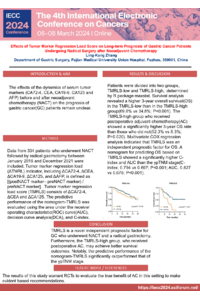
Background: Serum tumor markers have been shown to correlate with the prognosis of gastric cancer (GC); however, the effects of the dynamics of serum tumor markers (cancer antigen (CA)72-4, carcinoembryonic antigen (CEA), CA19-9, CA125, and alpha-fetoprotein (AFP)) on the prognosis of GC before and after neoadjuvant chemotherapy (NACT) remain unclear.
Methods: Data from 334 patients with GC who underwent NACT followed by radical gastrectomy between January 2016 and December 2021 were included in the present study. Tumor marker regression load (ΔTMRL) indicator, including ΔCA72-4, ΔCEA, ΔCA19-9, ΔCA125, and ΔAFP, is defined as [(postNACT marker – preNACT marker) / preNACT marker]. Based on the results of Cox regression analysis, the tumor marker regression load score (TMRLS) was composed of ΔCA72-4, ΔCEA, and ΔCA125. The predictive performance of the nomogram-TMRLS was evaluated using the area under the receiver operating characteristic (ROC) curve (AUC), decision curve analysis (DCA), and C-index.
Results: The patients were divided into two groups, TMRLS-low and TMRLS-high, based on the optimal breakpoint of TMRLS determined in R using the maxstat package. Survival analysis revealed a higher 3-year overall survival (OS) in the TMRLS-low than in the TMRLS-high group (69.8% vs. 34.8%, respectively; P < 0.001). Those in the TMRLS-high group who received postoperative adjuvant chemotherapy (AC) showed a significantly higher 3-year OS rate than those who did not (52.3% vs. 8.3%, respectively; P = 0.020). Multivariate Coxregression analysis indicated that TMRLS was an independent prognostic factor for OS. A nomogram for predicting OS based on TMRLS, ypT stage, ypN stage, and AC showed a significantly higher C-index and AUC than the traditional ypTNM stage (C-index, 0.794 vs. 0.697, respectively; P < 0.001; AUC, 0.827 vs. 0.678, respectively; P < 0.001).
Conclusion: TMRLS appears to be a novel independent prognostic factor for patients with GC who underwent NACT and a radical gastrectomy. Furthermore, the TMRLS-high group, who received postoperative AC, achieved better survival outcomes. Of note, the predictive performance of the nomogram-TMRLS significantly outperformed that of the ypTNM stage.
Keywords
Gastric cancer
Tumor marker
Neoadjuvant chemotherapy
Adjuvant chemotherapy
Independent prognostic factor.
Poster
IECC2024.pdf
Cancer Distribution Among Patients Registered at Hadhramout National Oncology Center During 2015-2020
Application of a Preoperative Nomogram Based on the Gastric Cancer Integrated Oxidative Stress Score in Predicting Overall Survival and Chemotherapy Benefits in Gastric Cancer Patients