Event submissions
Published
This submission belongs to the session Session G. Cancer Therapy of the event The 4th International Electronic Conference on Cancers
Published date
27 Mar, 2024
Academic Editor
'%3e%3cpath%20d='M12.6657%2010.9104C12.4185%2010.325%2012.0599%209.79327%2011.6097%209.34482C11.1609%208.89508%2010.6293%208.5365%2010.0442%208.28888C10.0389%208.28626%2010.0337%208.28495%2010.0285%208.28233C10.8446%207.69279%2011.3752%206.73249%2011.3752%205.64904C11.3752%203.8542%209.92103%202.39999%208.1262%202.39999C6.33136%202.39999%204.87715%203.8542%204.87715%205.64904C4.87715%206.73249%205.40774%207.69279%206.22393%208.28364C6.21869%208.28626%206.21345%208.28757%206.20821%208.29019C5.62129%208.5378%205.09463%208.89284%204.64265%209.34613C4.1929%209.79493%203.83432%2010.3266%203.58671%2010.9117C3.34345%2011.4845%203.21226%2012.0987%203.20023%2012.7209C3.19988%2012.7349%203.20233%2012.7488%203.20744%2012.7619C3.21255%2012.7749%203.22022%2012.7867%203.22998%2012.7968C3.23975%2012.8068%203.25142%2012.8147%203.26431%2012.8202C3.2772%2012.8256%203.29105%2012.8284%203.30504%2012.8284H4.09109C4.14874%2012.8284%204.19459%2012.7825%204.1959%2012.7262C4.2221%2011.7148%204.62823%2010.7676%205.34617%2010.0497C6.08899%209.30683%207.0755%208.89808%208.1262%208.89808C9.17689%208.89808%2010.1634%209.30683%2010.9062%2010.0497C11.6242%2010.7676%2012.0303%2011.7148%2012.0565%2012.7262C12.0578%2012.7838%2012.1037%2012.8284%2012.1613%2012.8284H12.9474C12.9613%2012.8284%2012.9752%2012.8256%2012.9881%2012.8202C13.001%2012.8147%2013.0126%2012.8068%2013.0224%2012.7968C13.0322%2012.7867%2013.0398%2012.7749%2013.0449%2012.7619C13.0501%2012.7488%2013.0525%2012.7349%2013.0522%2012.7209C13.0391%2012.0947%2012.9094%2011.4855%2012.6657%2010.9104ZM8.1262%207.9024C7.52486%207.9024%206.9589%207.6679%206.53312%207.24211C6.10733%206.81633%205.87283%206.25037%205.87283%205.64904C5.87283%205.0477%206.10733%204.48174%206.53312%204.05596C6.9589%203.63018%207.52486%203.39567%208.1262%203.39567C8.72753%203.39567%209.29349%203.63018%209.71927%204.05596C10.1451%204.48174%2010.3796%205.0477%2010.3796%205.64904C10.3796%206.25037%2010.1451%206.81633%209.71927%207.24211C9.29349%207.6679%208.72753%207.9024%208.1262%207.9024Z'%20fill='%235D1EE1'/%3e%3c/g%3e%3c/svg%3e) Ulrich Pfeffer
Ulrich PfefferCitation
RenXian XIE, HongXin Huang, QingXin Cai, Tong Chen, JiaYang Lu, JianZhou Chen, ChuangZhen CHEN, Hippocampus-sparing volume-modulated arc therapy (HS VMAT) for patients with World Health Organization grade II gliomas: a feasibility study, in Proceedings of The 4th International Electronic Conference on Cancers, 6 March–8 March 2024, MDPI: Basel, Switzerland
Share
Email
Facebook
Twitter
LinkedIn
Hippocampus-sparing volume-modulated arc therapy (HS VMAT) for patients with World Health Organization grade II gliomas: a feasibility study
'%3e%3cpath%20d='M12.6647%2010.9104C12.4176%2010.325%2012.0589%209.7933%2011.6088%209.34485C11.16%208.89511%2010.6283%208.53653%2010.0432%208.28891C10.038%208.28629%2010.0327%208.28498%2010.0275%208.28236C10.8437%207.69282%2011.3743%206.73252%2011.3743%205.64907C11.3743%203.85423%209.92005%202.40002%208.12522%202.40002C6.33038%202.40002%204.87618%203.85423%204.87618%205.64907C4.87618%206.73252%205.40677%207.69282%206.22296%208.28367C6.21772%208.28629%206.21248%208.2876%206.20724%208.29022C5.62031%208.53783%205.09365%208.89287%204.64167%209.34616C4.19192%209.79496%203.83334%2010.3266%203.58573%2010.9117C3.34247%2011.4846%203.21128%2012.0987%203.19925%2012.721C3.1989%2012.735%203.20135%2012.7489%203.20646%2012.7619C3.21157%2012.7749%203.21924%2012.7868%203.22901%2012.7968C3.23877%2012.8068%203.25045%2012.8148%203.26334%2012.8202C3.27623%2012.8256%203.29007%2012.8284%203.30406%2012.8284H4.09012C4.14776%2012.8284%204.19362%2012.7825%204.19493%2012.7262C4.22113%2011.7148%204.62726%2010.7676%205.34519%2010.0497C6.08802%209.30686%207.07452%208.89811%208.12522%208.89811C9.17592%208.89811%2010.1624%209.30686%2010.9052%2010.0497C11.6232%2010.7676%2012.0293%2011.7148%2012.0555%2012.7262C12.0568%2012.7839%2012.1027%2012.8284%2012.1603%2012.8284H12.9464C12.9604%2012.8284%2012.9742%2012.8256%2012.9871%2012.8202C13%2012.8148%2013.0117%2012.8068%2013.0214%2012.7968C13.0312%2012.7868%2013.0389%2012.7749%2013.044%2012.7619C13.0491%2012.7489%2013.0515%2012.735%2013.0512%2012.721C13.0381%2012.0947%2012.9084%2011.4856%2012.6647%2010.9104ZM8.12522%207.90243C7.52388%207.90243%206.95792%207.66793%206.53214%207.24215C6.10636%206.81636%205.87185%206.2504%205.87185%205.64907C5.87185%205.04773%206.10636%204.48177%206.53214%204.05599C6.95792%203.63021%207.52388%203.3957%208.12522%203.3957C8.72655%203.3957%209.29252%203.63021%209.7183%204.05599C10.1441%204.48177%2010.3786%205.04773%2010.3786%205.64907C10.3786%206.2504%2010.1441%206.81636%209.7183%207.24215C9.29252%207.66793%208.72655%207.90243%208.12522%207.90243Z'%20fill='%235D1EE1'/%3e%3c/g%3e%3c/svg%3e)
RenXian XIE 1
HongXin Huang 1
QingXin Cai 1
Tong Chen 1
JiaYang Lu 1
JianZhou Chen 1
ChuangZhen CHEN 1
1. Department of Radiation Oncology, Cancer Hospital of Shantou University Medical College, Shantou, P.R. China.
Abstract
Introduction
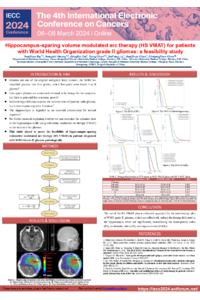
Radiotherapy can improve the survival rates of patients with gliomas; meanwhile, the impaired cognitive functions have been brought to the forefront, with the offending organ, radiosensitive hippocampus. Moreover, there is no further research exploring whether we can minimize the radiation dose to the hippocampus using volumetric-modulated arc therapy (VMAT) as the treatment for gliomas. This study aimed to assess the feasibility of hippocampus-sparing volumetric-modulated arc therapy (HS VMAT) in patients with WHO Grade II gliomas.
Materials & Methods
Hippocampus-sparing VMAT plans and non-hippocampus-sparing VMAT plans were generated using a computed tomography (CT) dataset of 10 patients with WHO grade II gliomas who underwent postoperative radiotherapy. The gross target volume (GTV), organs at risk (OARs), and hippocampus were localized based on the CT images and modified according to the pre-treatment MRI images in fusion. The prescribed dose for both radiotherapy plans was 54Gy/30F to primary tumor volume (PTV). The dose volume histogram (DVH), homogeneity index (HI), conformity index (CI), and irradiated dose of the hippocampus and other OARs were analyzed.
Results
The HI (0.057±0.014 vs 0.046±0.009, p=0.011) and CI (0.91±0.02 vs 0.92±0.02, p=0.071) for both HS VMAT plans and NHS VMAT plans were clinically acceptable. Regarding the protection of OARs, HS VMAT plans were equally capable and even lowered the radiation dosages to the brainstem (35.56±16.67 vs 41.74±16.18, p=0.017) and spinal cord (1.34±0.77 vs 1.43±0.80, p=0.006). The HS VMAT plans substantially reduced radiation doses to the hippocampus. The ipsilateral hippocampal Dmin, Dmean, Dmax, and D40% for NHS VMAT plans and HS VMAT plans were 22.33±19.12 vs. 7.80±4.20 (p=0.005), 35.20±19.58 vs. 18.60±8.52 (p=0.005), 45.37±16.84 vs. 34.28±12.79 (p=0.013), and 36.73±19.52 vs. 19.98±9.63 (p=0.005). While the contralateral hippocampal Dmin, Dmean, Dmax, and D40% of the two plans were 9.68±6.51 vs. 3.38±1.12 (p=0.005), 16.86±8.86 vs. 4.86±0.91 (p=0.006), 29.13±13.88 vs. 8.41±1.38 (p=0.001), and 17.30±9.14 vs. 4.89±0.94 (p=0.005), respectively.
Conclusion
The use of the HS VMAT plan is feasible, which can effectively reduce the dosage delivered to the hippocampus while not significantly exacerbating the HI, CI, and OARs. Consequently, it may help mitigate the risk of cognitive impairment to a certain extent.
Keywords
Hippocampus-sparing
Volumetric modulated arc therapy
Gliomas
Feasibility
Dosimetric
Poster
sciforum-084474-new.pdf
Exceptional Peritoneal Metastasis of Small Cell Carcinoma of Pulmonary Origin
Exploring BNCT as a Novel Approach for Metastatic Spinal Tumor Management