Event submissions
Published
This submission belongs to the session Session C. Cancer Immunology and Immunotherapy of the event The 4th International Electronic Conference on Cancers
Published date
27 Mar, 2024
Academic Editor
'%3e%3cpath%20d='M12.6657%2010.9104C12.4185%2010.325%2012.0599%209.79327%2011.6097%209.34482C11.1609%208.89508%2010.6293%208.5365%2010.0442%208.28888C10.0389%208.28626%2010.0337%208.28495%2010.0285%208.28233C10.8446%207.69279%2011.3752%206.73249%2011.3752%205.64904C11.3752%203.8542%209.92103%202.39999%208.1262%202.39999C6.33136%202.39999%204.87715%203.8542%204.87715%205.64904C4.87715%206.73249%205.40774%207.69279%206.22393%208.28364C6.21869%208.28626%206.21345%208.28757%206.20821%208.29019C5.62129%208.5378%205.09463%208.89284%204.64265%209.34613C4.1929%209.79493%203.83432%2010.3266%203.58671%2010.9117C3.34345%2011.4845%203.21226%2012.0987%203.20023%2012.7209C3.19988%2012.7349%203.20233%2012.7488%203.20744%2012.7619C3.21255%2012.7749%203.22022%2012.7867%203.22998%2012.7968C3.23975%2012.8068%203.25142%2012.8147%203.26431%2012.8202C3.2772%2012.8256%203.29105%2012.8284%203.30504%2012.8284H4.09109C4.14874%2012.8284%204.19459%2012.7825%204.1959%2012.7262C4.2221%2011.7148%204.62823%2010.7676%205.34617%2010.0497C6.08899%209.30683%207.0755%208.89808%208.1262%208.89808C9.17689%208.89808%2010.1634%209.30683%2010.9062%2010.0497C11.6242%2010.7676%2012.0303%2011.7148%2012.0565%2012.7262C12.0578%2012.7838%2012.1037%2012.8284%2012.1613%2012.8284H12.9474C12.9613%2012.8284%2012.9752%2012.8256%2012.9881%2012.8202C13.001%2012.8147%2013.0126%2012.8068%2013.0224%2012.7968C13.0322%2012.7867%2013.0398%2012.7749%2013.0449%2012.7619C13.0501%2012.7488%2013.0525%2012.7349%2013.0522%2012.7209C13.0391%2012.0947%2012.9094%2011.4855%2012.6657%2010.9104ZM8.1262%207.9024C7.52486%207.9024%206.9589%207.6679%206.53312%207.24211C6.10733%206.81633%205.87283%206.25037%205.87283%205.64904C5.87283%205.0477%206.10733%204.48174%206.53312%204.05596C6.9589%203.63018%207.52486%203.39567%208.1262%203.39567C8.72753%203.39567%209.29349%203.63018%209.71927%204.05596C10.1451%204.48174%2010.3796%205.0477%2010.3796%205.64904C10.3796%206.25037%2010.1451%206.81633%209.71927%207.24211C9.29349%207.6679%208.72753%207.9024%208.1262%207.9024Z'%20fill='%235D1EE1'/%3e%3c/g%3e%3c/svg%3e) Vasso Apostolopoulos
Vasso ApostolopoulosCitation
Devendra Kumar Mishra, Sandeep Yadav, Sumit Chaudhari, Ila Dixit, Lavkush Tiwari, Khalid Abdul Waheed, Shubham Shukla, Savita Upadhyay, Metabolic Strategies of Treg Cells in the Tumor Microenvironment: Implications for Immune Metabolism-Based Precision Medicine, in Proceedings of The 4th International Electronic Conference on Cancers, 6 March–8 March 2024, MDPI: Basel, Switzerland
Share
Email
Facebook
Twitter
LinkedIn
Metabolic Strategies of Treg Cells in the Tumor Microenvironment: Implications for Immune Metabolism-Based Precision Medicine
'%3e%3cpath%20d='M12.6647%2010.9104C12.4176%2010.325%2012.0589%209.7933%2011.6088%209.34485C11.16%208.89511%2010.6283%208.53653%2010.0432%208.28891C10.038%208.28629%2010.0327%208.28498%2010.0275%208.28236C10.8437%207.69282%2011.3743%206.73252%2011.3743%205.64907C11.3743%203.85423%209.92005%202.40002%208.12522%202.40002C6.33038%202.40002%204.87618%203.85423%204.87618%205.64907C4.87618%206.73252%205.40677%207.69282%206.22296%208.28367C6.21772%208.28629%206.21248%208.2876%206.20724%208.29022C5.62031%208.53783%205.09365%208.89287%204.64167%209.34616C4.19192%209.79496%203.83334%2010.3266%203.58573%2010.9117C3.34247%2011.4846%203.21128%2012.0987%203.19925%2012.721C3.1989%2012.735%203.20135%2012.7489%203.20646%2012.7619C3.21157%2012.7749%203.21924%2012.7868%203.22901%2012.7968C3.23877%2012.8068%203.25045%2012.8148%203.26334%2012.8202C3.27623%2012.8256%203.29007%2012.8284%203.30406%2012.8284H4.09012C4.14776%2012.8284%204.19362%2012.7825%204.19493%2012.7262C4.22113%2011.7148%204.62726%2010.7676%205.34519%2010.0497C6.08802%209.30686%207.07452%208.89811%208.12522%208.89811C9.17592%208.89811%2010.1624%209.30686%2010.9052%2010.0497C11.6232%2010.7676%2012.0293%2011.7148%2012.0555%2012.7262C12.0568%2012.7839%2012.1027%2012.8284%2012.1603%2012.8284H12.9464C12.9604%2012.8284%2012.9742%2012.8256%2012.9871%2012.8202C13%2012.8148%2013.0117%2012.8068%2013.0214%2012.7968C13.0312%2012.7868%2013.0389%2012.7749%2013.044%2012.7619C13.0491%2012.7489%2013.0515%2012.735%2013.0512%2012.721C13.0381%2012.0947%2012.9084%2011.4856%2012.6647%2010.9104ZM8.12522%207.90243C7.52388%207.90243%206.95792%207.66793%206.53214%207.24215C6.10636%206.81636%205.87185%206.2504%205.87185%205.64907C5.87185%205.04773%206.10636%204.48177%206.53214%204.05599C6.95792%203.63021%207.52388%203.3957%208.12522%203.3957C8.72655%203.3957%209.29252%203.63021%209.7183%204.05599C10.1441%204.48177%2010.3786%205.04773%2010.3786%205.64907C10.3786%206.2504%2010.1441%206.81636%209.7183%207.24215C9.29252%207.66793%208.72655%207.90243%208.12522%207.90243Z'%20fill='%235D1EE1'/%3e%3c/g%3e%3c/svg%3e)
Devendra Kumar Mishra 1
Sandeep Yadav 1
Sumit Chaudhari 1
Ila Dixit 1
Lavkush Tiwari 1
Khalid Abdul Waheed 1
Shubham Shukla 2
Savita Upadhyay 1
1. Ambekeshwar Institute of Pharmaceutical Sciences, Lucknow, Uttar Pradesh, 226201, India
2. BBAU Satellite Centre - Babasaheb Bhimrao Ambedkar University, Amethi, Uttar Pradesh, 227413, India
Abstract
In recent years, the complex relationship between immune cells and the area around the tumour has become an important factor in how cancer grows and how well treatment works. Regulatory T cells (Tregs), a specific type of CD4+ T cell, are very important for keeping the immune system in balance, but tumours can also use them to weaken the immune system. To improve precision medicine approaches in cancer immunotherapy, we need to know more about the metabolic strategies used by Tregs in the tumour microenvironment. This review looks at the changes that Tregs' metabolism goes through when they enter a tumour, showing how their metabolism is different from that of effector T cells. We look into how Tregs use glycolysis, oxidative phosphorylation, and fatty acid metabolism to help them stay alive and keep other cells from attacking. We also talk about how the metabolism of Treg cells changes in response to environmental cues and immune checkpoint inhibitors. We also talk about what Treg metabolic plasticity means for the development of new strategies in immune metabolism-based precision medicine. In conclusion, this review shows how important it is to understand how Treg cells work in the area around a tumour because it could lead to more personalised and effective cancer immunotherapy. The new information from these studies opens up new ways to treat cancer that might tip the balance in favour of the body's immune system. This could start a new era in the fight against cancer.
Keywords
Tumor microenvironment (TME)
Warburg effect
Regulatory T (Treg) cells
Immune metabolism-based precision medicine
Poster
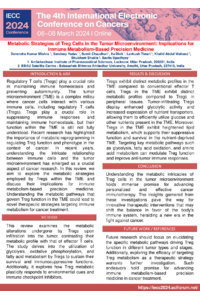
Poster.pdf
Polycyclic aromatic hydrocarbons (PAHs) in grilled marshmallows
Sanguinarine impedes Human Oral Cancer via attenuating Reactive Oxygen Species and PI3K/Akt/MAP kinase pathway