Event submissions
Published
This submission belongs to the session Session D. Tumor Microenvironment of the event The 4th International Electronic Conference on Cancers
Published date
27 Mar, 2024
Academic Editor
'%3e%3cpath%20d='M12.6657%2010.9104C12.4185%2010.325%2012.0599%209.79327%2011.6097%209.34482C11.1609%208.89508%2010.6293%208.5365%2010.0442%208.28888C10.0389%208.28626%2010.0337%208.28495%2010.0285%208.28233C10.8446%207.69279%2011.3752%206.73249%2011.3752%205.64904C11.3752%203.8542%209.92103%202.39999%208.1262%202.39999C6.33136%202.39999%204.87715%203.8542%204.87715%205.64904C4.87715%206.73249%205.40774%207.69279%206.22393%208.28364C6.21869%208.28626%206.21345%208.28757%206.20821%208.29019C5.62129%208.5378%205.09463%208.89284%204.64265%209.34613C4.1929%209.79493%203.83432%2010.3266%203.58671%2010.9117C3.34345%2011.4845%203.21226%2012.0987%203.20023%2012.7209C3.19988%2012.7349%203.20233%2012.7488%203.20744%2012.7619C3.21255%2012.7749%203.22022%2012.7867%203.22998%2012.7968C3.23975%2012.8068%203.25142%2012.8147%203.26431%2012.8202C3.2772%2012.8256%203.29105%2012.8284%203.30504%2012.8284H4.09109C4.14874%2012.8284%204.19459%2012.7825%204.1959%2012.7262C4.2221%2011.7148%204.62823%2010.7676%205.34617%2010.0497C6.08899%209.30683%207.0755%208.89808%208.1262%208.89808C9.17689%208.89808%2010.1634%209.30683%2010.9062%2010.0497C11.6242%2010.7676%2012.0303%2011.7148%2012.0565%2012.7262C12.0578%2012.7838%2012.1037%2012.8284%2012.1613%2012.8284H12.9474C12.9613%2012.8284%2012.9752%2012.8256%2012.9881%2012.8202C13.001%2012.8147%2013.0126%2012.8068%2013.0224%2012.7968C13.0322%2012.7867%2013.0398%2012.7749%2013.0449%2012.7619C13.0501%2012.7488%2013.0525%2012.7349%2013.0522%2012.7209C13.0391%2012.0947%2012.9094%2011.4855%2012.6657%2010.9104ZM8.1262%207.9024C7.52486%207.9024%206.9589%207.6679%206.53312%207.24211C6.10733%206.81633%205.87283%206.25037%205.87283%205.64904C5.87283%205.0477%206.10733%204.48174%206.53312%204.05596C6.9589%203.63018%207.52486%203.39567%208.1262%203.39567C8.72753%203.39567%209.29349%203.63018%209.71927%204.05596C10.1451%204.48174%2010.3796%205.0477%2010.3796%205.64904C10.3796%206.25037%2010.1451%206.81633%209.71927%207.24211C9.29349%207.6679%208.72753%207.9024%208.1262%207.9024Z'%20fill='%235D1EE1'/%3e%3c/g%3e%3c/svg%3e) Robert-Alain Toillon
Robert-Alain ToillonCitation
Ling-Kang Zhang, Zhi-Xin Shang-Guan, Jian-Wei Xie, Different longitudinal changes in the Neutrophil-to-Lymphocyte Ratio during neoadjuvant chemotherapy in gastric cancer are associated with short- and long-term prognosis: a group-based trajectory analysis, in Proceedings of The 4th International Electronic Conference on Cancers, 6 March–8 March 2024, MDPI: Basel, Switzerland
Share
Email
Facebook
Twitter
LinkedIn
Different longitudinal changes in the Neutrophil-to-Lymphocyte Ratio during neoadjuvant chemotherapy in gastric cancer are associated with short- and long-term prognosis: a group-based trajectory analysis
'%3e%3cpath%20d='M12.6647%2010.9104C12.4176%2010.325%2012.0589%209.7933%2011.6088%209.34485C11.16%208.89511%2010.6283%208.53653%2010.0432%208.28891C10.038%208.28629%2010.0327%208.28498%2010.0275%208.28236C10.8437%207.69282%2011.3743%206.73252%2011.3743%205.64907C11.3743%203.85423%209.92005%202.40002%208.12522%202.40002C6.33038%202.40002%204.87618%203.85423%204.87618%205.64907C4.87618%206.73252%205.40677%207.69282%206.22296%208.28367C6.21772%208.28629%206.21248%208.2876%206.20724%208.29022C5.62031%208.53783%205.09365%208.89287%204.64167%209.34616C4.19192%209.79496%203.83334%2010.3266%203.58573%2010.9117C3.34247%2011.4846%203.21128%2012.0987%203.19925%2012.721C3.1989%2012.735%203.20135%2012.7489%203.20646%2012.7619C3.21157%2012.7749%203.21924%2012.7868%203.22901%2012.7968C3.23877%2012.8068%203.25045%2012.8148%203.26334%2012.8202C3.27623%2012.8256%203.29007%2012.8284%203.30406%2012.8284H4.09012C4.14776%2012.8284%204.19362%2012.7825%204.19493%2012.7262C4.22113%2011.7148%204.62726%2010.7676%205.34519%2010.0497C6.08802%209.30686%207.07452%208.89811%208.12522%208.89811C9.17592%208.89811%2010.1624%209.30686%2010.9052%2010.0497C11.6232%2010.7676%2012.0293%2011.7148%2012.0555%2012.7262C12.0568%2012.7839%2012.1027%2012.8284%2012.1603%2012.8284H12.9464C12.9604%2012.8284%2012.9742%2012.8256%2012.9871%2012.8202C13%2012.8148%2013.0117%2012.8068%2013.0214%2012.7968C13.0312%2012.7868%2013.0389%2012.7749%2013.044%2012.7619C13.0491%2012.7489%2013.0515%2012.735%2013.0512%2012.721C13.0381%2012.0947%2012.9084%2011.4856%2012.6647%2010.9104ZM8.12522%207.90243C7.52388%207.90243%206.95792%207.66793%206.53214%207.24215C6.10636%206.81636%205.87185%206.2504%205.87185%205.64907C5.87185%205.04773%206.10636%204.48177%206.53214%204.05599C6.95792%203.63021%207.52388%203.3957%208.12522%203.3957C8.72655%203.3957%209.29252%203.63021%209.7183%204.05599C10.1441%204.48177%2010.3786%205.04773%2010.3786%205.64907C10.3786%206.2504%2010.1441%206.81636%209.7183%207.24215C9.29252%207.66793%208.72655%207.90243%208.12522%207.90243Z'%20fill='%235D1EE1'/%3e%3c/g%3e%3c/svg%3e)
Ling-Kang Zhang 1
Zhi-Xin Shang-Guan 1
Jian-Wei Xie 1
1. Department of Gastric Surgery, Fujian Medical University Union Hospital, Fuzhou, 35001, China
Abstract
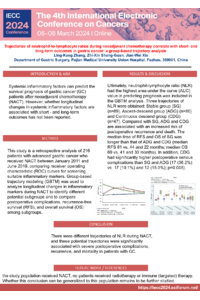
Background: Systemic inflammatory factors can predict the survival prognosis of gastric cancer (GC) patients after neoadjuvant chemotherapy (NACT). However, whether longitudinal changes to systemic inflammatory factors over time are related to short-term and long-term prognosis has not been reported.
Methods: Prospective collection retrospective analysis of 216 GC patients who received NACT in our department from January 2011 to April 2019. Comparing receiver operating characteristic (ROC) curves for screening suitable inflammatory markers. Group-based trajectory modeling (GBTM) was used to analyze longitudinal changes in inflammatory markers during NACT to identify different potential subgroups. The endpoints were postoperative complications, recurrence-free survival (RFS), and overall survival (OS).
Results: Finally, Neutrophil-Lymphocyte Ratio (NLR) was the best predictor of the prognosis of the area under the curve (AUC) value compared with other common inflammatory markers and was included in the GBTM analysis. Three trajectories of NLR were obtained, and named the stable group (SG) (n=89), the ascent–descent group (ADG) (n=80) and the continuous descent group (CDG) (n=47). Compared with SG OR=0.333 (95% CI: 0.141-0.788) and ADG OR=0.284 (95% CI: 0.119-0.675), the CDG had significantly higher postoperative serious complications. The risks of tumor recurrence and death in ADG were HR=1.989 (95% CI: 1.157-3.419) and HR=1.830 (95%CI: 1.127-2.969), while for CDG they were HR=2.031 (95% CI: 1.098-3.757) and HR=1.913 (95% CI: 1.092-3.351), respectively. The median RFS and OS of SG were better than those of ADG and CDG (median RFS 81 months vs. 44 and 22 months, and median OS 69 months vs. 41 and 30 months).
Conclusion: There were different trajectories of NLR during NACT, and these potential trajectories were significantly associated with severe postoperative complications, recurrence, and mortality in patients with GC.
Keywords
Gastric cancer
Neoadjuvant chemotherapy
Systemic inflammatory cytokines
Group-based trajectory model
Survival Prognosis
Poster
IECC2024.pdf
Impact of Removal of Lymph Nodes on Survival in Stage I-III Gastric Signet-ring Cell Cancer: The More, the Better?
Pulmonary tuberculosis: A comorbidity or misdiagnosis of primary lung cancer in Africa?