Event submissions
Published
This submission belongs to the session D. Identification and Quantification of Toxicants of the event The 1st International Electronic Conference on Toxics
Published date
03 Apr, 2024
Academic Editor
'%3e%3cpath%20d='M12.6657%2010.9104C12.4185%2010.325%2012.0599%209.79327%2011.6097%209.34482C11.1609%208.89508%2010.6293%208.5365%2010.0442%208.28888C10.0389%208.28626%2010.0337%208.28495%2010.0285%208.28233C10.8446%207.69279%2011.3752%206.73249%2011.3752%205.64904C11.3752%203.8542%209.92103%202.39999%208.1262%202.39999C6.33136%202.39999%204.87715%203.8542%204.87715%205.64904C4.87715%206.73249%205.40774%207.69279%206.22393%208.28364C6.21869%208.28626%206.21345%208.28757%206.20821%208.29019C5.62129%208.5378%205.09463%208.89284%204.64265%209.34613C4.1929%209.79493%203.83432%2010.3266%203.58671%2010.9117C3.34345%2011.4845%203.21226%2012.0987%203.20023%2012.7209C3.19988%2012.7349%203.20233%2012.7488%203.20744%2012.7619C3.21255%2012.7749%203.22022%2012.7867%203.22998%2012.7968C3.23975%2012.8068%203.25142%2012.8147%203.26431%2012.8202C3.2772%2012.8256%203.29105%2012.8284%203.30504%2012.8284H4.09109C4.14874%2012.8284%204.19459%2012.7825%204.1959%2012.7262C4.2221%2011.7148%204.62823%2010.7676%205.34617%2010.0497C6.08899%209.30683%207.0755%208.89808%208.1262%208.89808C9.17689%208.89808%2010.1634%209.30683%2010.9062%2010.0497C11.6242%2010.7676%2012.0303%2011.7148%2012.0565%2012.7262C12.0578%2012.7838%2012.1037%2012.8284%2012.1613%2012.8284H12.9474C12.9613%2012.8284%2012.9752%2012.8256%2012.9881%2012.8202C13.001%2012.8147%2013.0126%2012.8068%2013.0224%2012.7968C13.0322%2012.7867%2013.0398%2012.7749%2013.0449%2012.7619C13.0501%2012.7488%2013.0525%2012.7349%2013.0522%2012.7209C13.0391%2012.0947%2012.9094%2011.4855%2012.6657%2010.9104ZM8.1262%207.9024C7.52486%207.9024%206.9589%207.6679%206.53312%207.24211C6.10733%206.81633%205.87283%206.25037%205.87283%205.64904C5.87283%205.0477%206.10733%204.48174%206.53312%204.05596C6.9589%203.63018%207.52486%203.39567%208.1262%203.39567C8.72753%203.39567%209.29349%203.63018%209.71927%204.05596C10.1451%204.48174%2010.3796%205.0477%2010.3796%205.64904C10.3796%206.25037%2010.1451%206.81633%209.71927%207.24211C9.29349%207.6679%208.72753%207.9024%208.1262%207.9024Z'%20fill='%235D1EE1'/%3e%3c/g%3e%3c/svg%3e) Virgínia Cruz Fernandes
Virgínia Cruz FernandesCitation
Lorena González-Gómez, Sonia Morante-Zarcero, Jorge A.M. Pereira, José S. Câmara, Isabel Sierra, Occurrence of tropane alkaloids in teas. Effect of tea-making on atropine and scopolamine, in Proceedings of The 1st International Electronic Conference on Toxics, 20 March–22 March 2024, MDPI: Basel, Switzerland
Share
Email
Facebook
Twitter
LinkedIn
Occurrence of tropane alkaloids in teas. Effect of tea-making on atropine and scopolamine

Lorena González-Gómez 1

Sonia Morante-Zarcero 1

Jorge A.M. Pereira 2
'%3e%3cpath%20d='M12.6647%2010.9104C12.4176%2010.325%2012.0589%209.7933%2011.6088%209.34485C11.16%208.89511%2010.6283%208.53653%2010.0432%208.28891C10.038%208.28629%2010.0327%208.28498%2010.0275%208.28236C10.8437%207.69282%2011.3743%206.73252%2011.3743%205.64907C11.3743%203.85423%209.92005%202.40002%208.12522%202.40002C6.33038%202.40002%204.87618%203.85423%204.87618%205.64907C4.87618%206.73252%205.40677%207.69282%206.22296%208.28367C6.21772%208.28629%206.21248%208.2876%206.20724%208.29022C5.62031%208.53783%205.09365%208.89287%204.64167%209.34616C4.19192%209.79496%203.83334%2010.3266%203.58573%2010.9117C3.34247%2011.4846%203.21128%2012.0987%203.19925%2012.721C3.1989%2012.735%203.20135%2012.7489%203.20646%2012.7619C3.21157%2012.7749%203.21924%2012.7868%203.22901%2012.7968C3.23877%2012.8068%203.25045%2012.8148%203.26334%2012.8202C3.27623%2012.8256%203.29007%2012.8284%203.30406%2012.8284H4.09012C4.14776%2012.8284%204.19362%2012.7825%204.19493%2012.7262C4.22113%2011.7148%204.62726%2010.7676%205.34519%2010.0497C6.08802%209.30686%207.07452%208.89811%208.12522%208.89811C9.17592%208.89811%2010.1624%209.30686%2010.9052%2010.0497C11.6232%2010.7676%2012.0293%2011.7148%2012.0555%2012.7262C12.0568%2012.7839%2012.1027%2012.8284%2012.1603%2012.8284H12.9464C12.9604%2012.8284%2012.9742%2012.8256%2012.9871%2012.8202C13%2012.8148%2013.0117%2012.8068%2013.0214%2012.7968C13.0312%2012.7868%2013.0389%2012.7749%2013.044%2012.7619C13.0491%2012.7489%2013.0515%2012.735%2013.0512%2012.721C13.0381%2012.0947%2012.9084%2011.4856%2012.6647%2010.9104ZM8.12522%207.90243C7.52388%207.90243%206.95792%207.66793%206.53214%207.24215C6.10636%206.81636%205.87185%206.2504%205.87185%205.64907C5.87185%205.04773%206.10636%204.48177%206.53214%204.05599C6.95792%203.63021%207.52388%203.3957%208.12522%203.3957C8.72655%203.3957%209.29252%203.63021%209.7183%204.05599C10.1441%204.48177%2010.3786%205.04773%2010.3786%205.64907C10.3786%206.2504%2010.1441%206.81636%209.7183%207.24215C9.29252%207.66793%208.72655%207.90243%208.12522%207.90243Z'%20fill='%235D1EE1'/%3e%3c/g%3e%3c/svg%3e)
José S. Câmara 3

Isabel Sierra 1
1. ESCET – Escuela Superior de Ciencias Experimentales y Tecnología, Departamento de Tecnología Química y Ambiental, Universidad Rey Juan Carlos, C/Tulipán s/n, 28933 Móstoles, Madrid, Spain.
2. CQM – Centro de Química da Madeira, Universidade da Madeira, Campus da Penteada, 9020-105 Funchal, Portugal.
3. CQM – Centro de Química da Madeira, Universidade da Madeira, Campus da Penteada, 9020-105 Funchal, Portugal / Departamento de Química, Faculdade de Ciências Exatas e Engenharia, Universidade da Madeira, Campus Universitário da Penteada, 9000-390 Funchal,
Abstract
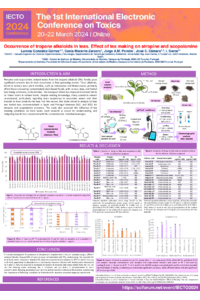
Tropane alkaloids (TAs), particularly atropine and scopolamine, are hazardous secondary metabolites found in toxic plants such as those from the Brassicaceae and Solanaceae families. Concerns arise from reported cases of food poisoning due to these toxins, which often contaminate crops in sustainable farming with limited herbicide use. TAs, when consumed through teas and herbal teas, exhibit anticholinergic effects. Despite high contamination, data on TAs in these beverages are scarce. Thus, this study aims to evaluate the presence of atropine and scopolamine in 33 teas and herbal teas purchased in Portugal and Spain.
Infusions (black, green, white tea, and mixed herbal tea) were prepared, cooled, and purified with a method previously validated and developed by our group in similar samples [1]. This methodology involved a microextraction technique (µ-SPEed®) with a PS/DVB cartridge, where 5×500 µL of sample was loaded and eluted with methanol (2×100 µL) before analysis via HPLC-MS/MS.
Our analysis showed recoveries (at 2.5 ng/mL) of 89–109% for atropine and 73–114% for scopolamine, and good linearity (0.1–25 ng/mL, R2 0.995-0.998). The method assessed contamination levels in infusions, revealing that 63.6% of samples contained one or both analytes, with 45.5% exceeding the 0.2 ng/g limit for liquid herbal infusions.
In addition, the impact of heating conditions on standard solutions (0.2 ng/mL and 4 ng/mL) and naturally contaminated green, white, and black teas was evaluated by brewing with different boiling times (5 and 10 min) at 97ºC. The infusion conditions described in the international standard ISO 3103 were also compared with the contaminated samples. In the experiment with standard solutions, these remained stable under boiling. In the other experiment, the results showed a higher extraction of the analytes. Overall, this study provides crucial insights into the contamination levels of TAs and demonstrates that TAs are not degraded as a result of tea-brewing.
Keywords
atropine
scopolamine
tropane alkaloids
µSPEed®
HPLC–MS/MS
teas/herbal teas
infusions
brewing conditions
Poster
IECTO 2024-Póster Lo.pdf
Development of green(er) cost-effective solvent-based method coupled with thin-layer chromatography imaging system for the determination of allethrin in blood and urine
A historical drug or a current problem? Determination of methaqualone and its analogs in biological material via UHPLC-QqQ-MS/MS