Event submissions
Published
This submission belongs to the session A. Environmental Contaminants and Health of the event The 1st International Electronic Conference on Toxics
Published date
03 Apr, 2024
Academic Editor
'%3e%3cpath%20d='M12.6657%2010.9104C12.4185%2010.325%2012.0599%209.79327%2011.6097%209.34482C11.1609%208.89508%2010.6293%208.5365%2010.0442%208.28888C10.0389%208.28626%2010.0337%208.28495%2010.0285%208.28233C10.8446%207.69279%2011.3752%206.73249%2011.3752%205.64904C11.3752%203.8542%209.92103%202.39999%208.1262%202.39999C6.33136%202.39999%204.87715%203.8542%204.87715%205.64904C4.87715%206.73249%205.40774%207.69279%206.22393%208.28364C6.21869%208.28626%206.21345%208.28757%206.20821%208.29019C5.62129%208.5378%205.09463%208.89284%204.64265%209.34613C4.1929%209.79493%203.83432%2010.3266%203.58671%2010.9117C3.34345%2011.4845%203.21226%2012.0987%203.20023%2012.7209C3.19988%2012.7349%203.20233%2012.7488%203.20744%2012.7619C3.21255%2012.7749%203.22022%2012.7867%203.22998%2012.7968C3.23975%2012.8068%203.25142%2012.8147%203.26431%2012.8202C3.2772%2012.8256%203.29105%2012.8284%203.30504%2012.8284H4.09109C4.14874%2012.8284%204.19459%2012.7825%204.1959%2012.7262C4.2221%2011.7148%204.62823%2010.7676%205.34617%2010.0497C6.08899%209.30683%207.0755%208.89808%208.1262%208.89808C9.17689%208.89808%2010.1634%209.30683%2010.9062%2010.0497C11.6242%2010.7676%2012.0303%2011.7148%2012.0565%2012.7262C12.0578%2012.7838%2012.1037%2012.8284%2012.1613%2012.8284H12.9474C12.9613%2012.8284%2012.9752%2012.8256%2012.9881%2012.8202C13.001%2012.8147%2013.0126%2012.8068%2013.0224%2012.7968C13.0322%2012.7867%2013.0398%2012.7749%2013.0449%2012.7619C13.0501%2012.7488%2013.0525%2012.7349%2013.0522%2012.7209C13.0391%2012.0947%2012.9094%2011.4855%2012.6657%2010.9104ZM8.1262%207.9024C7.52486%207.9024%206.9589%207.6679%206.53312%207.24211C6.10733%206.81633%205.87283%206.25037%205.87283%205.64904C5.87283%205.0477%206.10733%204.48174%206.53312%204.05596C6.9589%203.63018%207.52486%203.39567%208.1262%203.39567C8.72753%203.39567%209.29349%203.63018%209.71927%204.05596C10.1451%204.48174%2010.3796%205.0477%2010.3796%205.64904C10.3796%206.25037%2010.1451%206.81633%209.71927%207.24211C9.29349%207.6679%208.72753%207.9024%208.1262%207.9024Z'%20fill='%235D1EE1'/%3e%3c/g%3e%3c/svg%3e) Yankai Xia
Yankai XiaCitation
Ana Margarida Esteves, Rodrigo Alves, Eduardo Rocha, Maria João Rocha, Determination and Risk Assessment of PAHs and PCBs in Seawater and Blue Mussels from Vila-do-Conde, Portugal, in Proceedings of The 1st International Electronic Conference on Toxics, 20 March–22 March 2024, MDPI: Basel, Switzerland
Share
Email
Facebook
Twitter
LinkedIn
Determination and Risk Assessment of PAHs and PCBs in Seawater and Blue Mussels from Vila-do-Conde, Portugal
'%3e%3cpath%20d='M12.6647%2010.9104C12.4176%2010.325%2012.0589%209.7933%2011.6088%209.34485C11.16%208.89511%2010.6283%208.53653%2010.0432%208.28891C10.038%208.28629%2010.0327%208.28498%2010.0275%208.28236C10.8437%207.69282%2011.3743%206.73252%2011.3743%205.64907C11.3743%203.85423%209.92005%202.40002%208.12522%202.40002C6.33038%202.40002%204.87618%203.85423%204.87618%205.64907C4.87618%206.73252%205.40677%207.69282%206.22296%208.28367C6.21772%208.28629%206.21248%208.2876%206.20724%208.29022C5.62031%208.53783%205.09365%208.89287%204.64167%209.34616C4.19192%209.79496%203.83334%2010.3266%203.58573%2010.9117C3.34247%2011.4846%203.21128%2012.0987%203.19925%2012.721C3.1989%2012.735%203.20135%2012.7489%203.20646%2012.7619C3.21157%2012.7749%203.21924%2012.7868%203.22901%2012.7968C3.23877%2012.8068%203.25045%2012.8148%203.26334%2012.8202C3.27623%2012.8256%203.29007%2012.8284%203.30406%2012.8284H4.09012C4.14776%2012.8284%204.19362%2012.7825%204.19493%2012.7262C4.22113%2011.7148%204.62726%2010.7676%205.34519%2010.0497C6.08802%209.30686%207.07452%208.89811%208.12522%208.89811C9.17592%208.89811%2010.1624%209.30686%2010.9052%2010.0497C11.6232%2010.7676%2012.0293%2011.7148%2012.0555%2012.7262C12.0568%2012.7839%2012.1027%2012.8284%2012.1603%2012.8284H12.9464C12.9604%2012.8284%2012.9742%2012.8256%2012.9871%2012.8202C13%2012.8148%2013.0117%2012.8068%2013.0214%2012.7968C13.0312%2012.7868%2013.0389%2012.7749%2013.044%2012.7619C13.0491%2012.7489%2013.0515%2012.735%2013.0512%2012.721C13.0381%2012.0947%2012.9084%2011.4856%2012.6647%2010.9104ZM8.12522%207.90243C7.52388%207.90243%206.95792%207.66793%206.53214%207.24215C6.10636%206.81636%205.87185%206.2504%205.87185%205.64907C5.87185%205.04773%206.10636%204.48177%206.53214%204.05599C6.95792%203.63021%207.52388%203.3957%208.12522%203.3957C8.72655%203.3957%209.29252%203.63021%209.7183%204.05599C10.1441%204.48177%2010.3786%205.04773%2010.3786%205.64907C10.3786%206.2504%2010.1441%206.81636%209.7183%207.24215C9.29252%207.66793%208.72655%207.90243%208.12522%207.90243Z'%20fill='%235D1EE1'/%3e%3c/g%3e%3c/svg%3e)
Ana Margarida Esteves 1,2
Rodrigo Alves 1,2

Eduardo Rocha 1,2

Maria João Rocha 1,2
1. Laboratory of Histology and Embryology, Department of Microscopy, ICBAS – School of Medicine and Biomedical Sciences, University of Porto, R. Jorge Viterbo Ferreira 228, 4050-313 Porto, Portugal.
2. Team of Animal Morphology and Toxicology, CIIMAR/CIMAR – Interdisciplinary Centre of Marine and Environmental Research, University of Porto, Terminal de Cruzeiros do Porto de Leixões, Av. General Norton de Matos s/n, 4450-208 Matosinhos, Portugal.
Abstract
Polycyclic Aromatic Hydrocarbons (PAHs) and Polychlorinated Biphenyls (PCBs) are persistent organic pollutants that significantly threaten aquatic life. PAHs are formed through incomplete combustion and are found in sources, such as oil spills, vehicle emissions, and industrial discharges. PCBs are synthetic chemicals used in electrical and industrial applications before being banned due to their harmful effects. Both these groups exhibit hydrophobic properties, leading to their accumulation in sediments and the fatty tissues of aquatic organisms. The toxicity of these compounds varies depending on their chemical structure and concentration, with some being carcinogenic, mutagenic, and endocrine disruptors. This study evaluated the fluctuation patterns of 16 priority PAHs and 7 indicator PCBs in seawater and wild mussel samples collected from four sampling sites along the Atlantic Iberian Northwest Coastline (Vila-do-Conde, Portugal). The extraction methods included solid-phase extraction (SPE) for water samples and the QuEChERS method for mussel samples, followed by gas chromatography–mass spectrometry (GC-MS) analysis. The toxicity equivalents (TEQs) and risk quotients (RQs) were calculated to measure the environmental risks. The exposure daily intake (EDI), target hazard quotient (THQ), and carcinogenic risk (CR) were calculated to measure the potential human health risks. The seawater samples revealed the presence of PAHs and PCBs, indicating moderate contamination in the region. The results suggest that (i) PAHs have petrogenic and pyrogenic origins and pose a low ecological risk with potential carcinogenicity and that (ii) PCBs have minimal toxic potential, and the sources remain uncertain. Wild mussels showed widespread contamination due to their low metabolizing and high accumulation capacities. From our analysis, the PAHs posed a moderate environmental risk, exceeding the legal levels, but revealed considerable potential carcinogenicity, mainly due to the high ingestion rates. The study calls for the further monitoring and controlling POPs to protect local communities and ecosystems, as these contaminants are often found in complex mixtures, posing greater risks than the current study's findings indicate.
Funding: ATLANTIDA-NORTE-01-0145-FEDER-000040; FCT-UIDB/UIDB/04423/2020.
Keywords
mussels
PAHs
PCBs
risk assessment
marine pollution
Poster
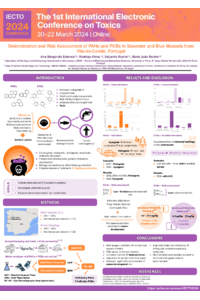
Ana Esteves Poster.pdf
A historical drug or a current problem? Determination of methaqualone and its analogs in biological material via UHPLC-QqQ-MS/MS
Target Analysis and Suspect Screening of Per- and Polyfluoroalkyl Substances in Tap Water Samples throughout Chinese Cities