Event submissions
Published
This submission belongs to the session A. Environmental Contaminants and Health of the event The 1st International Electronic Conference on Toxics
Published date
03 Apr, 2024
Academic Editor
'%3e%3cpath%20d='M12.6657%2010.9104C12.4185%2010.325%2012.0599%209.79327%2011.6097%209.34482C11.1609%208.89508%2010.6293%208.5365%2010.0442%208.28888C10.0389%208.28626%2010.0337%208.28495%2010.0285%208.28233C10.8446%207.69279%2011.3752%206.73249%2011.3752%205.64904C11.3752%203.8542%209.92103%202.39999%208.1262%202.39999C6.33136%202.39999%204.87715%203.8542%204.87715%205.64904C4.87715%206.73249%205.40774%207.69279%206.22393%208.28364C6.21869%208.28626%206.21345%208.28757%206.20821%208.29019C5.62129%208.5378%205.09463%208.89284%204.64265%209.34613C4.1929%209.79493%203.83432%2010.3266%203.58671%2010.9117C3.34345%2011.4845%203.21226%2012.0987%203.20023%2012.7209C3.19988%2012.7349%203.20233%2012.7488%203.20744%2012.7619C3.21255%2012.7749%203.22022%2012.7867%203.22998%2012.7968C3.23975%2012.8068%203.25142%2012.8147%203.26431%2012.8202C3.2772%2012.8256%203.29105%2012.8284%203.30504%2012.8284H4.09109C4.14874%2012.8284%204.19459%2012.7825%204.1959%2012.7262C4.2221%2011.7148%204.62823%2010.7676%205.34617%2010.0497C6.08899%209.30683%207.0755%208.89808%208.1262%208.89808C9.17689%208.89808%2010.1634%209.30683%2010.9062%2010.0497C11.6242%2010.7676%2012.0303%2011.7148%2012.0565%2012.7262C12.0578%2012.7838%2012.1037%2012.8284%2012.1613%2012.8284H12.9474C12.9613%2012.8284%2012.9752%2012.8256%2012.9881%2012.8202C13.001%2012.8147%2013.0126%2012.8068%2013.0224%2012.7968C13.0322%2012.7867%2013.0398%2012.7749%2013.0449%2012.7619C13.0501%2012.7488%2013.0525%2012.7349%2013.0522%2012.7209C13.0391%2012.0947%2012.9094%2011.4855%2012.6657%2010.9104ZM8.1262%207.9024C7.52486%207.9024%206.9589%207.6679%206.53312%207.24211C6.10733%206.81633%205.87283%206.25037%205.87283%205.64904C5.87283%205.0477%206.10733%204.48174%206.53312%204.05596C6.9589%203.63018%207.52486%203.39567%208.1262%203.39567C8.72753%203.39567%209.29349%203.63018%209.71927%204.05596C10.1451%204.48174%2010.3796%205.0477%2010.3796%205.64904C10.3796%206.25037%2010.1451%206.81633%209.71927%207.24211C9.29349%207.6679%208.72753%207.9024%208.1262%207.9024Z'%20fill='%235D1EE1'/%3e%3c/g%3e%3c/svg%3e) Yankai Xia
Yankai XiaCitation
Rita Couto, Beatriz Cunha, Eduardo Rocha, Fernada Malhão, Is tamoxifen cytotoxicity against breast cancer cells influenced by xenoestrogens?, in Proceedings of The 1st International Electronic Conference on Toxics, 20 March–22 March 2024, MDPI: Basel, Switzerland
Share
Email
Facebook
Twitter
LinkedIn
Is tamoxifen cytotoxicity against breast cancer cells influenced by xenoestrogens?
'%3e%3cpath%20d='M12.6647%2010.9104C12.4176%2010.325%2012.0589%209.7933%2011.6088%209.34485C11.16%208.89511%2010.6283%208.53653%2010.0432%208.28891C10.038%208.28629%2010.0327%208.28498%2010.0275%208.28236C10.8437%207.69282%2011.3743%206.73252%2011.3743%205.64907C11.3743%203.85423%209.92005%202.40002%208.12522%202.40002C6.33038%202.40002%204.87618%203.85423%204.87618%205.64907C4.87618%206.73252%205.40677%207.69282%206.22296%208.28367C6.21772%208.28629%206.21248%208.2876%206.20724%208.29022C5.62031%208.53783%205.09365%208.89287%204.64167%209.34616C4.19192%209.79496%203.83334%2010.3266%203.58573%2010.9117C3.34247%2011.4846%203.21128%2012.0987%203.19925%2012.721C3.1989%2012.735%203.20135%2012.7489%203.20646%2012.7619C3.21157%2012.7749%203.21924%2012.7868%203.22901%2012.7968C3.23877%2012.8068%203.25045%2012.8148%203.26334%2012.8202C3.27623%2012.8256%203.29007%2012.8284%203.30406%2012.8284H4.09012C4.14776%2012.8284%204.19362%2012.7825%204.19493%2012.7262C4.22113%2011.7148%204.62726%2010.7676%205.34519%2010.0497C6.08802%209.30686%207.07452%208.89811%208.12522%208.89811C9.17592%208.89811%2010.1624%209.30686%2010.9052%2010.0497C11.6232%2010.7676%2012.0293%2011.7148%2012.0555%2012.7262C12.0568%2012.7839%2012.1027%2012.8284%2012.1603%2012.8284H12.9464C12.9604%2012.8284%2012.9742%2012.8256%2012.9871%2012.8202C13%2012.8148%2013.0117%2012.8068%2013.0214%2012.7968C13.0312%2012.7868%2013.0389%2012.7749%2013.044%2012.7619C13.0491%2012.7489%2013.0515%2012.735%2013.0512%2012.721C13.0381%2012.0947%2012.9084%2011.4856%2012.6647%2010.9104ZM8.12522%207.90243C7.52388%207.90243%206.95792%207.66793%206.53214%207.24215C6.10636%206.81636%205.87185%206.2504%205.87185%205.64907C5.87185%205.04773%206.10636%204.48177%206.53214%204.05599C6.95792%203.63021%207.52388%203.3957%208.12522%203.3957C8.72655%203.3957%209.29252%203.63021%209.7183%204.05599C10.1441%204.48177%2010.3786%205.04773%2010.3786%205.64907C10.3786%206.2504%2010.1441%206.81636%209.7183%207.24215C9.29252%207.66793%208.72655%207.90243%208.12522%207.90243Z'%20fill='%235D1EE1'/%3e%3c/g%3e%3c/svg%3e)
Rita Couto 1
Beatriz Cunha 2

Eduardo Rocha 1

Fernada Malhão 2
1. Laboratory of Histology and Embryology, Department of Microscopy, ICBAS – School of Medicine and Biomedical Sciences, University of Porto (U.Porto), Rua Jorge Viterbo Ferreira 228, 4050-313 Porto, Portugal.
Team of Animal Morphology and Toxicology, CIIM
2. Laboratory of Histology and Embryology, Department of Microscopy, ICBAS – School of Medicine and Biomedical Sciences, University of Porto (U.Porto), Rua Jorge Viterbo Ferreira 228, 4050-313 Porto, Portugal. Team of Animal Morphology and Toxicology, CIIMAR
Abstract
Tamoxifen (TAM) is a chemical widely used in hormone therapy to treat hormone receptor-positive breast cancer (BC). Humans are regularly exposed to xenoestrogens, i.e., chemicals like bisphenol A (BPA) and endosulfan (END), which mimic the natural endogenous estrogens in many pathways and may potentiate (at least in theory) BC risk. BPA is one of the most produced chemicals worldwide used in polycarbonate plastic in food and drink packaging. END is an organochlorine pesticide that, although considered probable and carcinogenic to humans, is still illegally used in some countries. Both xenoestrogens share similar routes of exposure to humans through ingestion, and we wonder if such exposure may model the TAM impacts against BC cells. Therefore, in this study, we aimed to investigate the in vitro cytotoxicity effects of TAM, BPA, and END in single exposures, followed by the effects of co-exposures (TAM+BPA and TAM+END) on the MCF7 cell line (representative of hormone-positive BC). We intended to study the impact of TAM's therapy outcome in ER-positive BC cells when simultaneously exposed to the referred xenoestrogens. The cytotoxic effects were assessed by MTT and SRB assays, and cells' morphology rates were monitored and photographed during the experiments. Overall, TAM, BPA, and END showed a reduction in cell viability relative to the control. The combinations of TAM with BPA and END showed a statistically significant decrease in cell viability compared to the control and the compounds alone. The results support the notion that BPA and END can be cytotoxic to MCF7 alone but also interfere with the TAM effects. The current data call for further research in order to investigate the modulation of these ubiquitous and xenoestrogenic pollutants over established endocrine therapies for BC.
Keywords
mammary cancer
bisphenol A
endosulfan
estrogen-receptor inhibitors
MCF7 cells
Poster
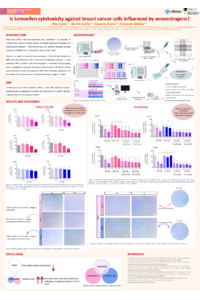
Electronic conference Toxics poster-Rita Couto.pdf
Neurotoxicity of valproic acid in wistar rats : effects on memory
Unravelling the effects of benzo[k]fluoranthene and temperature on the expression of detoxification genes in the rainbow trout liver RTL-W1 cell line