Event submissions
Published
This submission belongs to the session A. Environmental Contaminants and Health of the event The 1st International Electronic Conference on Toxics
Published date
03 Apr, 2024
Academic Editor
'%3e%3cpath%20d='M12.6657%2010.9104C12.4185%2010.325%2012.0599%209.79327%2011.6097%209.34482C11.1609%208.89508%2010.6293%208.5365%2010.0442%208.28888C10.0389%208.28626%2010.0337%208.28495%2010.0285%208.28233C10.8446%207.69279%2011.3752%206.73249%2011.3752%205.64904C11.3752%203.8542%209.92103%202.39999%208.1262%202.39999C6.33136%202.39999%204.87715%203.8542%204.87715%205.64904C4.87715%206.73249%205.40774%207.69279%206.22393%208.28364C6.21869%208.28626%206.21345%208.28757%206.20821%208.29019C5.62129%208.5378%205.09463%208.89284%204.64265%209.34613C4.1929%209.79493%203.83432%2010.3266%203.58671%2010.9117C3.34345%2011.4845%203.21226%2012.0987%203.20023%2012.7209C3.19988%2012.7349%203.20233%2012.7488%203.20744%2012.7619C3.21255%2012.7749%203.22022%2012.7867%203.22998%2012.7968C3.23975%2012.8068%203.25142%2012.8147%203.26431%2012.8202C3.2772%2012.8256%203.29105%2012.8284%203.30504%2012.8284H4.09109C4.14874%2012.8284%204.19459%2012.7825%204.1959%2012.7262C4.2221%2011.7148%204.62823%2010.7676%205.34617%2010.0497C6.08899%209.30683%207.0755%208.89808%208.1262%208.89808C9.17689%208.89808%2010.1634%209.30683%2010.9062%2010.0497C11.6242%2010.7676%2012.0303%2011.7148%2012.0565%2012.7262C12.0578%2012.7838%2012.1037%2012.8284%2012.1613%2012.8284H12.9474C12.9613%2012.8284%2012.9752%2012.8256%2012.9881%2012.8202C13.001%2012.8147%2013.0126%2012.8068%2013.0224%2012.7968C13.0322%2012.7867%2013.0398%2012.7749%2013.0449%2012.7619C13.0501%2012.7488%2013.0525%2012.7349%2013.0522%2012.7209C13.0391%2012.0947%2012.9094%2011.4855%2012.6657%2010.9104ZM8.1262%207.9024C7.52486%207.9024%206.9589%207.6679%206.53312%207.24211C6.10733%206.81633%205.87283%206.25037%205.87283%205.64904C5.87283%205.0477%206.10733%204.48174%206.53312%204.05596C6.9589%203.63018%207.52486%203.39567%208.1262%203.39567C8.72753%203.39567%209.29349%203.63018%209.71927%204.05596C10.1451%204.48174%2010.3796%205.0477%2010.3796%205.64904C10.3796%206.25037%2010.1451%206.81633%209.71927%207.24211C9.29349%207.6679%208.72753%207.9024%208.1262%207.9024Z'%20fill='%235D1EE1'/%3e%3c/g%3e%3c/svg%3e) Yankai Xia
Yankai XiaCitation
Varvara Maksimova, Anzhelika Bukina, Guzel Khayrieva, Valeriia Popova, Marianna Yakubovskaya, Kirill Kirsanov, Thiram Effects on HeLa TI Cells, in Proceedings of The 1st International Electronic Conference on Toxics, 20 March–22 March 2024, MDPI: Basel, Switzerland
Share
Email
Facebook
Twitter
LinkedIn
Thiram Effects on HeLa TI Cells
'%3e%3cpath%20d='M12.6647%2010.9104C12.4176%2010.325%2012.0589%209.7933%2011.6088%209.34485C11.16%208.89511%2010.6283%208.53653%2010.0432%208.28891C10.038%208.28629%2010.0327%208.28498%2010.0275%208.28236C10.8437%207.69282%2011.3743%206.73252%2011.3743%205.64907C11.3743%203.85423%209.92005%202.40002%208.12522%202.40002C6.33038%202.40002%204.87618%203.85423%204.87618%205.64907C4.87618%206.73252%205.40677%207.69282%206.22296%208.28367C6.21772%208.28629%206.21248%208.2876%206.20724%208.29022C5.62031%208.53783%205.09365%208.89287%204.64167%209.34616C4.19192%209.79496%203.83334%2010.3266%203.58573%2010.9117C3.34247%2011.4846%203.21128%2012.0987%203.19925%2012.721C3.1989%2012.735%203.20135%2012.7489%203.20646%2012.7619C3.21157%2012.7749%203.21924%2012.7868%203.22901%2012.7968C3.23877%2012.8068%203.25045%2012.8148%203.26334%2012.8202C3.27623%2012.8256%203.29007%2012.8284%203.30406%2012.8284H4.09012C4.14776%2012.8284%204.19362%2012.7825%204.19493%2012.7262C4.22113%2011.7148%204.62726%2010.7676%205.34519%2010.0497C6.08802%209.30686%207.07452%208.89811%208.12522%208.89811C9.17592%208.89811%2010.1624%209.30686%2010.9052%2010.0497C11.6232%2010.7676%2012.0293%2011.7148%2012.0555%2012.7262C12.0568%2012.7839%2012.1027%2012.8284%2012.1603%2012.8284H12.9464C12.9604%2012.8284%2012.9742%2012.8256%2012.9871%2012.8202C13%2012.8148%2013.0117%2012.8068%2013.0214%2012.7968C13.0312%2012.7868%2013.0389%2012.7749%2013.044%2012.7619C13.0491%2012.7489%2013.0515%2012.735%2013.0512%2012.721C13.0381%2012.0947%2012.9084%2011.4856%2012.6647%2010.9104ZM8.12522%207.90243C7.52388%207.90243%206.95792%207.66793%206.53214%207.24215C6.10636%206.81636%205.87185%206.2504%205.87185%205.64907C5.87185%205.04773%206.10636%204.48177%206.53214%204.05599C6.95792%203.63021%207.52388%203.3957%208.12522%203.3957C8.72655%203.3957%209.29252%203.63021%209.7183%204.05599C10.1441%204.48177%2010.3786%205.04773%2010.3786%205.64907C10.3786%206.2504%2010.1441%206.81636%209.7183%207.24215C9.29252%207.66793%208.72655%207.90243%208.12522%207.90243Z'%20fill='%235D1EE1'/%3e%3c/g%3e%3c/svg%3e)
Varvara Maksimova 1
Anzhelika Bukina 1,2
Guzel Khayrieva 3
Valeriia Popova 1
Marianna Yakubovskaya 1
Kirill Kirsanov 1
1. N.N. Blokhin National Medical Research Center of Oncology, 115478 Moscow, Russia
2. Lomonosov Institute of Fine Chemical Technologies, MIREA—Russian Technological University, 86 Vernadsky Ave., 119571 Moscow, Russia
3. I.M. Sechenov First Moscow State Medical University, 8-2 Trubetskaya Str., 119991 Moscow, Russia
Abstract
Introduction
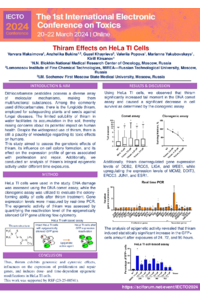
Dithiocarbamate pesticides possess a diverse array of molecular mechanisms, making them multifunctional substances. Among the commonly used dithiocarbamates, there is the fungicide thiram, employed for safeguarding plants and seeds against fungal diseases. The limited solubility of thiram in water facilitates its accumulation in the soil, thereby raising concerns about its potential impact on human health. Despite the widespread use of thiram, there is still a paucity of knowledge regarding its toxic effects on humans. This study aimed to assess the genotoxic effects of thiram, its influence on cell colony formation, and its effect on the expression profile of genes associated with proliferation and repair. Additionally, we conducted an analysis of thiram's integral epigenetic activity under different time exposures.
Materials and methods
HeLa TI cells were used in this study. DNA damage was assessed using the DNA comet assay, while the clonogenic assay was utilized to evaluate the colony-forming ability of cells after thiram treatment. Gene expression levels were measured using real-time PCR. The epigenetic activity of thiram was assessed by quantifying the reactivation level of the epigenetically silenced GFP gene utilizing flow cytometry.
Results
Using HeLa TI cells, we observed that thiram significantly increased tail moment in the DNA comet assay and caused a significant decrease in cell survival as determined by the clonogenic assay. Additionally, thiram downregulated the gene expression levels of DDB2, ERCC5, LIG4, and WEE1, while upregulating the expression levels of MCM2, DDIT3, ERCC3, JUN1, and ESR1. The analysis of epigenetic activity revealed that thiram induced a statistically significant increase in the GFP+ cells amount after exposures of 24, 72, and 96 hours.
Conclusion
Thus, thiram exhibits genotoxic and cytotoxic effects, influences the expression of proliferation and repair genes, and induces dose- and time-dependent epigenetic modifications in HeLa TI cells. This work was supported by RSF (23-25-00541).
Keywords
thiram
pesticide
HeLa TI cells
DNA damage
colony formation
proliferation
epigenetic activity
Poster
Toxics_VM_1.pdf
Global measures to stop the exportation of Highly Hazardous Pesticides from the EU to Developing Countries
Hormonal and sperm changes in rats treated with valproic acid