Event submissions
Published
This submission belongs to the session B. Drugs Toxicity and Safety of the event The 1st International Electronic Conference on Toxics
Published date
03 Apr, 2024
Academic Editor
'%3e%3cpath%20d='M12.6657%2010.9104C12.4185%2010.325%2012.0599%209.79327%2011.6097%209.34482C11.1609%208.89508%2010.6293%208.5365%2010.0442%208.28888C10.0389%208.28626%2010.0337%208.28495%2010.0285%208.28233C10.8446%207.69279%2011.3752%206.73249%2011.3752%205.64904C11.3752%203.8542%209.92103%202.39999%208.1262%202.39999C6.33136%202.39999%204.87715%203.8542%204.87715%205.64904C4.87715%206.73249%205.40774%207.69279%206.22393%208.28364C6.21869%208.28626%206.21345%208.28757%206.20821%208.29019C5.62129%208.5378%205.09463%208.89284%204.64265%209.34613C4.1929%209.79493%203.83432%2010.3266%203.58671%2010.9117C3.34345%2011.4845%203.21226%2012.0987%203.20023%2012.7209C3.19988%2012.7349%203.20233%2012.7488%203.20744%2012.7619C3.21255%2012.7749%203.22022%2012.7867%203.22998%2012.7968C3.23975%2012.8068%203.25142%2012.8147%203.26431%2012.8202C3.2772%2012.8256%203.29105%2012.8284%203.30504%2012.8284H4.09109C4.14874%2012.8284%204.19459%2012.7825%204.1959%2012.7262C4.2221%2011.7148%204.62823%2010.7676%205.34617%2010.0497C6.08899%209.30683%207.0755%208.89808%208.1262%208.89808C9.17689%208.89808%2010.1634%209.30683%2010.9062%2010.0497C11.6242%2010.7676%2012.0303%2011.7148%2012.0565%2012.7262C12.0578%2012.7838%2012.1037%2012.8284%2012.1613%2012.8284H12.9474C12.9613%2012.8284%2012.9752%2012.8256%2012.9881%2012.8202C13.001%2012.8147%2013.0126%2012.8068%2013.0224%2012.7968C13.0322%2012.7867%2013.0398%2012.7749%2013.0449%2012.7619C13.0501%2012.7488%2013.0525%2012.7349%2013.0522%2012.7209C13.0391%2012.0947%2012.9094%2011.4855%2012.6657%2010.9104ZM8.1262%207.9024C7.52486%207.9024%206.9589%207.6679%206.53312%207.24211C6.10733%206.81633%205.87283%206.25037%205.87283%205.64904C5.87283%205.0477%206.10733%204.48174%206.53312%204.05596C6.9589%203.63018%207.52486%203.39567%208.1262%203.39567C8.72753%203.39567%209.29349%203.63018%209.71927%204.05596C10.1451%204.48174%2010.3796%205.0477%2010.3796%205.64904C10.3796%206.25037%2010.1451%206.81633%209.71927%207.24211C9.29349%207.6679%208.72753%207.9024%208.1262%207.9024Z'%20fill='%235D1EE1'/%3e%3c/g%3e%3c/svg%3e) Youssef Sari
Youssef SariCitation
Kevin Castillo-Mendieta, Yovani Marrero-Ponce, Guillermin Agüero-Chapin, Mariela Perez Cardenas, In Silico Discovery of Hemolytic Peptides Through a Novel Approach Based on Network Science and Similarity Searching Methods, in Proceedings of The 1st International Electronic Conference on Toxics, 20 March–22 March 2024, MDPI: Basel, Switzerland
Share
Email
Facebook
Twitter
LinkedIn
In Silico Discovery of Hemolytic Peptides Through a Novel Approach Based on Network Science and Similarity Searching Methods

Kevin Castillo-Mendieta 1

Yovani Marrero-Ponce 2

Guillermin Agüero-Chapin 3
'%3e%3cpath%20d='M12.6647%2010.9104C12.4176%2010.325%2012.0589%209.7933%2011.6088%209.34485C11.16%208.89511%2010.6283%208.53653%2010.0432%208.28891C10.038%208.28629%2010.0327%208.28498%2010.0275%208.28236C10.8437%207.69282%2011.3743%206.73252%2011.3743%205.64907C11.3743%203.85423%209.92005%202.40002%208.12522%202.40002C6.33038%202.40002%204.87618%203.85423%204.87618%205.64907C4.87618%206.73252%205.40677%207.69282%206.22296%208.28367C6.21772%208.28629%206.21248%208.2876%206.20724%208.29022C5.62031%208.53783%205.09365%208.89287%204.64167%209.34616C4.19192%209.79496%203.83334%2010.3266%203.58573%2010.9117C3.34247%2011.4846%203.21128%2012.0987%203.19925%2012.721C3.1989%2012.735%203.20135%2012.7489%203.20646%2012.7619C3.21157%2012.7749%203.21924%2012.7868%203.22901%2012.7968C3.23877%2012.8068%203.25045%2012.8148%203.26334%2012.8202C3.27623%2012.8256%203.29007%2012.8284%203.30406%2012.8284H4.09012C4.14776%2012.8284%204.19362%2012.7825%204.19493%2012.7262C4.22113%2011.7148%204.62726%2010.7676%205.34519%2010.0497C6.08802%209.30686%207.07452%208.89811%208.12522%208.89811C9.17592%208.89811%2010.1624%209.30686%2010.9052%2010.0497C11.6232%2010.7676%2012.0293%2011.7148%2012.0555%2012.7262C12.0568%2012.7839%2012.1027%2012.8284%2012.1603%2012.8284H12.9464C12.9604%2012.8284%2012.9742%2012.8256%2012.9871%2012.8202C13%2012.8148%2013.0117%2012.8068%2013.0214%2012.7968C13.0312%2012.7868%2013.0389%2012.7749%2013.044%2012.7619C13.0491%2012.7489%2013.0515%2012.735%2013.0512%2012.721C13.0381%2012.0947%2012.9084%2011.4856%2012.6647%2010.9104ZM8.12522%207.90243C7.52388%207.90243%206.95792%207.66793%206.53214%207.24215C6.10636%206.81636%205.87185%206.2504%205.87185%205.64907C5.87185%205.04773%206.10636%204.48177%206.53214%204.05599C6.95792%203.63021%207.52388%203.3957%208.12522%203.3957C8.72655%203.3957%209.29252%203.63021%209.7183%204.05599C10.1441%204.48177%2010.3786%205.04773%2010.3786%205.64907C10.3786%206.2504%2010.1441%206.81636%209.7183%207.24215C9.29252%207.66793%208.72655%207.90243%208.12522%207.90243Z'%20fill='%235D1EE1'/%3e%3c/g%3e%3c/svg%3e)
Mariela Perez Cardenas 1
1. School of Biological Sciences and Engineering, Yachay Tech University, Hda. San José s/n y Proyecto Yachay, Urcuquí 100119, Ecuador.
2. Universidad San Francisco de Quito (USFQ), Grupo de Medicina Molecular y Traslacional (MeM&T), Colegio de Ciencias de la Salud (COCSA), Escuela de Medicina, Edificio de Especialidades Médicas; and Instituto de Simulación Computacional (ISC-USFQ), Diego de
3. CIIMAR, Centro Interdisciplinar de Investigação Marinha e Ambiental Universidade do Porto. Terminal de Cruzeiros do Porto de Leixões. Av. General Norton de Matos s/n, 4450-208 Matosinhos, Portugal
Abstract
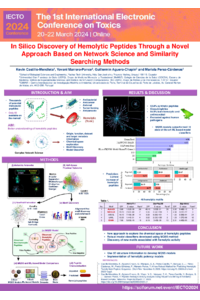
Peptides are promising drug development frameworks thanks to their high target selectivity, tolerability, and relatively low production cost. However, despite the fact that several thousand potentially therapeutic peptides have been reported, until 2018, only about sixty had been approved in the United States, Europe, and Japan. Toxic effects, including hemolysis, have been identified as the primary challenge that hinders the development of promising peptide drugs. To overcome this obstacle, we propose a novel approach based on complex network science, interactive data mining, and multi-query similarity searching (MQSS) to gain a better understanding of the chemical space of hemolytic peptides. By leveraging these techniques, we aim to design more effective peptide drugs with reduced hemolytic activity, thus facilitating the development of safer and more efficient therapies. Metadata networks (METNs) were used to systematically identify and characterize general patterns that are commonly associated with hemolytic peptides. In addition, half-space proximal networks (HSPNs) were constructed using five different two-way dissimilarity measures with the aim of effectively representing the hemolytic peptide space. Then, the best candidate HSPNs were used to extract various scaffolds that capture information on almost the entire chemical space while avoiding peptide overrepresentation. These scaffolds were used to develop MQSS models for predicting the hemolytic toxicity of peptide sequences. Our best model outperformed state-of-the-art machine learning (ML)-based models, achieving an MCC equal to 0.99. This model was used to characterize the prevalence of hemolytic toxicity on therapeutic peptides. We found that the number of reported hemolytic peptides might be 3.9-fold lower than their actual number. Finally, by means of an alignment-free approach, we reported 47 putative hemolytic motifs, which might provide hints about the mechanisms of hemolysis and can also be used as toxic signatures when developing novel peptide-based drugs.
Keywords
hemolytic peptide
complex networks
network science
HSPN
visual mining
similarity searching
In silico drug discovery
motif discovery
cluster analysis
similarity metric
StarPep toolbox.
Poster
Castillo-Mendieta_Kevin.pdf
Self-poisonings by use of ‘suicide kits’ and a ‘home-made’ multi-xenobiotics mixes: are they a growing problem in forensic toxicology?
Assessment of Chemical Hazards in Herbs consumed in Europe: Toxins, Heavy Metals, and Pesticide Residues