Event submissions
Published
This submission belongs to the session B. Drugs Toxicity and Safety of the event The 1st International Electronic Conference on Toxics
Published date
03 Apr, 2024
Academic Editor
'%3e%3cpath%20d='M12.6657%2010.9104C12.4185%2010.325%2012.0599%209.79327%2011.6097%209.34482C11.1609%208.89508%2010.6293%208.5365%2010.0442%208.28888C10.0389%208.28626%2010.0337%208.28495%2010.0285%208.28233C10.8446%207.69279%2011.3752%206.73249%2011.3752%205.64904C11.3752%203.8542%209.92103%202.39999%208.1262%202.39999C6.33136%202.39999%204.87715%203.8542%204.87715%205.64904C4.87715%206.73249%205.40774%207.69279%206.22393%208.28364C6.21869%208.28626%206.21345%208.28757%206.20821%208.29019C5.62129%208.5378%205.09463%208.89284%204.64265%209.34613C4.1929%209.79493%203.83432%2010.3266%203.58671%2010.9117C3.34345%2011.4845%203.21226%2012.0987%203.20023%2012.7209C3.19988%2012.7349%203.20233%2012.7488%203.20744%2012.7619C3.21255%2012.7749%203.22022%2012.7867%203.22998%2012.7968C3.23975%2012.8068%203.25142%2012.8147%203.26431%2012.8202C3.2772%2012.8256%203.29105%2012.8284%203.30504%2012.8284H4.09109C4.14874%2012.8284%204.19459%2012.7825%204.1959%2012.7262C4.2221%2011.7148%204.62823%2010.7676%205.34617%2010.0497C6.08899%209.30683%207.0755%208.89808%208.1262%208.89808C9.17689%208.89808%2010.1634%209.30683%2010.9062%2010.0497C11.6242%2010.7676%2012.0303%2011.7148%2012.0565%2012.7262C12.0578%2012.7838%2012.1037%2012.8284%2012.1613%2012.8284H12.9474C12.9613%2012.8284%2012.9752%2012.8256%2012.9881%2012.8202C13.001%2012.8147%2013.0126%2012.8068%2013.0224%2012.7968C13.0322%2012.7867%2013.0398%2012.7749%2013.0449%2012.7619C13.0501%2012.7488%2013.0525%2012.7349%2013.0522%2012.7209C13.0391%2012.0947%2012.9094%2011.4855%2012.6657%2010.9104ZM8.1262%207.9024C7.52486%207.9024%206.9589%207.6679%206.53312%207.24211C6.10733%206.81633%205.87283%206.25037%205.87283%205.64904C5.87283%205.0477%206.10733%204.48174%206.53312%204.05596C6.9589%203.63018%207.52486%203.39567%208.1262%203.39567C8.72753%203.39567%209.29349%203.63018%209.71927%204.05596C10.1451%204.48174%2010.3796%205.0477%2010.3796%205.64904C10.3796%206.25037%2010.1451%206.81633%209.71927%207.24211C9.29349%207.6679%208.72753%207.9024%208.1262%207.9024Z'%20fill='%235D1EE1'/%3e%3c/g%3e%3c/svg%3e) Youssef Sari
Youssef SariCitation
M. Carpena, P. Barciela, A. Perez-Vazquez, K. Noras, J. Trafiałek, M. A. Prieto, M. Trząskowska, Assessment of Chemical Hazards in Herbs consumed in Europe: Toxins, Heavy Metals, and Pesticide Residues, in Proceedings of The 1st International Electronic Conference on Toxics, 20 March–22 March 2024, MDPI: Basel, Switzerland
Share
Email
Facebook
Twitter
LinkedIn
Assessment of Chemical Hazards in Herbs consumed in Europe: Toxins, Heavy Metals, and Pesticide Residues

M. Carpena 1

P. Barciela 1
'%3e%3cpath%20d='M12.6647%2010.9104C12.4176%2010.325%2012.0589%209.7933%2011.6088%209.34485C11.16%208.89511%2010.6283%208.53653%2010.0432%208.28891C10.038%208.28629%2010.0327%208.28498%2010.0275%208.28236C10.8437%207.69282%2011.3743%206.73252%2011.3743%205.64907C11.3743%203.85423%209.92005%202.40002%208.12522%202.40002C6.33038%202.40002%204.87618%203.85423%204.87618%205.64907C4.87618%206.73252%205.40677%207.69282%206.22296%208.28367C6.21772%208.28629%206.21248%208.2876%206.20724%208.29022C5.62031%208.53783%205.09365%208.89287%204.64167%209.34616C4.19192%209.79496%203.83334%2010.3266%203.58573%2010.9117C3.34247%2011.4846%203.21128%2012.0987%203.19925%2012.721C3.1989%2012.735%203.20135%2012.7489%203.20646%2012.7619C3.21157%2012.7749%203.21924%2012.7868%203.22901%2012.7968C3.23877%2012.8068%203.25045%2012.8148%203.26334%2012.8202C3.27623%2012.8256%203.29007%2012.8284%203.30406%2012.8284H4.09012C4.14776%2012.8284%204.19362%2012.7825%204.19493%2012.7262C4.22113%2011.7148%204.62726%2010.7676%205.34519%2010.0497C6.08802%209.30686%207.07452%208.89811%208.12522%208.89811C9.17592%208.89811%2010.1624%209.30686%2010.9052%2010.0497C11.6232%2010.7676%2012.0293%2011.7148%2012.0555%2012.7262C12.0568%2012.7839%2012.1027%2012.8284%2012.1603%2012.8284H12.9464C12.9604%2012.8284%2012.9742%2012.8256%2012.9871%2012.8202C13%2012.8148%2013.0117%2012.8068%2013.0214%2012.7968C13.0312%2012.7868%2013.0389%2012.7749%2013.044%2012.7619C13.0491%2012.7489%2013.0515%2012.735%2013.0512%2012.721C13.0381%2012.0947%2012.9084%2011.4856%2012.6647%2010.9104ZM8.12522%207.90243C7.52388%207.90243%206.95792%207.66793%206.53214%207.24215C6.10636%206.81636%205.87185%206.2504%205.87185%205.64907C5.87185%205.04773%206.10636%204.48177%206.53214%204.05599C6.95792%203.63021%207.52388%203.3957%208.12522%203.3957C8.72655%203.3957%209.29252%203.63021%209.7183%204.05599C10.1441%204.48177%2010.3786%205.04773%2010.3786%205.64907C10.3786%206.2504%2010.1441%206.81636%209.7183%207.24215C9.29252%207.66793%208.72655%207.90243%208.12522%207.90243Z'%20fill='%235D1EE1'/%3e%3c/g%3e%3c/svg%3e)
A. Perez-Vazquez 1
K. Noras 2

J. Trafiałek 3

M. A. Prieto 1

M. Trząskowska 3
1. Universidade de Vigo, Nutrition and Bromatology Group, Department of Analytical Chemistry and Food Science, Instituto de Agroecoloxía e Alimentación (IAA) – CITEXVI, 36310 Vigo, España.
2. Department of Biometry, Institute of Agriculture, Warsaw University of Life Sciences–SGGW, Nowoursynowska 159 St., 02-776 Warsaw, Poland.
3. Department of Food Gastronomy and Food Hygiene, Institute of Human Nutrition Sciences, Warsaw University of Life Sciences–SGGW, Nowoursynowska 159 St., 02-776 Warsaw, Poland.
Abstract
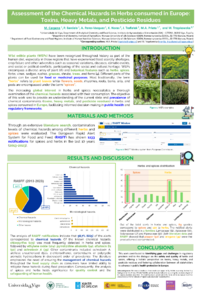
The increasing global interest in herbs and spices necessitates a thorough examination of chemical hazards associated with their consumption. The objective of this work was to provide an understanding of the current state and prevalence of chemical contaminants (toxins, heavy metals, and pesticide residues) in herbs and spices consumed in Europe, facilitating informed decision making in public health and regulatory frameworks [1].
Through an extensive literature search, the contamination levels of chemical hazards among different herbs and spices were evaluated. The European Rapid Alert System for Food and Feed (RASFF) has shown 1133 notifications for spices and herbs in the last 10 years (2013-2023). Focusing on the chemical hazards associated with the consumption of these products, mycotoxins (especially aflatoxins and ochratoxin A) and plant-derived compounds with potential health implications (e.g., pyrrolizidine alkaloids) were the most often notified. Nevertheless, besides these naturally occurring compounds, other deliberated substances such as artificial unauthorized dyes (e.g., Sudan I, II, III, and IV) that can pose a human health risk have been identified. Finally, environmental contaminants could be also present in herbs and spices. Pesticide residues (e.g., chlorpyrifos, carbendazim, and bifenthrin) have been notified and studies on their persistence and adherence to regulatory limits and heavy metals were also investigated focusing on cadmium, lead, and mercury due to the bioaccumulation abilities of plants. Other environmental contaminants such as dioxins and dioxin-like polychlorinated biphenyls (dl-PCBs) and polycyclic aromatic hydrocarbons (PAHs) were considered for the study.
In conclusion, this work contributed to identifying gaps and challenges in regulatory practices and to provide a dialogue on the safety and quality of herbs and spices, offering a holistic perspective on toxins, heavy metals, and pesticide residues and fostering collaboration between all stakeholders to advance public health protection in Europe.
Keywords
herbs
toxins
heavy metals
pesticide residues
risk assessment.
Poster
IECTO_2024.pdf
In Silico Discovery of Hemolytic Peptides Through a Novel Approach Based on Network Science and Similarity Searching Methods
Effects of subchronic methylmercury exposure on response to acute hypoxia in mice: role of HIF-1α