Event submissions
Published
This submission belongs to the session A. Environmental Contaminants and Health of the event The 1st International Electronic Conference on Toxics
Published date
03 Apr, 2024
Academic Editor
'%3e%3cpath%20d='M12.6657%2010.9104C12.4185%2010.325%2012.0599%209.79327%2011.6097%209.34482C11.1609%208.89508%2010.6293%208.5365%2010.0442%208.28888C10.0389%208.28626%2010.0337%208.28495%2010.0285%208.28233C10.8446%207.69279%2011.3752%206.73249%2011.3752%205.64904C11.3752%203.8542%209.92103%202.39999%208.1262%202.39999C6.33136%202.39999%204.87715%203.8542%204.87715%205.64904C4.87715%206.73249%205.40774%207.69279%206.22393%208.28364C6.21869%208.28626%206.21345%208.28757%206.20821%208.29019C5.62129%208.5378%205.09463%208.89284%204.64265%209.34613C4.1929%209.79493%203.83432%2010.3266%203.58671%2010.9117C3.34345%2011.4845%203.21226%2012.0987%203.20023%2012.7209C3.19988%2012.7349%203.20233%2012.7488%203.20744%2012.7619C3.21255%2012.7749%203.22022%2012.7867%203.22998%2012.7968C3.23975%2012.8068%203.25142%2012.8147%203.26431%2012.8202C3.2772%2012.8256%203.29105%2012.8284%203.30504%2012.8284H4.09109C4.14874%2012.8284%204.19459%2012.7825%204.1959%2012.7262C4.2221%2011.7148%204.62823%2010.7676%205.34617%2010.0497C6.08899%209.30683%207.0755%208.89808%208.1262%208.89808C9.17689%208.89808%2010.1634%209.30683%2010.9062%2010.0497C11.6242%2010.7676%2012.0303%2011.7148%2012.0565%2012.7262C12.0578%2012.7838%2012.1037%2012.8284%2012.1613%2012.8284H12.9474C12.9613%2012.8284%2012.9752%2012.8256%2012.9881%2012.8202C13.001%2012.8147%2013.0126%2012.8068%2013.0224%2012.7968C13.0322%2012.7867%2013.0398%2012.7749%2013.0449%2012.7619C13.0501%2012.7488%2013.0525%2012.7349%2013.0522%2012.7209C13.0391%2012.0947%2012.9094%2011.4855%2012.6657%2010.9104ZM8.1262%207.9024C7.52486%207.9024%206.9589%207.6679%206.53312%207.24211C6.10733%206.81633%205.87283%206.25037%205.87283%205.64904C5.87283%205.0477%206.10733%204.48174%206.53312%204.05596C6.9589%203.63018%207.52486%203.39567%208.1262%203.39567C8.72753%203.39567%209.29349%203.63018%209.71927%204.05596C10.1451%204.48174%2010.3796%205.0477%2010.3796%205.64904C10.3796%206.25037%2010.1451%206.81633%209.71927%207.24211C9.29349%207.6679%208.72753%207.9024%208.1262%207.9024Z'%20fill='%235D1EE1'/%3e%3c/g%3e%3c/svg%3e) Yankai Xia
Yankai XiaCitation
Ana Fernandez Agudo, Agathi Charistou, Niki Arapaki, Kyriaki Machera, Mercedes Alba Gonzalez, Maria del Carmen Gonzalez Caballero, Jose V. Tarazona Lafarga, Adding Realism to the Assessment of Occupational Exposure to Pesticides Using Probabilistic Modelling. A Case Study on Aggregate Exposure to Pyrethroids., in Proceedings of The 1st International Electronic Conference on Toxics, 20 March–22 March 2024, MDPI: Basel, Switzerland
Share
Email
Facebook
Twitter
LinkedIn
Adding Realism to the Assessment of Occupational Exposure to Pesticides Using Probabilistic Modelling. A Case Study on Aggregate Exposure to Pyrethroids.
'%3e%3cpath%20d='M12.6647%2010.9104C12.4176%2010.325%2012.0589%209.7933%2011.6088%209.34485C11.16%208.89511%2010.6283%208.53653%2010.0432%208.28891C10.038%208.28629%2010.0327%208.28498%2010.0275%208.28236C10.8437%207.69282%2011.3743%206.73252%2011.3743%205.64907C11.3743%203.85423%209.92005%202.40002%208.12522%202.40002C6.33038%202.40002%204.87618%203.85423%204.87618%205.64907C4.87618%206.73252%205.40677%207.69282%206.22296%208.28367C6.21772%208.28629%206.21248%208.2876%206.20724%208.29022C5.62031%208.53783%205.09365%208.89287%204.64167%209.34616C4.19192%209.79496%203.83334%2010.3266%203.58573%2010.9117C3.34247%2011.4846%203.21128%2012.0987%203.19925%2012.721C3.1989%2012.735%203.20135%2012.7489%203.20646%2012.7619C3.21157%2012.7749%203.21924%2012.7868%203.22901%2012.7968C3.23877%2012.8068%203.25045%2012.8148%203.26334%2012.8202C3.27623%2012.8256%203.29007%2012.8284%203.30406%2012.8284H4.09012C4.14776%2012.8284%204.19362%2012.7825%204.19493%2012.7262C4.22113%2011.7148%204.62726%2010.7676%205.34519%2010.0497C6.08802%209.30686%207.07452%208.89811%208.12522%208.89811C9.17592%208.89811%2010.1624%209.30686%2010.9052%2010.0497C11.6232%2010.7676%2012.0293%2011.7148%2012.0555%2012.7262C12.0568%2012.7839%2012.1027%2012.8284%2012.1603%2012.8284H12.9464C12.9604%2012.8284%2012.9742%2012.8256%2012.9871%2012.8202C13%2012.8148%2013.0117%2012.8068%2013.0214%2012.7968C13.0312%2012.7868%2013.0389%2012.7749%2013.044%2012.7619C13.0491%2012.7489%2013.0515%2012.735%2013.0512%2012.721C13.0381%2012.0947%2012.9084%2011.4856%2012.6647%2010.9104ZM8.12522%207.90243C7.52388%207.90243%206.95792%207.66793%206.53214%207.24215C6.10636%206.81636%205.87185%206.2504%205.87185%205.64907C5.87185%205.04773%206.10636%204.48177%206.53214%204.05599C6.95792%203.63021%207.52388%203.3957%208.12522%203.3957C8.72655%203.3957%209.29252%203.63021%209.7183%204.05599C10.1441%204.48177%2010.3786%205.04773%2010.3786%205.64907C10.3786%206.2504%2010.1441%206.81636%209.7183%207.24215C9.29252%207.66793%208.72655%207.90243%208.12522%207.90243Z'%20fill='%235D1EE1'/%3e%3c/g%3e%3c/svg%3e)
Ana Fernandez Agudo 1
Agathi Charistou 2
Niki Arapaki 2
Kyriaki Machera 2
Mercedes Alba Gonzalez 3
Maria del Carmen Gonzalez Caballero 3

Jose V. Tarazona Lafarga 3
1. National Environmental Health Centre. Instituto de Salud Carlos III
2. Benaki Phytopathological Institute
3. National Environmental Health Centre
Abstract
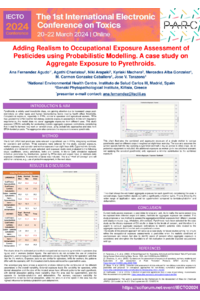
Pyrethroid usage has risen due to restrictions on other insecticides, prompting interest in biomonitoring data as exposure indicators. Occupational exposure, particularly in Plant Protection Product (PPP) applications, is a focus. Regulatory agencies, like the European Food Safety Authority (EFSA), use tools such as OPEX to assess non-dietary exposure, employing worst-case scenarios for increased protection.
This research explores OPEX's suitability for realistic exposure estimations via probabilistic modeling and Monte Carlo simulations. This study uses data from the EU PARC project estimating aggregated pyrethroid exposure. This study uses workflows for operators and workers, integrating tasks and applying Monte Carlo simulations for exposure estimation variability. Probability distributions replace default values, addressing real-world uncertainties.
The intention is to present a conceptual model for three occupational exposure scenarios, highlighting variability in task roles and exposure routes. Monte Carlo simulations offer full probability distributions, aiding sensitivity and uncertainty analyses. This study plans to compare aggregated exposure, including dietary exposure, with some preliminary results. The ongoing project aims to refine default values via a probabilistic assessment strategy.
To conclude, there is a need for aggregate exposure models considering shared neurotoxicity among pyrethroids. The proposed approach, based on the regulatory OPEX tool, facilitates comparisons between regulatory and aggregate assessments. Pyrethroids are chosen due to their proximity to concerning dietary exposure levels. This study's innovative approach aims to refine occupational exposure assessments, identify aggregate exposure risks, and enhance pesticide risk evaluation in occupational settings, contributing valuable insights for future studies.
Keywords
Pesticide Exposure | Probabilistic Modeling | Pyrethroids | Occupational Exposure Assessment | Aggregate Exposure | Monte Carlo Simulations | Risk Evaluation
Poster
Poster_Toxics_FernandezA et al.pdf
Effects of subchronic methylmercury exposure on response to acute hypoxia in mice: role of HIF-1α
Exploring the Role and Regulation of HIF-1 in Manganese Toxicity Using Caenorhabditis
elegans as a Model
elegans as a Model