Event submissions
Published
This submission belongs to the session C. Toxicological Mechanisms of Toxicants of the event The 1st International Electronic Conference on Toxics
Published date
03 Apr, 2024
Academic Editor
'%3e%3cpath%20d='M12.6657%2010.9104C12.4185%2010.325%2012.0599%209.79327%2011.6097%209.34482C11.1609%208.89508%2010.6293%208.5365%2010.0442%208.28888C10.0389%208.28626%2010.0337%208.28495%2010.0285%208.28233C10.8446%207.69279%2011.3752%206.73249%2011.3752%205.64904C11.3752%203.8542%209.92103%202.39999%208.1262%202.39999C6.33136%202.39999%204.87715%203.8542%204.87715%205.64904C4.87715%206.73249%205.40774%207.69279%206.22393%208.28364C6.21869%208.28626%206.21345%208.28757%206.20821%208.29019C5.62129%208.5378%205.09463%208.89284%204.64265%209.34613C4.1929%209.79493%203.83432%2010.3266%203.58671%2010.9117C3.34345%2011.4845%203.21226%2012.0987%203.20023%2012.7209C3.19988%2012.7349%203.20233%2012.7488%203.20744%2012.7619C3.21255%2012.7749%203.22022%2012.7867%203.22998%2012.7968C3.23975%2012.8068%203.25142%2012.8147%203.26431%2012.8202C3.2772%2012.8256%203.29105%2012.8284%203.30504%2012.8284H4.09109C4.14874%2012.8284%204.19459%2012.7825%204.1959%2012.7262C4.2221%2011.7148%204.62823%2010.7676%205.34617%2010.0497C6.08899%209.30683%207.0755%208.89808%208.1262%208.89808C9.17689%208.89808%2010.1634%209.30683%2010.9062%2010.0497C11.6242%2010.7676%2012.0303%2011.7148%2012.0565%2012.7262C12.0578%2012.7838%2012.1037%2012.8284%2012.1613%2012.8284H12.9474C12.9613%2012.8284%2012.9752%2012.8256%2012.9881%2012.8202C13.001%2012.8147%2013.0126%2012.8068%2013.0224%2012.7968C13.0322%2012.7867%2013.0398%2012.7749%2013.0449%2012.7619C13.0501%2012.7488%2013.0525%2012.7349%2013.0522%2012.7209C13.0391%2012.0947%2012.9094%2011.4855%2012.6657%2010.9104ZM8.1262%207.9024C7.52486%207.9024%206.9589%207.6679%206.53312%207.24211C6.10733%206.81633%205.87283%206.25037%205.87283%205.64904C5.87283%205.0477%206.10733%204.48174%206.53312%204.05596C6.9589%203.63018%207.52486%203.39567%208.1262%203.39567C8.72753%203.39567%209.29349%203.63018%209.71927%204.05596C10.1451%204.48174%2010.3796%205.0477%2010.3796%205.64904C10.3796%206.25037%2010.1451%206.81633%209.71927%207.24211C9.29349%207.6679%208.72753%207.9024%208.1262%207.9024Z'%20fill='%235D1EE1'/%3e%3c/g%3e%3c/svg%3e) Demetrio Raldúa
Demetrio RaldúaCitation
Tao Zehua, Exploring the Role and Regulation of HIF-1 in Manganese Toxicity Using Caenorhabditiselegans as a Model, in Proceedings of The 1st International Electronic Conference on Toxics, 20 March–22 March 2024, MDPI: Basel, Switzerland
Share
Email
Facebook
Twitter
LinkedIn
Exploring the Role and Regulation of HIF-1 in Manganese Toxicity Using Caenorhabditis
elegans as a Model
elegans as a Model
'%3e%3cpath%20d='M12.6647%2010.9104C12.4176%2010.325%2012.0589%209.7933%2011.6088%209.34485C11.16%208.89511%2010.6283%208.53653%2010.0432%208.28891C10.038%208.28629%2010.0327%208.28498%2010.0275%208.28236C10.8437%207.69282%2011.3743%206.73252%2011.3743%205.64907C11.3743%203.85423%209.92005%202.40002%208.12522%202.40002C6.33038%202.40002%204.87618%203.85423%204.87618%205.64907C4.87618%206.73252%205.40677%207.69282%206.22296%208.28367C6.21772%208.28629%206.21248%208.2876%206.20724%208.29022C5.62031%208.53783%205.09365%208.89287%204.64167%209.34616C4.19192%209.79496%203.83334%2010.3266%203.58573%2010.9117C3.34247%2011.4846%203.21128%2012.0987%203.19925%2012.721C3.1989%2012.735%203.20135%2012.7489%203.20646%2012.7619C3.21157%2012.7749%203.21924%2012.7868%203.22901%2012.7968C3.23877%2012.8068%203.25045%2012.8148%203.26334%2012.8202C3.27623%2012.8256%203.29007%2012.8284%203.30406%2012.8284H4.09012C4.14776%2012.8284%204.19362%2012.7825%204.19493%2012.7262C4.22113%2011.7148%204.62726%2010.7676%205.34519%2010.0497C6.08802%209.30686%207.07452%208.89811%208.12522%208.89811C9.17592%208.89811%2010.1624%209.30686%2010.9052%2010.0497C11.6232%2010.7676%2012.0293%2011.7148%2012.0555%2012.7262C12.0568%2012.7839%2012.1027%2012.8284%2012.1603%2012.8284H12.9464C12.9604%2012.8284%2012.9742%2012.8256%2012.9871%2012.8202C13%2012.8148%2013.0117%2012.8068%2013.0214%2012.7968C13.0312%2012.7868%2013.0389%2012.7749%2013.044%2012.7619C13.0491%2012.7489%2013.0515%2012.735%2013.0512%2012.721C13.0381%2012.0947%2012.9084%2011.4856%2012.6647%2010.9104ZM8.12522%207.90243C7.52388%207.90243%206.95792%207.66793%206.53214%207.24215C6.10636%206.81636%205.87185%206.2504%205.87185%205.64907C5.87185%205.04773%206.10636%204.48177%206.53214%204.05599C6.95792%203.63021%207.52388%203.3957%208.12522%203.3957C8.72655%203.3957%209.29252%203.63021%209.7183%204.05599C10.1441%204.48177%2010.3786%205.04773%2010.3786%205.64907C10.3786%206.2504%2010.1441%206.81636%209.7183%207.24215C9.29252%207.66793%208.72655%207.90243%208.12522%207.90243Z'%20fill='%235D1EE1'/%3e%3c/g%3e%3c/svg%3e)
Tao Zehua 1
1. Department of Preventive Medicine and Health Inspection, School of Medicine, Jiangsu University
Abstract
Abstract:
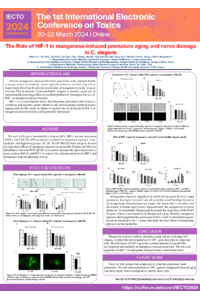
Introduction: Chronic manganese exposure has been associated with multiple health consequences, including neurological, behavioral, and cognitive impairments. However, the precise mechanism of manganese toxicity remains unclear. The nematode Caenorhabditis elegans, a model organism in environmental toxicology, offers an excellent platform to investigate the role of HIF-1 in manganese-induced toxicity. HIF-1 is a transcription factor that becomes activated under hypoxic conditions and regulates genes related to cell survival, energy metabolism, and angiogenesis. In this study, we aimed to explore the involvement of HIF-1 in manganese-induced toxicity and its potential mechanism.
Methods: We used wild-type Caenorhabditis elegans (N2), HIF-1 mutant nematodes (ZG31), and DAF-16::GFP nematodes as models for manganese exposure. Low-, medium-, and high-dose groups (10, 20, 50 mM MnCl2) were set up to observe the regulatory effects of manganese exposure on nematode lifespan and behavior. Quantitative real-time PCR (qPCR) was used to measure the expression levels of genes such as Daf-16 and HIF-1 to explore the relationship between HIF-1 and manganese-induced nematode toxicity.
Results: Manganese exposure significantly inhibited the growth of L1-stage nematodes, leading to increased mortality and decreased bending frequency. As manganese concentration increased, the nematodes' curvature rate decreased. Lifespan experiments demonstrated that manganese exposure shortened the nematodes' lifespan and decreased the expression of the DAF-16 gene, which is associated with lifespan and aging. Notably, manganese exposure downregulated the expression of HIF-1 and its downstream genes. However, knockout of HIF-1 genes alleviated the toxic effects of manganese exposure on the nematodes.
Conclusion: Manganese exposure can damage nematode survival and behavior, possibly through the downregulation of HIF-1 expression. The role and regulation of HIF-1 in manganese toxicity warrant further investigation.
Keywords: Caenorhabditis elegans, manganese exposure, HIF-1
Keywords
Caenorhabditis elegans; Manganese Exposure; HIF-1
Poster
The Role of HIF-1 in manganese-induced premature aging and nerve damage in C. elegans.pdf
Adding Realism to the Assessment of Occupational Exposure to Pesticides Using Probabilistic Modelling. A Case Study on Aggregate Exposure to Pyrethroids.
The role of the HIF-1α-BNIP3 pathway in acrylonitrile-induced hippocampal neuronal cell toxicity