Event submissions
Published
This submission belongs to the session A. Environmental Contaminants and Health of the event The 1st International Electronic Conference on Toxics
Published date
03 Apr, 2024
Academic Editor
'%3e%3cpath%20d='M12.6657%2010.9104C12.4185%2010.325%2012.0599%209.79327%2011.6097%209.34482C11.1609%208.89508%2010.6293%208.5365%2010.0442%208.28888C10.0389%208.28626%2010.0337%208.28495%2010.0285%208.28233C10.8446%207.69279%2011.3752%206.73249%2011.3752%205.64904C11.3752%203.8542%209.92103%202.39999%208.1262%202.39999C6.33136%202.39999%204.87715%203.8542%204.87715%205.64904C4.87715%206.73249%205.40774%207.69279%206.22393%208.28364C6.21869%208.28626%206.21345%208.28757%206.20821%208.29019C5.62129%208.5378%205.09463%208.89284%204.64265%209.34613C4.1929%209.79493%203.83432%2010.3266%203.58671%2010.9117C3.34345%2011.4845%203.21226%2012.0987%203.20023%2012.7209C3.19988%2012.7349%203.20233%2012.7488%203.20744%2012.7619C3.21255%2012.7749%203.22022%2012.7867%203.22998%2012.7968C3.23975%2012.8068%203.25142%2012.8147%203.26431%2012.8202C3.2772%2012.8256%203.29105%2012.8284%203.30504%2012.8284H4.09109C4.14874%2012.8284%204.19459%2012.7825%204.1959%2012.7262C4.2221%2011.7148%204.62823%2010.7676%205.34617%2010.0497C6.08899%209.30683%207.0755%208.89808%208.1262%208.89808C9.17689%208.89808%2010.1634%209.30683%2010.9062%2010.0497C11.6242%2010.7676%2012.0303%2011.7148%2012.0565%2012.7262C12.0578%2012.7838%2012.1037%2012.8284%2012.1613%2012.8284H12.9474C12.9613%2012.8284%2012.9752%2012.8256%2012.9881%2012.8202C13.001%2012.8147%2013.0126%2012.8068%2013.0224%2012.7968C13.0322%2012.7867%2013.0398%2012.7749%2013.0449%2012.7619C13.0501%2012.7488%2013.0525%2012.7349%2013.0522%2012.7209C13.0391%2012.0947%2012.9094%2011.4855%2012.6657%2010.9104ZM8.1262%207.9024C7.52486%207.9024%206.9589%207.6679%206.53312%207.24211C6.10733%206.81633%205.87283%206.25037%205.87283%205.64904C5.87283%205.0477%206.10733%204.48174%206.53312%204.05596C6.9589%203.63018%207.52486%203.39567%208.1262%203.39567C8.72753%203.39567%209.29349%203.63018%209.71927%204.05596C10.1451%204.48174%2010.3796%205.0477%2010.3796%205.64904C10.3796%206.25037%2010.1451%206.81633%209.71927%207.24211C9.29349%207.6679%208.72753%207.9024%208.1262%207.9024Z'%20fill='%235D1EE1'/%3e%3c/g%3e%3c/svg%3e) Yankai Xia
Yankai XiaCitation
Mazhar Sultan, Guan Quanquan, Yankai Xia, Association of Individual and Combined Exposure to Bisphenol and Serum Thyroid Hormones Levels in Adults and Pregnant Women: A Systematic Review and Meta-Analysis, in Proceedings of The 1st International Electronic Conference on Toxics, 20 March–22 March 2024, MDPI: Basel, Switzerland
Share
Email
Facebook
Twitter
LinkedIn
Association of Individual and Combined Exposure to Bisphenol and Serum Thyroid Hormones Levels in Adults and Pregnant Women: A Systematic Review and Meta-Analysis
'%3e%3cpath%20d='M12.6647%2010.9104C12.4176%2010.325%2012.0589%209.7933%2011.6088%209.34485C11.16%208.89511%2010.6283%208.53653%2010.0432%208.28891C10.038%208.28629%2010.0327%208.28498%2010.0275%208.28236C10.8437%207.69282%2011.3743%206.73252%2011.3743%205.64907C11.3743%203.85423%209.92005%202.40002%208.12522%202.40002C6.33038%202.40002%204.87618%203.85423%204.87618%205.64907C4.87618%206.73252%205.40677%207.69282%206.22296%208.28367C6.21772%208.28629%206.21248%208.2876%206.20724%208.29022C5.62031%208.53783%205.09365%208.89287%204.64167%209.34616C4.19192%209.79496%203.83334%2010.3266%203.58573%2010.9117C3.34247%2011.4846%203.21128%2012.0987%203.19925%2012.721C3.1989%2012.735%203.20135%2012.7489%203.20646%2012.7619C3.21157%2012.7749%203.21924%2012.7868%203.22901%2012.7968C3.23877%2012.8068%203.25045%2012.8148%203.26334%2012.8202C3.27623%2012.8256%203.29007%2012.8284%203.30406%2012.8284H4.09012C4.14776%2012.8284%204.19362%2012.7825%204.19493%2012.7262C4.22113%2011.7148%204.62726%2010.7676%205.34519%2010.0497C6.08802%209.30686%207.07452%208.89811%208.12522%208.89811C9.17592%208.89811%2010.1624%209.30686%2010.9052%2010.0497C11.6232%2010.7676%2012.0293%2011.7148%2012.0555%2012.7262C12.0568%2012.7839%2012.1027%2012.8284%2012.1603%2012.8284H12.9464C12.9604%2012.8284%2012.9742%2012.8256%2012.9871%2012.8202C13%2012.8148%2013.0117%2012.8068%2013.0214%2012.7968C13.0312%2012.7868%2013.0389%2012.7749%2013.044%2012.7619C13.0491%2012.7489%2013.0515%2012.735%2013.0512%2012.721C13.0381%2012.0947%2012.9084%2011.4856%2012.6647%2010.9104ZM8.12522%207.90243C7.52388%207.90243%206.95792%207.66793%206.53214%207.24215C6.10636%206.81636%205.87185%206.2504%205.87185%205.64907C5.87185%205.04773%206.10636%204.48177%206.53214%204.05599C6.95792%203.63021%207.52388%203.3957%208.12522%203.3957C8.72655%203.3957%209.29252%203.63021%209.7183%204.05599C10.1441%204.48177%2010.3786%205.04773%2010.3786%205.64907C10.3786%206.2504%2010.1441%206.81636%209.7183%207.24215C9.29252%207.66793%208.72655%207.90243%208.12522%207.90243Z'%20fill='%235D1EE1'/%3e%3c/g%3e%3c/svg%3e)
Mazhar Sultan 1,2
Guan Quanquan 3,4

Yankai Xia 3,4
1. State Key Laboratory of Reproductive Medicine, Center for Global Health, School of Public Health, Nanjing Medical University; Nanjing, 211166, China.
2. Key Laboratory of Modern Toxicology of Ministry of Education, School of Public Health, Nanjing Medical University; Nanjing, 211166, China.
3. State Key Laboratory of Reproductive Medicine, Center for Global Health, School of Public Health, Nanjing Medical University, Nanjing, 211166, China.
4. Key Laboratory of Modern Toxicology, Ministry of Education, School of Public Health, Nanjing Medical University, Nanjing, 211166, China.
Abstract
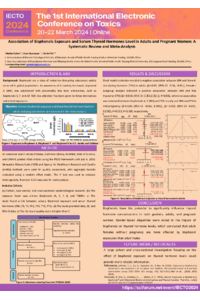
Background: Environmental factors influence thyroid malfunction. Bisphenols are a class of endocrine-disrupting substances widely detected in global populations. As awareness of its toxicity increased, BPA was substituted with presumably less toxic alternatives, such as bisphenols S, F, and AF. The present meta-analysis examines the association of individual and combined exposure to bisphenol and serum thyroid hormone levels in adults and pregnant women.
Material and Methods: A comprehensive search was conducted on PubMed, Web of Science, Embase, and Cochrane Library databases, resulting in the retrieval of a total of 4160 articles, utilizing both prospective and cross-sectional research designs. In total, aggregate hazards for the reliability of the included studies were also evaluated using a random effects model. The heterogeneity test was performed using the I2.
Results: Fourteen studies were deemed eligible for our analysis. Overall, fixed model summary estimates indicated a negative association between BPA and TSH in adults, with regression coefficient β = 0.02 and [95% CI: -0.04; -0.0]. Meanwhile, marginally significant results also found an association between BPA and TT4 in adults. The overall summary showed that there is no association between bisphenols and thyroid hormones in the first and second trimesters of pregnant women. Subgroup analysis in females revealed a positive association between BPA and TSH and a negative relationship with BPA and TSH, witheffect sizes of β=0.01 [95% CI: 0.00; 0.01] and β=-0.09 [95% CI: -0.17; -0.01], respectively.
Conclusion: There were notable gender-based disparities in the impact of BP on the levels of thyroid hormones. Bisphenols have the potential to exert a substantial influence on the concentrations of thyroid hormones in males, females, adults, and pregnant women. There were insufficient data to analyze the relationship between BPF and BPB exposure and thyroid hormones, so conducting a comprehensive study on the association of combined exposure to bisphenols with thyroid hormones in adults and pregnant women is suggested.
Keywords
Bisphenol A: Bisphenol B: BPS: BPB: TBPA
thyroid hormones: thyroxine: triiodothyronine: Free thyroxine: triiodothyronine: Thyroid stimulating hormone: Thyroid dysfunction
Poster
mazhar poster.pdf
Potential risk of cyclopiazonic acid toxicity in Kodo millet (Paspalum scrobiculatum L.) poisoning
Nanomaterial Exposure Assessment in a Carbon Fiber-Processing Laboratory