Event submissions
Published
This submission belongs to the session A. Environmental Contaminants and Health of the event The 1st International Electronic Conference on Toxics
Published date
03 Apr, 2024
Academic Editor
'%3e%3cpath%20d='M12.6657%2010.9104C12.4185%2010.325%2012.0599%209.79327%2011.6097%209.34482C11.1609%208.89508%2010.6293%208.5365%2010.0442%208.28888C10.0389%208.28626%2010.0337%208.28495%2010.0285%208.28233C10.8446%207.69279%2011.3752%206.73249%2011.3752%205.64904C11.3752%203.8542%209.92103%202.39999%208.1262%202.39999C6.33136%202.39999%204.87715%203.8542%204.87715%205.64904C4.87715%206.73249%205.40774%207.69279%206.22393%208.28364C6.21869%208.28626%206.21345%208.28757%206.20821%208.29019C5.62129%208.5378%205.09463%208.89284%204.64265%209.34613C4.1929%209.79493%203.83432%2010.3266%203.58671%2010.9117C3.34345%2011.4845%203.21226%2012.0987%203.20023%2012.7209C3.19988%2012.7349%203.20233%2012.7488%203.20744%2012.7619C3.21255%2012.7749%203.22022%2012.7867%203.22998%2012.7968C3.23975%2012.8068%203.25142%2012.8147%203.26431%2012.8202C3.2772%2012.8256%203.29105%2012.8284%203.30504%2012.8284H4.09109C4.14874%2012.8284%204.19459%2012.7825%204.1959%2012.7262C4.2221%2011.7148%204.62823%2010.7676%205.34617%2010.0497C6.08899%209.30683%207.0755%208.89808%208.1262%208.89808C9.17689%208.89808%2010.1634%209.30683%2010.9062%2010.0497C11.6242%2010.7676%2012.0303%2011.7148%2012.0565%2012.7262C12.0578%2012.7838%2012.1037%2012.8284%2012.1613%2012.8284H12.9474C12.9613%2012.8284%2012.9752%2012.8256%2012.9881%2012.8202C13.001%2012.8147%2013.0126%2012.8068%2013.0224%2012.7968C13.0322%2012.7867%2013.0398%2012.7749%2013.0449%2012.7619C13.0501%2012.7488%2013.0525%2012.7349%2013.0522%2012.7209C13.0391%2012.0947%2012.9094%2011.4855%2012.6657%2010.9104ZM8.1262%207.9024C7.52486%207.9024%206.9589%207.6679%206.53312%207.24211C6.10733%206.81633%205.87283%206.25037%205.87283%205.64904C5.87283%205.0477%206.10733%204.48174%206.53312%204.05596C6.9589%203.63018%207.52486%203.39567%208.1262%203.39567C8.72753%203.39567%209.29349%203.63018%209.71927%204.05596C10.1451%204.48174%2010.3796%205.0477%2010.3796%205.64904C10.3796%206.25037%2010.1451%206.81633%209.71927%207.24211C9.29349%207.6679%208.72753%207.9024%208.1262%207.9024Z'%20fill='%235D1EE1'/%3e%3c/g%3e%3c/svg%3e) Yankai Xia
Yankai XiaCitation
Gurminderjeet S. Jagdev, Maria del Carmen Lobo-Bedmar, Mª Ángeles Peña Fernández, Mark D. Evans, Antonio Peña-Fernández, Biomonitoring chromium contamination in urban and rural topsoils from Leicestershire, England, in Proceedings of The 1st International Electronic Conference on Toxics, 20 March–22 March 2024, MDPI: Basel, Switzerland
Share
Email
Facebook
Twitter
LinkedIn
Biomonitoring chromium contamination in urban and rural topsoils from Leicestershire, England
'%3e%3cpath%20d='M12.6647%2010.9104C12.4176%2010.325%2012.0589%209.7933%2011.6088%209.34485C11.16%208.89511%2010.6283%208.53653%2010.0432%208.28891C10.038%208.28629%2010.0327%208.28498%2010.0275%208.28236C10.8437%207.69282%2011.3743%206.73252%2011.3743%205.64907C11.3743%203.85423%209.92005%202.40002%208.12522%202.40002C6.33038%202.40002%204.87618%203.85423%204.87618%205.64907C4.87618%206.73252%205.40677%207.69282%206.22296%208.28367C6.21772%208.28629%206.21248%208.2876%206.20724%208.29022C5.62031%208.53783%205.09365%208.89287%204.64167%209.34616C4.19192%209.79496%203.83334%2010.3266%203.58573%2010.9117C3.34247%2011.4846%203.21128%2012.0987%203.19925%2012.721C3.1989%2012.735%203.20135%2012.7489%203.20646%2012.7619C3.21157%2012.7749%203.21924%2012.7868%203.22901%2012.7968C3.23877%2012.8068%203.25045%2012.8148%203.26334%2012.8202C3.27623%2012.8256%203.29007%2012.8284%203.30406%2012.8284H4.09012C4.14776%2012.8284%204.19362%2012.7825%204.19493%2012.7262C4.22113%2011.7148%204.62726%2010.7676%205.34519%2010.0497C6.08802%209.30686%207.07452%208.89811%208.12522%208.89811C9.17592%208.89811%2010.1624%209.30686%2010.9052%2010.0497C11.6232%2010.7676%2012.0293%2011.7148%2012.0555%2012.7262C12.0568%2012.7839%2012.1027%2012.8284%2012.1603%2012.8284H12.9464C12.9604%2012.8284%2012.9742%2012.8256%2012.9871%2012.8202C13%2012.8148%2013.0117%2012.8068%2013.0214%2012.7968C13.0312%2012.7868%2013.0389%2012.7749%2013.044%2012.7619C13.0491%2012.7489%2013.0515%2012.735%2013.0512%2012.721C13.0381%2012.0947%2012.9084%2011.4856%2012.6647%2010.9104ZM8.12522%207.90243C7.52388%207.90243%206.95792%207.66793%206.53214%207.24215C6.10636%206.81636%205.87185%206.2504%205.87185%205.64907C5.87185%205.04773%206.10636%204.48177%206.53214%204.05599C6.95792%203.63021%207.52388%203.3957%208.12522%203.3957C8.72655%203.3957%209.29252%203.63021%209.7183%204.05599C10.1441%204.48177%2010.3786%205.04773%2010.3786%205.64907C10.3786%206.2504%2010.1441%206.81636%209.7183%207.24215C9.29252%207.66793%208.72655%207.90243%208.12522%207.90243Z'%20fill='%235D1EE1'/%3e%3c/g%3e%3c/svg%3e)
Gurminderjeet S. Jagdev 1
Maria del Carmen Lobo-Bedmar 2

Mª Ángeles Peña Fernández 3
Mark D. Evans 4

Antonio Peña-Fernández 5
1. PhD Research
2. Research in IMIDRA (Madrid Institute for Rural, Agricultural and Food Research)
3. University of Alcalá
4. Professor in Leicester School of Allied Health Sciences, De Montfort University, Leicester
5. Professor in Department of Surgery, Medical and Social Sciences, Faculty of Medicine and Health Sciences, University of Alcalá
Abstract
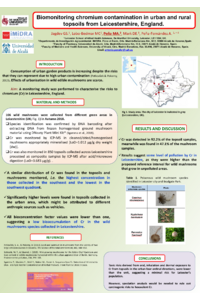
A monitoring study was performed to characterise the risks ofchromium (Cr) in Leicestershire, England. A total of 106 wild-growing mushrooms were collected from Leicester city and Bradgate Park (a nearby rural park). Cr was monitored via ICP-MS in cleaned/dried/homogenised and appropriately mineralised mushrooms [LoD=1.012 µg/g dry weight (dw)]. Cr was also monitored in 850 topsoils collected across Leicestershire and processed as composite samples via ICP-MS after acid/microwave digestion (LoD=3.683 µg/g). Cr was detected in 92.2% of the topsoil samples and 47.1% of the mushroom samples [median and range, in µg/g dw; 0.863 (1.012-19.466)], showing significant distribution across the four ordinal directions in which Leicestershire was divided [SE (1.908) > NW (1.738) > NE (0.987) > SW (<LoD); Peto–Prentice test, χ2(2)=12.4, p-value=0.002]. These results might suggest some level of Cr pollution in Leicestershire, as they are higher than the proposed reference interval for wild mushrooms that grow in unpolluted areas (0.5-5 µg/g dw). A similar distribution of Cr was found in the monitored topsoils. The highest concentration was found in those collected in the southeast and the lowest in the southwest quadrant (123.137 vs. 20.947 µg/g). Moreover, significantly higher levels were found in topsoils collected in the urban area (median and range, in µg/g; Peto–Prentice test, χ2(1)=1.1, p-value=9x10⁻⁴): 82.542 (3.683-196.795) vs. 32.806 (3.683-265.069). This difference might be attributed to different anthropogenic sources, such as vehicles. All bioconcentration factor values were lower than one, suggesting a low bioaccumulation of Cr in the wild mushrooms species collected in Leicestershire. Toxic risks derived from oral, inhalation, and dermal exposure to Cr from topsoils in the four urban ordinal directions (NW=1.95E-01, NE=1.40E-01, SW=2.53E-01, SE=4.30E-02) were lower than one, suggesting a minimal risk for Leicester’s population. However, speciation analysis would be needed to rule out carcinogenic risks of exposure to hexavalent Cr.
Keywords
chromium mushrooms
presence and distribution
human risks
Leicestershire
Poster
MDPI Toxics 2024 Leicester Cr mushrooms soils APF.pdf
Human health risks due to copper in urban and rural topsoils from East Midlands, England
Neonatal cytokines: Mediators and indicators of PM2.5 exposure during early pregnancy and childhood eczema