Event submissions
Published
This submission belongs to the session B. Drugs Toxicity and Safety of the event The 1st International Electronic Conference on Toxics
Published date
03 Apr, 2024
Academic Editor
'%3e%3cpath%20d='M12.6657%2010.9104C12.4185%2010.325%2012.0599%209.79327%2011.6097%209.34482C11.1609%208.89508%2010.6293%208.5365%2010.0442%208.28888C10.0389%208.28626%2010.0337%208.28495%2010.0285%208.28233C10.8446%207.69279%2011.3752%206.73249%2011.3752%205.64904C11.3752%203.8542%209.92103%202.39999%208.1262%202.39999C6.33136%202.39999%204.87715%203.8542%204.87715%205.64904C4.87715%206.73249%205.40774%207.69279%206.22393%208.28364C6.21869%208.28626%206.21345%208.28757%206.20821%208.29019C5.62129%208.5378%205.09463%208.89284%204.64265%209.34613C4.1929%209.79493%203.83432%2010.3266%203.58671%2010.9117C3.34345%2011.4845%203.21226%2012.0987%203.20023%2012.7209C3.19988%2012.7349%203.20233%2012.7488%203.20744%2012.7619C3.21255%2012.7749%203.22022%2012.7867%203.22998%2012.7968C3.23975%2012.8068%203.25142%2012.8147%203.26431%2012.8202C3.2772%2012.8256%203.29105%2012.8284%203.30504%2012.8284H4.09109C4.14874%2012.8284%204.19459%2012.7825%204.1959%2012.7262C4.2221%2011.7148%204.62823%2010.7676%205.34617%2010.0497C6.08899%209.30683%207.0755%208.89808%208.1262%208.89808C9.17689%208.89808%2010.1634%209.30683%2010.9062%2010.0497C11.6242%2010.7676%2012.0303%2011.7148%2012.0565%2012.7262C12.0578%2012.7838%2012.1037%2012.8284%2012.1613%2012.8284H12.9474C12.9613%2012.8284%2012.9752%2012.8256%2012.9881%2012.8202C13.001%2012.8147%2013.0126%2012.8068%2013.0224%2012.7968C13.0322%2012.7867%2013.0398%2012.7749%2013.0449%2012.7619C13.0501%2012.7488%2013.0525%2012.7349%2013.0522%2012.7209C13.0391%2012.0947%2012.9094%2011.4855%2012.6657%2010.9104ZM8.1262%207.9024C7.52486%207.9024%206.9589%207.6679%206.53312%207.24211C6.10733%206.81633%205.87283%206.25037%205.87283%205.64904C5.87283%205.0477%206.10733%204.48174%206.53312%204.05596C6.9589%203.63018%207.52486%203.39567%208.1262%203.39567C8.72753%203.39567%209.29349%203.63018%209.71927%204.05596C10.1451%204.48174%2010.3796%205.0477%2010.3796%205.64904C10.3796%206.25037%2010.1451%206.81633%209.71927%207.24211C9.29349%207.6679%208.72753%207.9024%208.1262%207.9024Z'%20fill='%235D1EE1'/%3e%3c/g%3e%3c/svg%3e) Youssef Sari
Youssef SariCitation
Ivan Dolanc, Goran Slivšek, Nives Ražnjević, Sandra Mijač, Antonija Jonjić, Miran Čoklo, The Antibacterial Efficacy and Drug Safety Profile of Trans-cinnamaldehyde against Acinetobacter baumannii: Bioinformatics and Cheminformatics Approach, in Proceedings of The 1st International Electronic Conference on Toxics, 20 March–22 March 2024, MDPI: Basel, Switzerland
Share
Email
Facebook
Twitter
LinkedIn
The Antibacterial Efficacy and Drug Safety Profile of Trans-cinnamaldehyde against Acinetobacter baumannii: Bioinformatics and Cheminformatics Approach

Ivan Dolanc 1

Goran Slivšek 2
'%3e%3cpath%20d='M12.6647%2010.9104C12.4176%2010.325%2012.0589%209.7933%2011.6088%209.34485C11.16%208.89511%2010.6283%208.53653%2010.0432%208.28891C10.038%208.28629%2010.0327%208.28498%2010.0275%208.28236C10.8437%207.69282%2011.3743%206.73252%2011.3743%205.64907C11.3743%203.85423%209.92005%202.40002%208.12522%202.40002C6.33038%202.40002%204.87618%203.85423%204.87618%205.64907C4.87618%206.73252%205.40677%207.69282%206.22296%208.28367C6.21772%208.28629%206.21248%208.2876%206.20724%208.29022C5.62031%208.53783%205.09365%208.89287%204.64167%209.34616C4.19192%209.79496%203.83334%2010.3266%203.58573%2010.9117C3.34247%2011.4846%203.21128%2012.0987%203.19925%2012.721C3.1989%2012.735%203.20135%2012.7489%203.20646%2012.7619C3.21157%2012.7749%203.21924%2012.7868%203.22901%2012.7968C3.23877%2012.8068%203.25045%2012.8148%203.26334%2012.8202C3.27623%2012.8256%203.29007%2012.8284%203.30406%2012.8284H4.09012C4.14776%2012.8284%204.19362%2012.7825%204.19493%2012.7262C4.22113%2011.7148%204.62726%2010.7676%205.34519%2010.0497C6.08802%209.30686%207.07452%208.89811%208.12522%208.89811C9.17592%208.89811%2010.1624%209.30686%2010.9052%2010.0497C11.6232%2010.7676%2012.0293%2011.7148%2012.0555%2012.7262C12.0568%2012.7839%2012.1027%2012.8284%2012.1603%2012.8284H12.9464C12.9604%2012.8284%2012.9742%2012.8256%2012.9871%2012.8202C13%2012.8148%2013.0117%2012.8068%2013.0214%2012.7968C13.0312%2012.7868%2013.0389%2012.7749%2013.044%2012.7619C13.0491%2012.7489%2013.0515%2012.735%2013.0512%2012.721C13.0381%2012.0947%2012.9084%2011.4856%2012.6647%2010.9104ZM8.12522%207.90243C7.52388%207.90243%206.95792%207.66793%206.53214%207.24215C6.10636%206.81636%205.87185%206.2504%205.87185%205.64907C5.87185%205.04773%206.10636%204.48177%206.53214%204.05599C6.95792%203.63021%207.52388%203.3957%208.12522%203.3957C8.72655%203.3957%209.29252%203.63021%209.7183%204.05599C10.1441%204.48177%2010.3786%205.04773%2010.3786%205.64907C10.3786%206.2504%2010.1441%206.81636%209.7183%207.24215C9.29252%207.66793%208.72655%207.90243%208.12522%207.90243Z'%20fill='%235D1EE1'/%3e%3c/g%3e%3c/svg%3e)
Nives Ražnjević 3
Sandra Mijač 4
Antonija Jonjić 1
Miran Čoklo 1
1. Institute for Anthropological Research, Centre for Applied Bioanthropology, Zagreb, Croatia
2. Faculty of Veterinary Medicine, University of Sarajevo, Sarajevo, Bosnia and Herzegovina
3. University Hospital of Split, Split, Croatia
4. Children’s Hospital Srebrnjak, Zagreb, Croatia
Abstract
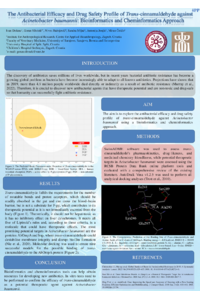
Introduction: The discovery of antibiotics saves millions of lives worldwide, but in recent years bacterial antibiotic resistance has become a growing global problem as bacteria have become increasingly able to adapt to all known antibiotics. Projections have shown that in 2019, more than 4.9 million people worldwide died directly or indirectly as a result of antibiotic resistance. Therefore, it is crucial to discover new antibacterial agents that have therapeutic potential and are non-toxic and drug-safe so that humanity can successfully fight antibiotic resistance. Since such studies are usually very expensive and disappointing results are a waste of valuable time, the use of bioinformatics and chemoinformatics tools can help overcome these problems.
Methods: SwissADME software was used to assess trans-cinnamaldehyde’s pharmacokinetics, drug-likeness, and medicinal chemistry friendliness, while potential therapeutic targets in Acinetobacter baumannii were assessed using the RCSB Protein Data Bank online platform tools and evaluated with a comprehensive review of the existing literature.
Results: Trans-cinnamaldehyde fulfils the requirements for the number of rotatable bonds and proton acceptors, which should be readily absorbed in the gut and can cross the blood—brain barrier, but is not a substrate for P-gp, which contributes to its therapeutic potential as it is not immediately excreted from the body. Theoretically, it should not be hepatotoxic as it has no inhibitory effect on liver cytochromes. It meets all five of Lipinski’s rules and, according to these criteria, is a molecule that could have therapeutic effects. The most promising potential targets in Acinetobacter baumannii are the proteins AbOmpA and bap, where trans-cimetaldehyde could destabilise membrane integrity and disrupt biofilm formation.
Conclusions: Bioinformatics and chemoinformatics tools can help obtain resources for developing new antibiotics. In vitro tests need to be performed to confirm the efficacy of trans-cinnamaldehyde as a potential therapeutic agent against Acinetobacter baumannii.
Keywords
Acinetobacter baumannii
antibiotic resistance
bioinformatics
cheminformatics
drug development
toxicity
trans-cinnamaldehyde
Poster
Ivan Dolanc et al. (E-poster).pdf
Encapsulating UiO-66(Zr) in polyvinyl alcohol/sodium alginate beads for enhanced removal of roxarsone from aqueous solutions
Human exposure characteristics of liquid crystal monomers (LCMs) and their mechanisms to cross the skin barrier