Event submissions
Published
This submission belongs to the session C. Toxicological Mechanisms of Toxicants of the event The 1st International Electronic Conference on Toxics
Published date
03 Apr, 2024
Academic Editor
'%3e%3cpath%20d='M12.6657%2010.9104C12.4185%2010.325%2012.0599%209.79327%2011.6097%209.34482C11.1609%208.89508%2010.6293%208.5365%2010.0442%208.28888C10.0389%208.28626%2010.0337%208.28495%2010.0285%208.28233C10.8446%207.69279%2011.3752%206.73249%2011.3752%205.64904C11.3752%203.8542%209.92103%202.39999%208.1262%202.39999C6.33136%202.39999%204.87715%203.8542%204.87715%205.64904C4.87715%206.73249%205.40774%207.69279%206.22393%208.28364C6.21869%208.28626%206.21345%208.28757%206.20821%208.29019C5.62129%208.5378%205.09463%208.89284%204.64265%209.34613C4.1929%209.79493%203.83432%2010.3266%203.58671%2010.9117C3.34345%2011.4845%203.21226%2012.0987%203.20023%2012.7209C3.19988%2012.7349%203.20233%2012.7488%203.20744%2012.7619C3.21255%2012.7749%203.22022%2012.7867%203.22998%2012.7968C3.23975%2012.8068%203.25142%2012.8147%203.26431%2012.8202C3.2772%2012.8256%203.29105%2012.8284%203.30504%2012.8284H4.09109C4.14874%2012.8284%204.19459%2012.7825%204.1959%2012.7262C4.2221%2011.7148%204.62823%2010.7676%205.34617%2010.0497C6.08899%209.30683%207.0755%208.89808%208.1262%208.89808C9.17689%208.89808%2010.1634%209.30683%2010.9062%2010.0497C11.6242%2010.7676%2012.0303%2011.7148%2012.0565%2012.7262C12.0578%2012.7838%2012.1037%2012.8284%2012.1613%2012.8284H12.9474C12.9613%2012.8284%2012.9752%2012.8256%2012.9881%2012.8202C13.001%2012.8147%2013.0126%2012.8068%2013.0224%2012.7968C13.0322%2012.7867%2013.0398%2012.7749%2013.0449%2012.7619C13.0501%2012.7488%2013.0525%2012.7349%2013.0522%2012.7209C13.0391%2012.0947%2012.9094%2011.4855%2012.6657%2010.9104ZM8.1262%207.9024C7.52486%207.9024%206.9589%207.6679%206.53312%207.24211C6.10733%206.81633%205.87283%206.25037%205.87283%205.64904C5.87283%205.0477%206.10733%204.48174%206.53312%204.05596C6.9589%203.63018%207.52486%203.39567%208.1262%203.39567C8.72753%203.39567%209.29349%203.63018%209.71927%204.05596C10.1451%204.48174%2010.3796%205.0477%2010.3796%205.64904C10.3796%206.25037%2010.1451%206.81633%209.71927%207.24211C9.29349%207.6679%208.72753%207.9024%208.1262%207.9024Z'%20fill='%235D1EE1'/%3e%3c/g%3e%3c/svg%3e) Demetrio Raldúa
Demetrio RaldúaCitation
Francisco Ríos, Manuela Lechuga, Ana Isabel García-López, José María Vicaria-Rivillas, Germán Luzón, Toxicity mechanisms of mixtures of anionic and non-ionic surfactants, in Proceedings of The 1st International Electronic Conference on Toxics, 20 March–22 March 2024, MDPI: Basel, Switzerland
Share
Email
Facebook
Twitter
LinkedIn
Toxicity mechanisms of mixtures of anionic and non-ionic surfactants

Francisco Ríos 1

Manuela Lechuga 1
'%3e%3cpath%20d='M12.6647%2010.9104C12.4176%2010.325%2012.0589%209.7933%2011.6088%209.34485C11.16%208.89511%2010.6283%208.53653%2010.0432%208.28891C10.038%208.28629%2010.0327%208.28498%2010.0275%208.28236C10.8437%207.69282%2011.3743%206.73252%2011.3743%205.64907C11.3743%203.85423%209.92005%202.40002%208.12522%202.40002C6.33038%202.40002%204.87618%203.85423%204.87618%205.64907C4.87618%206.73252%205.40677%207.69282%206.22296%208.28367C6.21772%208.28629%206.21248%208.2876%206.20724%208.29022C5.62031%208.53783%205.09365%208.89287%204.64167%209.34616C4.19192%209.79496%203.83334%2010.3266%203.58573%2010.9117C3.34247%2011.4846%203.21128%2012.0987%203.19925%2012.721C3.1989%2012.735%203.20135%2012.7489%203.20646%2012.7619C3.21157%2012.7749%203.21924%2012.7868%203.22901%2012.7968C3.23877%2012.8068%203.25045%2012.8148%203.26334%2012.8202C3.27623%2012.8256%203.29007%2012.8284%203.30406%2012.8284H4.09012C4.14776%2012.8284%204.19362%2012.7825%204.19493%2012.7262C4.22113%2011.7148%204.62726%2010.7676%205.34519%2010.0497C6.08802%209.30686%207.07452%208.89811%208.12522%208.89811C9.17592%208.89811%2010.1624%209.30686%2010.9052%2010.0497C11.6232%2010.7676%2012.0293%2011.7148%2012.0555%2012.7262C12.0568%2012.7839%2012.1027%2012.8284%2012.1603%2012.8284H12.9464C12.9604%2012.8284%2012.9742%2012.8256%2012.9871%2012.8202C13%2012.8148%2013.0117%2012.8068%2013.0214%2012.7968C13.0312%2012.7868%2013.0389%2012.7749%2013.044%2012.7619C13.0491%2012.7489%2013.0515%2012.735%2013.0512%2012.721C13.0381%2012.0947%2012.9084%2011.4856%2012.6647%2010.9104ZM8.12522%207.90243C7.52388%207.90243%206.95792%207.66793%206.53214%207.24215C6.10636%206.81636%205.87185%206.2504%205.87185%205.64907C5.87185%205.04773%206.10636%204.48177%206.53214%204.05599C6.95792%203.63021%207.52388%203.3957%208.12522%203.3957C8.72655%203.3957%209.29252%203.63021%209.7183%204.05599C10.1441%204.48177%2010.3786%205.04773%2010.3786%205.64907C10.3786%206.2504%2010.1441%206.81636%209.7183%207.24215C9.29252%207.66793%208.72655%207.90243%208.12522%207.90243Z'%20fill='%235D1EE1'/%3e%3c/g%3e%3c/svg%3e)
Ana Isabel García-López 1

José María Vicaria-Rivillas 1

Germán Luzón 1
1. University of Granada
Abstract
1. Introduction
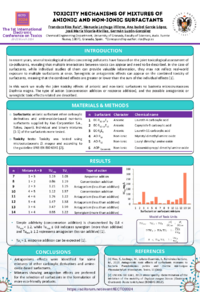
In recent years, several toxicological studies concerning pollutants have focused on the joint toxicological assessment of co-pollutants, revealing that multiple interactions between toxics can appear and need to be described. In the case of surfactants, while individual studies of them can provide valuable information, they may not reflect real-world exposure to multiple surfactants at once. Synergistic or antagonistic effects stem from the combined toxicity of surfactants, meaning that combined effects are greater or lower than the sum of the individual effects.
In this work, we study the joint toxicity effects of anionic and non-ionic surfactants to bacteria microcrustaceans Daphnia magna. The type of action (concentration addition or response addition) and the possible related antagonistic or synergistic toxic effects are described.
2. Materials and Methods
Surfactants: Anionic surfactant ether carboxylic derivatives (EC-R12-14E3, EC-R12-14E10, and EC-R8E8) and amine-oxide-based non-ionic surfactants (AO-R14, AO-R12, and AO-Cocoamido) (supplied by Kao Corporation S.A., Tokyo, Japan) were used. Individual and binary mixtures (1:1) of the surfactants were tested. Toxicity tests: Toxicity was tested using microcrustaceans D. magna and according to the guideline UNE-EN ISO 6341.
3. Results
The toxicity test of binary mixtures (1:1) reveals that concentration addition can be expected for mixtures of the most toxic surfactants from the same family (EC-EC-R12-14E10 + EC-R12-14E3, and AO-R14 + AO-R12), whereas response addition can be expected for the mixture EC-EC-R8E8 + EC-R12-14E3. Antagonism effects, less toxic than the expected, were identified for mixtures including AO-Cocoamido, but a synergism effect was identified for the mixture of EC-EC-R12-14E3 + AO-R14.
4. Conclusions
- Antagonisms effects were identified for some mixtures of ether carboxylic derivatives and amine-oxide-based surfactants.
- Mixtures showing antagonism effects are preferred for the selection of surfactants in the formulation of more eco-friendly products.
Keywords
Surfactants
toxicity
mode of action
synergism
antagonism
Poster
Surfactants Mechanisms-F. Ríos.pdf
Spatiotemporal gradients of PAHs in Greek urban environments and subsequent health impacts
Impact of microfibers on the marine microalgae Phaeodactylum tricornutum