Event submissions
Published
This submission belongs to the session A. Environmental Contaminants and Health of the event The 1st International Electronic Conference on Toxics
Published date
03 Apr, 2024
Academic Editor
'%3e%3cpath%20d='M12.6657%2010.9104C12.4185%2010.325%2012.0599%209.79327%2011.6097%209.34482C11.1609%208.89508%2010.6293%208.5365%2010.0442%208.28888C10.0389%208.28626%2010.0337%208.28495%2010.0285%208.28233C10.8446%207.69279%2011.3752%206.73249%2011.3752%205.64904C11.3752%203.8542%209.92103%202.39999%208.1262%202.39999C6.33136%202.39999%204.87715%203.8542%204.87715%205.64904C4.87715%206.73249%205.40774%207.69279%206.22393%208.28364C6.21869%208.28626%206.21345%208.28757%206.20821%208.29019C5.62129%208.5378%205.09463%208.89284%204.64265%209.34613C4.1929%209.79493%203.83432%2010.3266%203.58671%2010.9117C3.34345%2011.4845%203.21226%2012.0987%203.20023%2012.7209C3.19988%2012.7349%203.20233%2012.7488%203.20744%2012.7619C3.21255%2012.7749%203.22022%2012.7867%203.22998%2012.7968C3.23975%2012.8068%203.25142%2012.8147%203.26431%2012.8202C3.2772%2012.8256%203.29105%2012.8284%203.30504%2012.8284H4.09109C4.14874%2012.8284%204.19459%2012.7825%204.1959%2012.7262C4.2221%2011.7148%204.62823%2010.7676%205.34617%2010.0497C6.08899%209.30683%207.0755%208.89808%208.1262%208.89808C9.17689%208.89808%2010.1634%209.30683%2010.9062%2010.0497C11.6242%2010.7676%2012.0303%2011.7148%2012.0565%2012.7262C12.0578%2012.7838%2012.1037%2012.8284%2012.1613%2012.8284H12.9474C12.9613%2012.8284%2012.9752%2012.8256%2012.9881%2012.8202C13.001%2012.8147%2013.0126%2012.8068%2013.0224%2012.7968C13.0322%2012.7867%2013.0398%2012.7749%2013.0449%2012.7619C13.0501%2012.7488%2013.0525%2012.7349%2013.0522%2012.7209C13.0391%2012.0947%2012.9094%2011.4855%2012.6657%2010.9104ZM8.1262%207.9024C7.52486%207.9024%206.9589%207.6679%206.53312%207.24211C6.10733%206.81633%205.87283%206.25037%205.87283%205.64904C5.87283%205.0477%206.10733%204.48174%206.53312%204.05596C6.9589%203.63018%207.52486%203.39567%208.1262%203.39567C8.72753%203.39567%209.29349%203.63018%209.71927%204.05596C10.1451%204.48174%2010.3796%205.0477%2010.3796%205.64904C10.3796%206.25037%2010.1451%206.81633%209.71927%207.24211C9.29349%207.6679%208.72753%207.9024%208.1262%207.9024Z'%20fill='%235D1EE1'/%3e%3c/g%3e%3c/svg%3e) Yankai Xia
Yankai XiaCitation
Andreia Garces, Filipe Silva, Isabel Pires, Acorn poisoning as a potential threat to animals, in Proceedings of The 1st International Electronic Conference on Toxics, 20 March–22 March 2024, MDPI: Basel, Switzerland
Share
Email
Facebook
Twitter
LinkedIn
Acorn poisoning as a potential threat to animals

Andreia Garces 1

Filipe Silva 2

Isabel Pires 2
1. Wildlife Rehabilitation Centre (CRAS), Veterinary Teaching Hospital, University of Trás-os-Montes e AltoDouro (UTAD), 5000-801 Vila Real, Portugal
2. CECAV, University of Trás-os-Montes and Alto Douro, Vila Real, Portugal
Abstract
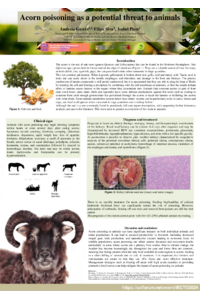
The acorn is the nut of oak trees (genera Quercus and Lithocarpus) that can be found in the Northern Hemisphere. They are a valuable source of food for many animals (birds, rats, squirrels, pigs), but can pose health risks when consumed in large quantities. This nut contains gallotannin. When ingested, gallotannin is broken down into gallic acid and tannic acid. Tannic acid is toxic and can cause ulcers in the mouth, esophagus, and intestines, and damage the liver and kidneys. Animals that consume acorns as part of their diets (wild boars, deer, bears, birds, and squirrels) have some defense mechanisms against this toxin, such as waiting to consume them until enough groundwater has percolated through the acorns to leach the tannins or buffering the acorns with other foods. Some animals metabolize tannins better than others. Acorns can be particularly toxic to cattle, horses, and dogs, and fatal to all species when consumed in large quantities due to kidney failure. Animals with acorn poisoning may begin showing symptoms within hours or even several days after eating acorns. Symptoms include vomiting, diarrhea, cramping, abdominal tenderness, depression, rapid weight loss, loss of appetite, tiredness, and dehydration. There is no specific treatment for acorn poisoning, with prevention being key. Limiting access to fields with many oak trees to domestic animals during the fall is one measure. Diagnosis is based on clinical findings, necropsy, history, and histopathologic examination of the kidneys. Due to climate change, the weather has become increasingly dry throughout the year and forest fires are common, meaning that during autumn, often the only food available in some regions is acorns, leading to a silent killing of animals due to lack of resources. It is important that farmers and veterinarians are aware so that they can offer faster and more effective treatment.
Keywords
quercus
tannic acid
acorn
horses
Poster
2024_toxins acorn.pdf
Multielemental profile of peritoneal fluid in gynaecology patients presenting with uterine myomas
PM2.5-induced declined cardiac tolerance to ischemia-reperfusion injury can be ameliorated by hydrogen sulfide