Event submissions
Published
This submission belongs to the session 6. Bioinformatics and Computational Biology of the event The 3rd International Electronic Conference on Biomolecules
Published date
12 Apr, 2024
Academic Editor
'%3e%3cpath%20d='M12.6657%2010.9104C12.4185%2010.325%2012.0599%209.79327%2011.6097%209.34482C11.1609%208.89508%2010.6293%208.5365%2010.0442%208.28888C10.0389%208.28626%2010.0337%208.28495%2010.0285%208.28233C10.8446%207.69279%2011.3752%206.73249%2011.3752%205.64904C11.3752%203.8542%209.92103%202.39999%208.1262%202.39999C6.33136%202.39999%204.87715%203.8542%204.87715%205.64904C4.87715%206.73249%205.40774%207.69279%206.22393%208.28364C6.21869%208.28626%206.21345%208.28757%206.20821%208.29019C5.62129%208.5378%205.09463%208.89284%204.64265%209.34613C4.1929%209.79493%203.83432%2010.3266%203.58671%2010.9117C3.34345%2011.4845%203.21226%2012.0987%203.20023%2012.7209C3.19988%2012.7349%203.20233%2012.7488%203.20744%2012.7619C3.21255%2012.7749%203.22022%2012.7867%203.22998%2012.7968C3.23975%2012.8068%203.25142%2012.8147%203.26431%2012.8202C3.2772%2012.8256%203.29105%2012.8284%203.30504%2012.8284H4.09109C4.14874%2012.8284%204.19459%2012.7825%204.1959%2012.7262C4.2221%2011.7148%204.62823%2010.7676%205.34617%2010.0497C6.08899%209.30683%207.0755%208.89808%208.1262%208.89808C9.17689%208.89808%2010.1634%209.30683%2010.9062%2010.0497C11.6242%2010.7676%2012.0303%2011.7148%2012.0565%2012.7262C12.0578%2012.7838%2012.1037%2012.8284%2012.1613%2012.8284H12.9474C12.9613%2012.8284%2012.9752%2012.8256%2012.9881%2012.8202C13.001%2012.8147%2013.0126%2012.8068%2013.0224%2012.7968C13.0322%2012.7867%2013.0398%2012.7749%2013.0449%2012.7619C13.0501%2012.7488%2013.0525%2012.7349%2013.0522%2012.7209C13.0391%2012.0947%2012.9094%2011.4855%2012.6657%2010.9104ZM8.1262%207.9024C7.52486%207.9024%206.9589%207.6679%206.53312%207.24211C6.10733%206.81633%205.87283%206.25037%205.87283%205.64904C5.87283%205.0477%206.10733%204.48174%206.53312%204.05596C6.9589%203.63018%207.52486%203.39567%208.1262%203.39567C8.72753%203.39567%209.29349%203.63018%209.71927%204.05596C10.1451%204.48174%2010.3796%205.0477%2010.3796%205.64904C10.3796%206.25037%2010.1451%206.81633%209.71927%207.24211C9.29349%207.6679%208.72753%207.9024%208.1262%207.9024Z'%20fill='%235D1EE1'/%3e%3c/g%3e%3c/svg%3e) Thomas Caulfield
Thomas CaulfieldCitation
Ivan Dolanc, Goran Slivšek, Nives Ražnjević, Sandra Mijač, Nevija Brstilo, Miran Čoklo, The Evaluation of the Antibacterial Efficacy and Drug Safety of Thymoquinone against Acinetobacter baumannii: Utilising Bioinformatics and Cheminformatics Methods in Microbiology, in Proceedings of The 3rd International Electronic Conference on Biomolecules, 23 April–25 April 2024, MDPI: Basel, Switzerland
Share
Email
Facebook
Twitter
LinkedIn
The Evaluation of the Antibacterial Efficacy and Drug Safety of Thymoquinone against Acinetobacter baumannii: Utilising Bioinformatics and Cheminformatics Methods in Microbiology

Ivan Dolanc 1

Goran Slivšek 2
'%3e%3cpath%20d='M12.6647%2010.9104C12.4176%2010.325%2012.0589%209.7933%2011.6088%209.34485C11.16%208.89511%2010.6283%208.53653%2010.0432%208.28891C10.038%208.28629%2010.0327%208.28498%2010.0275%208.28236C10.8437%207.69282%2011.3743%206.73252%2011.3743%205.64907C11.3743%203.85423%209.92005%202.40002%208.12522%202.40002C6.33038%202.40002%204.87618%203.85423%204.87618%205.64907C4.87618%206.73252%205.40677%207.69282%206.22296%208.28367C6.21772%208.28629%206.21248%208.2876%206.20724%208.29022C5.62031%208.53783%205.09365%208.89287%204.64167%209.34616C4.19192%209.79496%203.83334%2010.3266%203.58573%2010.9117C3.34247%2011.4846%203.21128%2012.0987%203.19925%2012.721C3.1989%2012.735%203.20135%2012.7489%203.20646%2012.7619C3.21157%2012.7749%203.21924%2012.7868%203.22901%2012.7968C3.23877%2012.8068%203.25045%2012.8148%203.26334%2012.8202C3.27623%2012.8256%203.29007%2012.8284%203.30406%2012.8284H4.09012C4.14776%2012.8284%204.19362%2012.7825%204.19493%2012.7262C4.22113%2011.7148%204.62726%2010.7676%205.34519%2010.0497C6.08802%209.30686%207.07452%208.89811%208.12522%208.89811C9.17592%208.89811%2010.1624%209.30686%2010.9052%2010.0497C11.6232%2010.7676%2012.0293%2011.7148%2012.0555%2012.7262C12.0568%2012.7839%2012.1027%2012.8284%2012.1603%2012.8284H12.9464C12.9604%2012.8284%2012.9742%2012.8256%2012.9871%2012.8202C13%2012.8148%2013.0117%2012.8068%2013.0214%2012.7968C13.0312%2012.7868%2013.0389%2012.7749%2013.044%2012.7619C13.0491%2012.7489%2013.0515%2012.735%2013.0512%2012.721C13.0381%2012.0947%2012.9084%2011.4856%2012.6647%2010.9104ZM8.12522%207.90243C7.52388%207.90243%206.95792%207.66793%206.53214%207.24215C6.10636%206.81636%205.87185%206.2504%205.87185%205.64907C5.87185%205.04773%206.10636%204.48177%206.53214%204.05599C6.95792%203.63021%207.52388%203.3957%208.12522%203.3957C8.72655%203.3957%209.29252%203.63021%209.7183%204.05599C10.1441%204.48177%2010.3786%205.04773%2010.3786%205.64907C10.3786%206.2504%2010.1441%206.81636%209.7183%207.24215C9.29252%207.66793%208.72655%207.90243%208.12522%207.90243Z'%20fill='%235D1EE1'/%3e%3c/g%3e%3c/svg%3e)
Nives Ražnjević 3
Sandra Mijač 4
Nevija Brstilo 2
Miran Čoklo 1
1. Institute for Anthropological Research, Centre for Applied Bioanthropology, Zagreb, Croatia
2. Josip Juraj Strossmayer University of Osijek, Osijek, Croatia
3. University Hospital of Split, Split, Croatia
4. Children’s Hospital Srebrnjak, Zagreb, Croatia
Abstract
Introduction: The discovery of antibiotics is considered one of the most important discoveries in the history of humanity. Bacterial antibiotic resistance has long been a growing global problem, and today, bacteria are becoming able to adapt to all known antibiotics. Projections have shown that in 2019, there were 1.27 million deaths due to antibiotic resistance. It is necessary to discover new antibacterial agents that have therapeutic potential and are drug-safe so that humanity can successfully overcome antibiotic resistance. Applying bioinformatics and chemoinformatics in microbiology can be useful to rapidly evaluate the efficacy and drug safety of potential antibacterial agents, thus avoiding the loss of resources due to unsuccessful trials.
Methods: SwissADME software was used to assess timiquinone’s pharmacokinetics, drug-likeness and medicinal chemistry friendliness, while potential therapeutic targets in Acinetobacter baumannii were assessed using the RCSB Protein Data Bank online platform tools and evaluated with a comprehensive review of the existing literature.
Results: Thymoquinone weights less than 500 g/mol fulfill the requirements for the number of rotatable bonds, proton donors and acceptors, should be easily absorbed in the intestine and can cross the blood–brain barrier, but is not a substrate for P-gp. It should not be hepatotoxic as it has no inhibitory effect on liver cytochromes. It satisfies Lipinski’s rules and is therefore a molecule that could have therapeutic effects. The most promising potential targets in Acinetobacter baumannii are the proteins AbOmpA and bap. Here, thymoquinone could induce reactive oxygen species that destabilise membrane integrity and disrupt biofilm formation by damaging the secondary and tertiary structure of Acinetobacter baumannii proteins and possibly also affect its nucleic acids, leading to cell death.
Conclusions: Bioinformatics and chemoinformatics tools can be helpful in microbiology. It seems promising to perform in vitro tests to assess the antibacterial efficacy of thymoquinone as an antibacterial agent against Acinetobacter baumannii.
Keywords
Acinetobacter baumannii
antibiotic resistance
bioinformatics
cheminformatics
drug development
microbiology
timiquinone
Poster
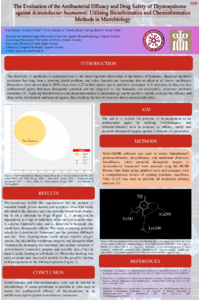
The Evaluation of the Antibacterial Efficacy and Drug Safety of Thymoquinone against Acinetobacter baumannii - Utilising Bioinformatics and Cheminformatics Methods in Microbiology_DolancIvan et al..pdf
"Study on Mercury exposure and different approaches for the management of Mercury toxicity"
Enhanced Efficacy of Homeophotodynamic Therapy of Rhobdomyosarcoma Cancer Cells by using Chemo-drug as an Adjuvant Agent