Event submissions
Published
This submission belongs to the session S5. Poster Session of the event The 1st International Online Conference on Biomimetics
Published date
15 May, 2024
Academic Editor
'%3e%3cpath%20d='M12.6657%2010.9104C12.4185%2010.325%2012.0599%209.79327%2011.6097%209.34482C11.1609%208.89508%2010.6293%208.5365%2010.0442%208.28888C10.0389%208.28626%2010.0337%208.28495%2010.0285%208.28233C10.8446%207.69279%2011.3752%206.73249%2011.3752%205.64904C11.3752%203.8542%209.92103%202.39999%208.1262%202.39999C6.33136%202.39999%204.87715%203.8542%204.87715%205.64904C4.87715%206.73249%205.40774%207.69279%206.22393%208.28364C6.21869%208.28626%206.21345%208.28757%206.20821%208.29019C5.62129%208.5378%205.09463%208.89284%204.64265%209.34613C4.1929%209.79493%203.83432%2010.3266%203.58671%2010.9117C3.34345%2011.4845%203.21226%2012.0987%203.20023%2012.7209C3.19988%2012.7349%203.20233%2012.7488%203.20744%2012.7619C3.21255%2012.7749%203.22022%2012.7867%203.22998%2012.7968C3.23975%2012.8068%203.25142%2012.8147%203.26431%2012.8202C3.2772%2012.8256%203.29105%2012.8284%203.30504%2012.8284H4.09109C4.14874%2012.8284%204.19459%2012.7825%204.1959%2012.7262C4.2221%2011.7148%204.62823%2010.7676%205.34617%2010.0497C6.08899%209.30683%207.0755%208.89808%208.1262%208.89808C9.17689%208.89808%2010.1634%209.30683%2010.9062%2010.0497C11.6242%2010.7676%2012.0303%2011.7148%2012.0565%2012.7262C12.0578%2012.7838%2012.1037%2012.8284%2012.1613%2012.8284H12.9474C12.9613%2012.8284%2012.9752%2012.8256%2012.9881%2012.8202C13.001%2012.8147%2013.0126%2012.8068%2013.0224%2012.7968C13.0322%2012.7867%2013.0398%2012.7749%2013.0449%2012.7619C13.0501%2012.7488%2013.0525%2012.7349%2013.0522%2012.7209C13.0391%2012.0947%2012.9094%2011.4855%2012.6657%2010.9104ZM8.1262%207.9024C7.52486%207.9024%206.9589%207.6679%206.53312%207.24211C6.10733%206.81633%205.87283%206.25037%205.87283%205.64904C5.87283%205.0477%206.10733%204.48174%206.53312%204.05596C6.9589%203.63018%207.52486%203.39567%208.1262%203.39567C8.72753%203.39567%209.29349%203.63018%209.71927%204.05596C10.1451%204.48174%2010.3796%205.0477%2010.3796%205.64904C10.3796%206.25037%2010.1451%206.81633%209.71927%207.24211C9.29349%207.6679%208.72753%207.9024%208.1262%207.9024Z'%20fill='%235D1EE1'/%3e%3c/g%3e%3c/svg%3e) Luca Patanè
Luca PatanèCitation
Jun-Hyeog Jang, Engineering Multifunctional Biomimetic ECM Proteins with Elastin-Like Polypeptide Fusion for Enhanced Tissue Regeneration, in Proceedings of The 1st International Online Conference on Biomimetics, 15 May–17 May 2024, MDPI: Basel, Switzerland
Share
Email
Facebook
Twitter
LinkedIn
Engineering Multifunctional Biomimetic ECM Proteins with Elastin-Like Polypeptide Fusion for Enhanced Tissue Regeneration

Jun-Hyeog Jang 1
1. Department of Biochemistry, Inha University School of Medicine, Michuhol-gu, Incheon 22212, Korea
Abstract
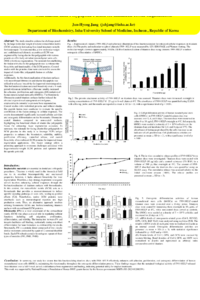
The study aimed to address the challenge posed by the large molecular weight of natural extracellular matrix (ECM) proteins in fabricating functional structures suitable for tissue repair. To overcome this, a low-molecular-weight and multifunctional chimeric recombinant ECM was engineered by fusing elastin-like polypeptide with various proteins to effectively stimulate mesenchymal stem cells (MSCs) for tissue regeneration. The rationale for establishing the fusion with elastin-like polypeptide was to enhance the bioactivity and functionality of the ECM proteins. Control studies with the proteins alone were conducted to assess the impact of elastin-like polypeptide fusion on cellular responses.
Additionally, the bio-functionalization of titanium surfaces with recombinant fibronectin and elastin-like peptide was utilized to enhance bioactivity for improved osseointegration. This biofunctionalization sustained bioactivity over a 4-week period without an initial burst effect and notably increased the adhesion, proliferation, and osteogenic differentiation of human mesenchymal stem cells (hMSCs). The biomimetic fibronectin-coated titanium surfaces further induced the elevated expression of osteogenesis-related genes, emphasizing its potential to promote bone regeneration.
Control studies with individual proteins and without elastin-like peptide fusion were conducted to evaluate the specific contribution of the fusion strategy to cellular responses. The results demonstrated significantly increased cellular activities and osteogenic differentiation on the biomimetic fibronectin-coated titanium compared to non-coated surfaces, highlighting the beneficial effects of elastin-like polypeptide fusion for enhancing tissue regeneration outcomes. In summary, the rationale for fusing elastin-like polypeptide to ECM proteins in this study is to leverage ELP's unique properties to enhance the biomimicry, solubility, stability, purification efficiency, controlled release, and overall bioactivity of recombinant ECM proteins for improved tissue regeneration applications. The fusion strategy offers a promising approach to overcome challenges associated with large-molecular-weight ECM proteins and optimize their therapeutic potential.
Keywords
extracellular matrix (ECM)
mesenchymal stem cell (MSC)
Poster
sciforum-087687.pdf
Assessing the removal efficiency of ibuprofen in an aqueous solution using Acacia Erioloba nanoparticles
Recycling Used Textile Waste to Achieve Biomimicry and Promote Circular Economy