Event submissions
Published
This submission belongs to the session S1. Biomimetics of Materials and Structures of the event The 1st International Online Conference on Biomimetics
Published date
15 May, 2024
Academic Editor
'%3e%3cpath%20d='M12.6657%2010.9104C12.4185%2010.325%2012.0599%209.79327%2011.6097%209.34482C11.1609%208.89508%2010.6293%208.5365%2010.0442%208.28888C10.0389%208.28626%2010.0337%208.28495%2010.0285%208.28233C10.8446%207.69279%2011.3752%206.73249%2011.3752%205.64904C11.3752%203.8542%209.92103%202.39999%208.1262%202.39999C6.33136%202.39999%204.87715%203.8542%204.87715%205.64904C4.87715%206.73249%205.40774%207.69279%206.22393%208.28364C6.21869%208.28626%206.21345%208.28757%206.20821%208.29019C5.62129%208.5378%205.09463%208.89284%204.64265%209.34613C4.1929%209.79493%203.83432%2010.3266%203.58671%2010.9117C3.34345%2011.4845%203.21226%2012.0987%203.20023%2012.7209C3.19988%2012.7349%203.20233%2012.7488%203.20744%2012.7619C3.21255%2012.7749%203.22022%2012.7867%203.22998%2012.7968C3.23975%2012.8068%203.25142%2012.8147%203.26431%2012.8202C3.2772%2012.8256%203.29105%2012.8284%203.30504%2012.8284H4.09109C4.14874%2012.8284%204.19459%2012.7825%204.1959%2012.7262C4.2221%2011.7148%204.62823%2010.7676%205.34617%2010.0497C6.08899%209.30683%207.0755%208.89808%208.1262%208.89808C9.17689%208.89808%2010.1634%209.30683%2010.9062%2010.0497C11.6242%2010.7676%2012.0303%2011.7148%2012.0565%2012.7262C12.0578%2012.7838%2012.1037%2012.8284%2012.1613%2012.8284H12.9474C12.9613%2012.8284%2012.9752%2012.8256%2012.9881%2012.8202C13.001%2012.8147%2013.0126%2012.8068%2013.0224%2012.7968C13.0322%2012.7867%2013.0398%2012.7749%2013.0449%2012.7619C13.0501%2012.7488%2013.0525%2012.7349%2013.0522%2012.7209C13.0391%2012.0947%2012.9094%2011.4855%2012.6657%2010.9104ZM8.1262%207.9024C7.52486%207.9024%206.9589%207.6679%206.53312%207.24211C6.10733%206.81633%205.87283%206.25037%205.87283%205.64904C5.87283%205.0477%206.10733%204.48174%206.53312%204.05596C6.9589%203.63018%207.52486%203.39567%208.1262%203.39567C8.72753%203.39567%209.29349%203.63018%209.71927%204.05596C10.1451%204.48174%2010.3796%205.0477%2010.3796%205.64904C10.3796%206.25037%2010.1451%206.81633%209.71927%207.24211C9.29349%207.6679%208.72753%207.9024%208.1262%207.9024Z'%20fill='%235D1EE1'/%3e%3c/g%3e%3c/svg%3e) Antonio Concilio
Antonio ConcilioCitation
Yiheng SONG, Youlong Wang, Jie Chen, Chenwei Guo, Sihan Ruan, Flexural Enhancement in Beetle-Inspired Sandwich Plates with a Large Height-to-Thickness Ratio Core, in Proceedings of The 1st International Online Conference on Biomimetics, 15 May–17 May 2024, MDPI: Basel, Switzerland
Share
Email
Facebook
Twitter
LinkedIn
Flexural Enhancement in Beetle-Inspired Sandwich Plates with a Large Height-to-Thickness Ratio Core

Yiheng SONG 1,2
'%3e%3cpath%20d='M12.6647%2010.9104C12.4176%2010.325%2012.0589%209.7933%2011.6088%209.34485C11.16%208.89511%2010.6283%208.53653%2010.0432%208.28891C10.038%208.28629%2010.0327%208.28498%2010.0275%208.28236C10.8437%207.69282%2011.3743%206.73252%2011.3743%205.64907C11.3743%203.85423%209.92005%202.40002%208.12522%202.40002C6.33038%202.40002%204.87618%203.85423%204.87618%205.64907C4.87618%206.73252%205.40677%207.69282%206.22296%208.28367C6.21772%208.28629%206.21248%208.2876%206.20724%208.29022C5.62031%208.53783%205.09365%208.89287%204.64167%209.34616C4.19192%209.79496%203.83334%2010.3266%203.58573%2010.9117C3.34247%2011.4846%203.21128%2012.0987%203.19925%2012.721C3.1989%2012.735%203.20135%2012.7489%203.20646%2012.7619C3.21157%2012.7749%203.21924%2012.7868%203.22901%2012.7968C3.23877%2012.8068%203.25045%2012.8148%203.26334%2012.8202C3.27623%2012.8256%203.29007%2012.8284%203.30406%2012.8284H4.09012C4.14776%2012.8284%204.19362%2012.7825%204.19493%2012.7262C4.22113%2011.7148%204.62726%2010.7676%205.34519%2010.0497C6.08802%209.30686%207.07452%208.89811%208.12522%208.89811C9.17592%208.89811%2010.1624%209.30686%2010.9052%2010.0497C11.6232%2010.7676%2012.0293%2011.7148%2012.0555%2012.7262C12.0568%2012.7839%2012.1027%2012.8284%2012.1603%2012.8284H12.9464C12.9604%2012.8284%2012.9742%2012.8256%2012.9871%2012.8202C13%2012.8148%2013.0117%2012.8068%2013.0214%2012.7968C13.0312%2012.7868%2013.0389%2012.7749%2013.044%2012.7619C13.0491%2012.7489%2013.0515%2012.735%2013.0512%2012.721C13.0381%2012.0947%2012.9084%2011.4856%2012.6647%2010.9104ZM8.12522%207.90243C7.52388%207.90243%206.95792%207.66793%206.53214%207.24215C6.10636%206.81636%205.87185%206.2504%205.87185%205.64907C5.87185%205.04773%206.10636%204.48177%206.53214%204.05599C6.95792%203.63021%207.52388%203.3957%208.12522%203.3957C8.72655%203.3957%209.29252%203.63021%209.7183%204.05599C10.1441%204.48177%2010.3786%205.04773%2010.3786%205.64907C10.3786%206.2504%2010.1441%206.81636%209.7183%207.24215C9.29252%207.66793%208.72655%207.90243%208.12522%207.90243Z'%20fill='%235D1EE1'/%3e%3c/g%3e%3c/svg%3e)
Youlong Wang 2
Jie Chen 2
Chenwei Guo 2
Sihan Ruan 2
1. School of Engineering, The University of Tokyo, 113-8656, Tokyo, Japan
2. School of Civil Engineering, Southeast University, 211189, Nanjing, P.R. China
Abstract
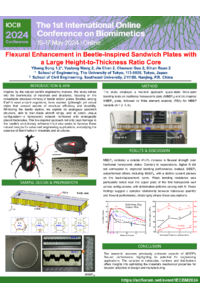
This study investigates the flexural mechanical properties of aluminum middle-trabecular beetle elytron plates (MBEPN) with a significant height-to-thickness ratio core to understand how varying numbers of trabeculae (N) influence their bending resistance.
Introduction: Inspired by the natural world's engineering marvels, this study delves into the biomimetics of materials and structures, focusing on the remarkable structural mimicry of beetle elytron plates. Beetles, among Earth's most ancient organisms, have evolved lightweight yet robust elytra that conceal secrets of structural efficiency and durability. Mimicking the beetle elytron, we explore its analogous sandwich structure, akin to man-made aircraft wings, and its core's unique configuration—a honeycomb network reinforced with strategically placed trabeculae. This bio-inspired approach not only pays homage to the beetle's evolutionary refinement but also seeks to harness these natural designs for advanced engineering applications, embodying the essence of biomimetics in materials and structures.
Methods: This study employed a two-fold approach: quasi-static three-point bending tests on traditional honeycomb plates (MBEP0) and bio-inspired MBEP2 plates, followed by finite element analysis for MBEP variants (N = 2, 4, 6).
Results: MBEP2 exhibited a notable 41.4% increase in flexural strength over traditional honeycomb plates. Contrary to expectations, higher N did not correspond to improved bending performance; instead, MBEP2 outperformed others, including MBEP6, with a distinct upward plateau on the load-displacement curve. Weak bending resistance was particularly noted near the upper plate of the first honeycomb wall across configurations, with deformation patterns varying with N. These findings suggest a complex relationship between trabeculae quantity and flexural performance, challenging simple linear assumptions.
Conclusions: This research uncovers previously unknown aspects of MBEP's flexural performance, highlighting its potential for engineering applications. The variation in trabeculae numbers and distributions offers insights into optimizing the material's mechanical properties for broader utilization in design and manufacturing.
Keywords
aluminum beetle elytron plate
honeycomb plate
flexural properties
thin-walled structure
large height-to-thickness ratio
Poster
Flexural Enhancement in Beetle-Inspired Sandwich Plates with a Large Height-to-Thickness Ratio Core.pdf
The Impact of Simple Layering and Layer Rotation Design on the Natural Vibration Performance of Grid Beetle Elytron Plates
A Mitigating Strategy for Urban Heat Islands: the Biomimicry Approach Case of Delhi