Event submissions
Published
This submission belongs to the session S1. Biomimetics of Materials and Structures of the event The 1st International Online Conference on Biomimetics
Published date
15 May, 2024
Academic Editor
'%3e%3cpath%20d='M12.6657%2010.9104C12.4185%2010.325%2012.0599%209.79327%2011.6097%209.34482C11.1609%208.89508%2010.6293%208.5365%2010.0442%208.28888C10.0389%208.28626%2010.0337%208.28495%2010.0285%208.28233C10.8446%207.69279%2011.3752%206.73249%2011.3752%205.64904C11.3752%203.8542%209.92103%202.39999%208.1262%202.39999C6.33136%202.39999%204.87715%203.8542%204.87715%205.64904C4.87715%206.73249%205.40774%207.69279%206.22393%208.28364C6.21869%208.28626%206.21345%208.28757%206.20821%208.29019C5.62129%208.5378%205.09463%208.89284%204.64265%209.34613C4.1929%209.79493%203.83432%2010.3266%203.58671%2010.9117C3.34345%2011.4845%203.21226%2012.0987%203.20023%2012.7209C3.19988%2012.7349%203.20233%2012.7488%203.20744%2012.7619C3.21255%2012.7749%203.22022%2012.7867%203.22998%2012.7968C3.23975%2012.8068%203.25142%2012.8147%203.26431%2012.8202C3.2772%2012.8256%203.29105%2012.8284%203.30504%2012.8284H4.09109C4.14874%2012.8284%204.19459%2012.7825%204.1959%2012.7262C4.2221%2011.7148%204.62823%2010.7676%205.34617%2010.0497C6.08899%209.30683%207.0755%208.89808%208.1262%208.89808C9.17689%208.89808%2010.1634%209.30683%2010.9062%2010.0497C11.6242%2010.7676%2012.0303%2011.7148%2012.0565%2012.7262C12.0578%2012.7838%2012.1037%2012.8284%2012.1613%2012.8284H12.9474C12.9613%2012.8284%2012.9752%2012.8256%2012.9881%2012.8202C13.001%2012.8147%2013.0126%2012.8068%2013.0224%2012.7968C13.0322%2012.7867%2013.0398%2012.7749%2013.0449%2012.7619C13.0501%2012.7488%2013.0525%2012.7349%2013.0522%2012.7209C13.0391%2012.0947%2012.9094%2011.4855%2012.6657%2010.9104ZM8.1262%207.9024C7.52486%207.9024%206.9589%207.6679%206.53312%207.24211C6.10733%206.81633%205.87283%206.25037%205.87283%205.64904C5.87283%205.0477%206.10733%204.48174%206.53312%204.05596C6.9589%203.63018%207.52486%203.39567%208.1262%203.39567C8.72753%203.39567%209.29349%203.63018%209.71927%204.05596C10.1451%204.48174%2010.3796%205.0477%2010.3796%205.64904C10.3796%206.25037%2010.1451%206.81633%209.71927%207.24211C9.29349%207.6679%208.72753%207.9024%208.1262%207.9024Z'%20fill='%235D1EE1'/%3e%3c/g%3e%3c/svg%3e) Xu Hou
Xu HouCitation
Anushka Dhankhar, Anway Kundu, Neha Basumatary, Sanika Khune Khune, Amit Kumar Jaglan, A Mitigating Strategy for Urban Heat Islands: the Biomimicry Approach Case of Delhi, in Proceedings of The 1st International Online Conference on Biomimetics, 15 May–17 May 2024, MDPI: Basel, Switzerland
Share
Email
Facebook
Twitter
LinkedIn
A Mitigating Strategy for Urban Heat Islands: the Biomimicry Approach Case of Delhi
'%3e%3cpath%20d='M12.6647%2010.9104C12.4176%2010.325%2012.0589%209.7933%2011.6088%209.34485C11.16%208.89511%2010.6283%208.53653%2010.0432%208.28891C10.038%208.28629%2010.0327%208.28498%2010.0275%208.28236C10.8437%207.69282%2011.3743%206.73252%2011.3743%205.64907C11.3743%203.85423%209.92005%202.40002%208.12522%202.40002C6.33038%202.40002%204.87618%203.85423%204.87618%205.64907C4.87618%206.73252%205.40677%207.69282%206.22296%208.28367C6.21772%208.28629%206.21248%208.2876%206.20724%208.29022C5.62031%208.53783%205.09365%208.89287%204.64167%209.34616C4.19192%209.79496%203.83334%2010.3266%203.58573%2010.9117C3.34247%2011.4846%203.21128%2012.0987%203.19925%2012.721C3.1989%2012.735%203.20135%2012.7489%203.20646%2012.7619C3.21157%2012.7749%203.21924%2012.7868%203.22901%2012.7968C3.23877%2012.8068%203.25045%2012.8148%203.26334%2012.8202C3.27623%2012.8256%203.29007%2012.8284%203.30406%2012.8284H4.09012C4.14776%2012.8284%204.19362%2012.7825%204.19493%2012.7262C4.22113%2011.7148%204.62726%2010.7676%205.34519%2010.0497C6.08802%209.30686%207.07452%208.89811%208.12522%208.89811C9.17592%208.89811%2010.1624%209.30686%2010.9052%2010.0497C11.6232%2010.7676%2012.0293%2011.7148%2012.0555%2012.7262C12.0568%2012.7839%2012.1027%2012.8284%2012.1603%2012.8284H12.9464C12.9604%2012.8284%2012.9742%2012.8256%2012.9871%2012.8202C13%2012.8148%2013.0117%2012.8068%2013.0214%2012.7968C13.0312%2012.7868%2013.0389%2012.7749%2013.044%2012.7619C13.0491%2012.7489%2013.0515%2012.735%2013.0512%2012.721C13.0381%2012.0947%2012.9084%2011.4856%2012.6647%2010.9104ZM8.12522%207.90243C7.52388%207.90243%206.95792%207.66793%206.53214%207.24215C6.10636%206.81636%205.87185%206.2504%205.87185%205.64907C5.87185%205.04773%206.10636%204.48177%206.53214%204.05599C6.95792%203.63021%207.52388%203.3957%208.12522%203.3957C8.72655%203.3957%209.29252%203.63021%209.7183%204.05599C10.1441%204.48177%2010.3786%205.04773%2010.3786%205.64907C10.3786%206.2504%2010.1441%206.81636%209.7183%207.24215C9.29252%207.66793%208.72655%207.90243%208.12522%207.90243Z'%20fill='%235D1EE1'/%3e%3c/g%3e%3c/svg%3e)
Anushka Dhankhar 1,2
Anway Kundu 1
Neha Basumatary 1
Sanika Khune Khune 1

Amit Kumar Jaglan 3
1. Student - School of Planning & Architecture, New Delhi
2. Student - Department of Architecture
3. Department of Architecture, School of Planning & Architecture, New Delhi,110002, India
Abstract
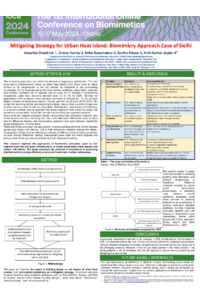
The need for widespread urbanisation has increased due to population growth. Because of this, there is now a phenomenon called an Urban Heat Islands (UHIs), which form when there are greater air levels or surface temperatures in urban areas than in rural areas. The local climate, the urban fabric, the materials used, and the surfaces all contribute to UHIs. Architects (2014) found that with every 0.6 °C increase in midsummer temperature, peak hour power demand climbs 1.5 to 2% for Delhi. It has been projected that for every degree over a (locally specified) cut-off point, mortality rates for populations inside the European Union increase by 1 to 4%. However, in the middle of the hot buildings and humid streets, nature provides us with a multitude of clever cooling strategies that we might imitate. A creative approach to problem solving, bioinspiration, also called biomimicry, draws inspiration from nature to develop and innovate across a range of industries. It offers pleasing aesthetics in addition to useful solutions. A few of the bio-inspired techniques include using materials with high reflectance, i.e., those which are similar to the skin of Saharan ants; imitating the colour and reflectance variations of zebra skin for differential heating; and adding water features and vegetation that are modelled after human skin's evapotranspiration. Quite a few architectural components use these biomimetic concepts. Sun protection is actively provided by kinetic facades. Albedo is increased by the use of materials with high reflectivity. Differential heating caused by the incorporation of materials with varying degrees of reflectance creates convection currents. A localised cooling effect is achieved by the interspersion of green walls, water features, and porous materials that retain water. The goal of this study is to develop sustainable urban environments with lower UHI impacts using biomimetic concepts, such as green infrastructure and bio-inspired materials.
Keywords
Biomimicry
Urban Heat Island
Albedo
Materials
Building Skin
Poster
Sciforum_086655_Anushka_Anway_Neha_Sanika_Amit.pdf
Flexural Enhancement in Beetle-Inspired Sandwich Plates with a Large Height-to-Thickness Ratio Core
Evaluation of the in vitro anti-inflammatory potential of biogenically synthesized Silver/Silver Oxide nanoparticles utilizing pumpkin agricultural byproducts