Event submissions
Published
This submission belongs to the session S5. Poster Session of the event The 1st International Online Conference on Biomimetics
Published date
15 May, 2024
Academic Editor
'%3e%3cpath%20d='M12.6657%2010.9104C12.4185%2010.325%2012.0599%209.79327%2011.6097%209.34482C11.1609%208.89508%2010.6293%208.5365%2010.0442%208.28888C10.0389%208.28626%2010.0337%208.28495%2010.0285%208.28233C10.8446%207.69279%2011.3752%206.73249%2011.3752%205.64904C11.3752%203.8542%209.92103%202.39999%208.1262%202.39999C6.33136%202.39999%204.87715%203.8542%204.87715%205.64904C4.87715%206.73249%205.40774%207.69279%206.22393%208.28364C6.21869%208.28626%206.21345%208.28757%206.20821%208.29019C5.62129%208.5378%205.09463%208.89284%204.64265%209.34613C4.1929%209.79493%203.83432%2010.3266%203.58671%2010.9117C3.34345%2011.4845%203.21226%2012.0987%203.20023%2012.7209C3.19988%2012.7349%203.20233%2012.7488%203.20744%2012.7619C3.21255%2012.7749%203.22022%2012.7867%203.22998%2012.7968C3.23975%2012.8068%203.25142%2012.8147%203.26431%2012.8202C3.2772%2012.8256%203.29105%2012.8284%203.30504%2012.8284H4.09109C4.14874%2012.8284%204.19459%2012.7825%204.1959%2012.7262C4.2221%2011.7148%204.62823%2010.7676%205.34617%2010.0497C6.08899%209.30683%207.0755%208.89808%208.1262%208.89808C9.17689%208.89808%2010.1634%209.30683%2010.9062%2010.0497C11.6242%2010.7676%2012.0303%2011.7148%2012.0565%2012.7262C12.0578%2012.7838%2012.1037%2012.8284%2012.1613%2012.8284H12.9474C12.9613%2012.8284%2012.9752%2012.8256%2012.9881%2012.8202C13.001%2012.8147%2013.0126%2012.8068%2013.0224%2012.7968C13.0322%2012.7867%2013.0398%2012.7749%2013.0449%2012.7619C13.0501%2012.7488%2013.0525%2012.7349%2013.0522%2012.7209C13.0391%2012.0947%2012.9094%2011.4855%2012.6657%2010.9104ZM8.1262%207.9024C7.52486%207.9024%206.9589%207.6679%206.53312%207.24211C6.10733%206.81633%205.87283%206.25037%205.87283%205.64904C5.87283%205.0477%206.10733%204.48174%206.53312%204.05596C6.9589%203.63018%207.52486%203.39567%208.1262%203.39567C8.72753%203.39567%209.29349%203.63018%209.71927%204.05596C10.1451%204.48174%2010.3796%205.0477%2010.3796%205.64904C10.3796%206.25037%2010.1451%206.81633%209.71927%207.24211C9.29349%207.6679%208.72753%207.9024%208.1262%207.9024Z'%20fill='%235D1EE1'/%3e%3c/g%3e%3c/svg%3e) Yongmei Zheng
Yongmei ZhengCitation
Vildan Sultanaev, Anastasia Nazarova, Ivan Stoikov, Biocompatible pillar[5]arene-based ionic liquids containing amino acid fragments as potential water treatment systems, in Proceedings of The 1st International Online Conference on Biomimetics, 15 May–17 May 2024, MDPI: Basel, Switzerland
Share
Email
Facebook
Twitter
LinkedIn
Biocompatible pillar[5]arene-based ionic liquids containing amino acid fragments as potential water treatment systems
'%3e%3cpath%20d='M12.6647%2010.9104C12.4176%2010.325%2012.0589%209.7933%2011.6088%209.34485C11.16%208.89511%2010.6283%208.53653%2010.0432%208.28891C10.038%208.28629%2010.0327%208.28498%2010.0275%208.28236C10.8437%207.69282%2011.3743%206.73252%2011.3743%205.64907C11.3743%203.85423%209.92005%202.40002%208.12522%202.40002C6.33038%202.40002%204.87618%203.85423%204.87618%205.64907C4.87618%206.73252%205.40677%207.69282%206.22296%208.28367C6.21772%208.28629%206.21248%208.2876%206.20724%208.29022C5.62031%208.53783%205.09365%208.89287%204.64167%209.34616C4.19192%209.79496%203.83334%2010.3266%203.58573%2010.9117C3.34247%2011.4846%203.21128%2012.0987%203.19925%2012.721C3.1989%2012.735%203.20135%2012.7489%203.20646%2012.7619C3.21157%2012.7749%203.21924%2012.7868%203.22901%2012.7968C3.23877%2012.8068%203.25045%2012.8148%203.26334%2012.8202C3.27623%2012.8256%203.29007%2012.8284%203.30406%2012.8284H4.09012C4.14776%2012.8284%204.19362%2012.7825%204.19493%2012.7262C4.22113%2011.7148%204.62726%2010.7676%205.34519%2010.0497C6.08802%209.30686%207.07452%208.89811%208.12522%208.89811C9.17592%208.89811%2010.1624%209.30686%2010.9052%2010.0497C11.6232%2010.7676%2012.0293%2011.7148%2012.0555%2012.7262C12.0568%2012.7839%2012.1027%2012.8284%2012.1603%2012.8284H12.9464C12.9604%2012.8284%2012.9742%2012.8256%2012.9871%2012.8202C13%2012.8148%2013.0117%2012.8068%2013.0214%2012.7968C13.0312%2012.7868%2013.0389%2012.7749%2013.044%2012.7619C13.0491%2012.7489%2013.0515%2012.735%2013.0512%2012.721C13.0381%2012.0947%2012.9084%2011.4856%2012.6647%2010.9104ZM8.12522%207.90243C7.52388%207.90243%206.95792%207.66793%206.53214%207.24215C6.10636%206.81636%205.87185%206.2504%205.87185%205.64907C5.87185%205.04773%206.10636%204.48177%206.53214%204.05599C6.95792%203.63021%207.52388%203.3957%208.12522%203.3957C8.72655%203.3957%209.29252%203.63021%209.7183%204.05599C10.1441%204.48177%2010.3786%205.04773%2010.3786%205.64907C10.3786%206.2504%2010.1441%206.81636%209.7183%207.24215C9.29252%207.66793%208.72655%207.90243%208.12522%207.90243Z'%20fill='%235D1EE1'/%3e%3c/g%3e%3c/svg%3e)
Vildan Sultanaev 1
Anastasia Nazarova 1

Ivan Stoikov 1
1. A.M. Butlerov Chemical Institute, Kazan Federal University, 420008 Kazan, Kremlevskaya 18, Russian Federation
Abstract
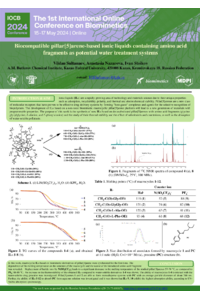
Ionic liquids (ILs) are a rapidly growing area of technology and materials science due to their unique properties such as adsorption, recyclability, polarity, and thermal and electrochemical stability. Pillar[5]arenes are a new class of molecular receptors that have proven to be effective drug delivery systems by forming "host-guest" complexes and agents for the selective recognition of biopolymers. The development of ILs based on a non-toxic biomimetic macrocyclic pillar[5]arene platform will lead to a new generation of materials with programmable properties. The purpose of this work is the synthesis of new ILs based on decasubstituted pillar[5]arenes with amino acid fragments (glycine, glycylglycine, L-alanine, and L-phenylalanine) and the study of their thermal stability and the effect of substituents and counterions, as well as the absorption of water-soluble pollutants. Melting point determination and simultaneous thermogravimetry (TG) and differential scanning calorimetry (DSC) were used to study the thermodynamic properties of the ILs. UV spectroscopy was applied to study the interaction and absorption of contaminants by ILs.
Replacement of the bromide anion in the pillar[5]arene structure with NTf2– resulted in a more significant decrease in melting point (56–88 °C) compared to the PF6– anion (86–95 °C), which is logically related to the symmetry and density of the molecular packing. The onset of decomposition of the synthesized compounds was established at 240–300 °C. ILs with L-phenylalanine residues showed lower thermal stability and higher melting points compared to smaller fragments (glycine, alanine). The absorption of water-soluble contaminants by ionic liquids was shown to be possible, as expressed by a decrease in optical density.
The obtained results can be applied to the design of novel biomimetic supramolecular materials for substrate recognition and water treatment.
The work was supported by the Russian Science Foundation (№ 23-73-01087), https://rscf.ru/en/project/23-73-01087/
Keywords
pillar[5]arene
ionic liquids
amino acids
thermal stability
water treatment
Poster
Sultanaev VR_IOCB-2024.pdf
Multi-FMAV time-varying formation control method with mixed delay
Biomimetic Synthesis of Lepidocrocite on Marine Spongin Scaffolds: Mechanistic Insights and Multifunctional Potential