Event submissions
Published
This submission belongs to the session S5. Poster Session of the event The 1st International Online Conference on Biomimetics
Published date
15 May, 2024
Academic Editor
'%3e%3cpath%20d='M12.6657%2010.9104C12.4185%2010.325%2012.0599%209.79327%2011.6097%209.34482C11.1609%208.89508%2010.6293%208.5365%2010.0442%208.28888C10.0389%208.28626%2010.0337%208.28495%2010.0285%208.28233C10.8446%207.69279%2011.3752%206.73249%2011.3752%205.64904C11.3752%203.8542%209.92103%202.39999%208.1262%202.39999C6.33136%202.39999%204.87715%203.8542%204.87715%205.64904C4.87715%206.73249%205.40774%207.69279%206.22393%208.28364C6.21869%208.28626%206.21345%208.28757%206.20821%208.29019C5.62129%208.5378%205.09463%208.89284%204.64265%209.34613C4.1929%209.79493%203.83432%2010.3266%203.58671%2010.9117C3.34345%2011.4845%203.21226%2012.0987%203.20023%2012.7209C3.19988%2012.7349%203.20233%2012.7488%203.20744%2012.7619C3.21255%2012.7749%203.22022%2012.7867%203.22998%2012.7968C3.23975%2012.8068%203.25142%2012.8147%203.26431%2012.8202C3.2772%2012.8256%203.29105%2012.8284%203.30504%2012.8284H4.09109C4.14874%2012.8284%204.19459%2012.7825%204.1959%2012.7262C4.2221%2011.7148%204.62823%2010.7676%205.34617%2010.0497C6.08899%209.30683%207.0755%208.89808%208.1262%208.89808C9.17689%208.89808%2010.1634%209.30683%2010.9062%2010.0497C11.6242%2010.7676%2012.0303%2011.7148%2012.0565%2012.7262C12.0578%2012.7838%2012.1037%2012.8284%2012.1613%2012.8284H12.9474C12.9613%2012.8284%2012.9752%2012.8256%2012.9881%2012.8202C13.001%2012.8147%2013.0126%2012.8068%2013.0224%2012.7968C13.0322%2012.7867%2013.0398%2012.7749%2013.0449%2012.7619C13.0501%2012.7488%2013.0525%2012.7349%2013.0522%2012.7209C13.0391%2012.0947%2012.9094%2011.4855%2012.6657%2010.9104ZM8.1262%207.9024C7.52486%207.9024%206.9589%207.6679%206.53312%207.24211C6.10733%206.81633%205.87283%206.25037%205.87283%205.64904C5.87283%205.0477%206.10733%204.48174%206.53312%204.05596C6.9589%203.63018%207.52486%203.39567%208.1262%203.39567C8.72753%203.39567%209.29349%203.63018%209.71927%204.05596C10.1451%204.48174%2010.3796%205.0477%2010.3796%205.64904C10.3796%206.25037%2010.1451%206.81633%209.71927%207.24211C9.29349%207.6679%208.72753%207.9024%208.1262%207.9024Z'%20fill='%235D1EE1'/%3e%3c/g%3e%3c/svg%3e) Marc Weissburg
Marc WeissburgCitation
Anita Kubiak, Martyna Pajewska-Szmyt, Martyna Kotula, Bartosz Leśniewski, Kamil Dydek, Hermann Ehrlich, Biomimetic Synthesis of Lepidocrocite on Marine Spongin Scaffolds: Mechanistic Insights and Multifunctional Potential, in Proceedings of The 1st International Online Conference on Biomimetics, 15 May–17 May 2024, MDPI: Basel, Switzerland
Share
Email
Facebook
Twitter
LinkedIn
Biomimetic Synthesis of Lepidocrocite on Marine Spongin Scaffolds: Mechanistic Insights and Multifunctional Potential

Anita Kubiak 1,2
'%3e%3cpath%20d='M12.6647%2010.9104C12.4176%2010.325%2012.0589%209.7933%2011.6088%209.34485C11.16%208.89511%2010.6283%208.53653%2010.0432%208.28891C10.038%208.28629%2010.0327%208.28498%2010.0275%208.28236C10.8437%207.69282%2011.3743%206.73252%2011.3743%205.64907C11.3743%203.85423%209.92005%202.40002%208.12522%202.40002C6.33038%202.40002%204.87618%203.85423%204.87618%205.64907C4.87618%206.73252%205.40677%207.69282%206.22296%208.28367C6.21772%208.28629%206.21248%208.2876%206.20724%208.29022C5.62031%208.53783%205.09365%208.89287%204.64167%209.34616C4.19192%209.79496%203.83334%2010.3266%203.58573%2010.9117C3.34247%2011.4846%203.21128%2012.0987%203.19925%2012.721C3.1989%2012.735%203.20135%2012.7489%203.20646%2012.7619C3.21157%2012.7749%203.21924%2012.7868%203.22901%2012.7968C3.23877%2012.8068%203.25045%2012.8148%203.26334%2012.8202C3.27623%2012.8256%203.29007%2012.8284%203.30406%2012.8284H4.09012C4.14776%2012.8284%204.19362%2012.7825%204.19493%2012.7262C4.22113%2011.7148%204.62726%2010.7676%205.34519%2010.0497C6.08802%209.30686%207.07452%208.89811%208.12522%208.89811C9.17592%208.89811%2010.1624%209.30686%2010.9052%2010.0497C11.6232%2010.7676%2012.0293%2011.7148%2012.0555%2012.7262C12.0568%2012.7839%2012.1027%2012.8284%2012.1603%2012.8284H12.9464C12.9604%2012.8284%2012.9742%2012.8256%2012.9871%2012.8202C13%2012.8148%2013.0117%2012.8068%2013.0214%2012.7968C13.0312%2012.7868%2013.0389%2012.7749%2013.044%2012.7619C13.0491%2012.7489%2013.0515%2012.735%2013.0512%2012.721C13.0381%2012.0947%2012.9084%2011.4856%2012.6647%2010.9104ZM8.12522%207.90243C7.52388%207.90243%206.95792%207.66793%206.53214%207.24215C6.10636%206.81636%205.87185%206.2504%205.87185%205.64907C5.87185%205.04773%206.10636%204.48177%206.53214%204.05599C6.95792%203.63021%207.52388%203.3957%208.12522%203.3957C8.72655%203.3957%209.29252%203.63021%209.7183%204.05599C10.1441%204.48177%2010.3786%205.04773%2010.3786%205.64907C10.3786%206.2504%2010.1441%206.81636%209.7183%207.24215C9.29252%207.66793%208.72655%207.90243%208.12522%207.90243Z'%20fill='%235D1EE1'/%3e%3c/g%3e%3c/svg%3e)
Martyna Pajewska-Szmyt 3
Martyna Kotula 1,3
Bartosz Leśniewski 1,3
Kamil Dydek 3

Hermann Ehrlich 3,4
1. Faculty of Chemistry, Adam Mickiewicz University, Uniwersytetu Poznańskiego 8, 61-614 Poznan, Poland
2. Center of Advanced Technology, Adam Mickiewicz University, Uniwersytetu Poznańskiego 10, 61-614, Poznan, Poland
3. Center of Advanced Technology, Adam Mickiewicz University, Uniwersytetu Poznańskiego 10, 61-614 Poznan, Poland
4. Institute of Chemical Technology and Engineering, University of Technology, Berdychowo 4, 60-965 Poznan, Poland
Abstract
Introduction
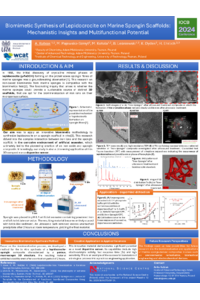
In 19681, a significant milestone in marine biomineralogy was achieved through the observation of crystalline lepidocrocite mineral phases (γ-FeOOH) forming on the proteinaceous spongin fibers of marine demosponges. This finding laid the foundation for exploring the field of biomimetics, raising intriguing questions about the potential of marine sponges as a sustainable source of unique spongin-based 3D scaffolds suitable for the in vitro biomineralization of iron ions on and within their microporous surfaces2.
Methods
Our recent advancements have employed cutting-edge biomimetic techniques to synthesize lepidocrocite in vitro on a spongin scaffold 3. This research study explores the complex interaction between iron ions and the spongin scaffold in an artificial seawater environment, resulting in the development of a centimeter-large 3D iron–spongin composite. It is analyzed using analytical techniques including digital optical microscopy, scanning electron microscopy (SEM/EDX), high-resolution transmission electron microscopy (HRTEM), FTIR, X-ray diffraction, and confocal micro X-ray fluorescence spectroscopy (CMXRF).
Results
Our research reveals a likely mechanism for lepidocrocite formation, seemingly linked to the amino acid functional groups in spongin. Building on this insight, we developed an iron–spongin composite characterized by its porosity, macroscopic 3D structure, and magnetic properties, as confirmed by comprehensive analyses using various techniques. Moving beyond merely providing foundational knowledge, our study pioneers the application of this 3D composite as a dopamine sensor. This represents not just a breakthrough in sensor technology but also exemplifies the effective translation of a biological process into a practical engineering application.
Conclusions
We successfully synthesized the 3D iron–spongin composite in vitro, leveraging the unique properties of spongin and its interaction with iron. This innovative material demonstrates significant potential as a novel dopamine sensor, highlighting its broader applicability in fields such as environmental remediation, biomedical engineering, and electrochemical devices, thereby exemplifying the seamless integration of biomimetic research with practical engineering solutions.
Keywords
marine sponge
lepidocrocite
biomineralization
sensor
dopamine
Poster
Poster - Online IOCB 2024.pdf
Biocompatible pillar[5]arene-based ionic liquids containing amino acid fragments as potential water treatment systems
Image analysis of butterfly wing surfaces for the creation of new biomimetic materials