Event submissions
Published
This submission belongs to the session S1. Biomimetics of Materials and Structures of the event The 1st International Online Conference on Biomimetics
Published date
15 May, 2024
Academic Editor
'%3e%3cpath%20d='M12.6657%2010.9104C12.4185%2010.325%2012.0599%209.79327%2011.6097%209.34482C11.1609%208.89508%2010.6293%208.5365%2010.0442%208.28888C10.0389%208.28626%2010.0337%208.28495%2010.0285%208.28233C10.8446%207.69279%2011.3752%206.73249%2011.3752%205.64904C11.3752%203.8542%209.92103%202.39999%208.1262%202.39999C6.33136%202.39999%204.87715%203.8542%204.87715%205.64904C4.87715%206.73249%205.40774%207.69279%206.22393%208.28364C6.21869%208.28626%206.21345%208.28757%206.20821%208.29019C5.62129%208.5378%205.09463%208.89284%204.64265%209.34613C4.1929%209.79493%203.83432%2010.3266%203.58671%2010.9117C3.34345%2011.4845%203.21226%2012.0987%203.20023%2012.7209C3.19988%2012.7349%203.20233%2012.7488%203.20744%2012.7619C3.21255%2012.7749%203.22022%2012.7867%203.22998%2012.7968C3.23975%2012.8068%203.25142%2012.8147%203.26431%2012.8202C3.2772%2012.8256%203.29105%2012.8284%203.30504%2012.8284H4.09109C4.14874%2012.8284%204.19459%2012.7825%204.1959%2012.7262C4.2221%2011.7148%204.62823%2010.7676%205.34617%2010.0497C6.08899%209.30683%207.0755%208.89808%208.1262%208.89808C9.17689%208.89808%2010.1634%209.30683%2010.9062%2010.0497C11.6242%2010.7676%2012.0303%2011.7148%2012.0565%2012.7262C12.0578%2012.7838%2012.1037%2012.8284%2012.1613%2012.8284H12.9474C12.9613%2012.8284%2012.9752%2012.8256%2012.9881%2012.8202C13.001%2012.8147%2013.0126%2012.8068%2013.0224%2012.7968C13.0322%2012.7867%2013.0398%2012.7749%2013.0449%2012.7619C13.0501%2012.7488%2013.0525%2012.7349%2013.0522%2012.7209C13.0391%2012.0947%2012.9094%2011.4855%2012.6657%2010.9104ZM8.1262%207.9024C7.52486%207.9024%206.9589%207.6679%206.53312%207.24211C6.10733%206.81633%205.87283%206.25037%205.87283%205.64904C5.87283%205.0477%206.10733%204.48174%206.53312%204.05596C6.9589%203.63018%207.52486%203.39567%208.1262%203.39567C8.72753%203.39567%209.29349%203.63018%209.71927%204.05596C10.1451%204.48174%2010.3796%205.0477%2010.3796%205.64904C10.3796%206.25037%2010.1451%206.81633%209.71927%207.24211C9.29349%207.6679%208.72753%207.9024%208.1262%207.9024Z'%20fill='%235D1EE1'/%3e%3c/g%3e%3c/svg%3e) Xu Hou
Xu HouCitation
Anastasia N. Kocheva, Konstantin V. Deriabin, Regina M. Islamova, Chameleon-like self-healing flexible materials based on ferrocenyl-containing polysiloxanes, in Proceedings of The 1st International Online Conference on Biomimetics, 15 May–17 May 2024, MDPI: Basel, Switzerland
Share
Email
Facebook
Twitter
LinkedIn
Chameleon-like self-healing flexible materials based on ferrocenyl-containing polysiloxanes
'%3e%3cpath%20d='M12.6647%2010.9104C12.4176%2010.325%2012.0589%209.7933%2011.6088%209.34485C11.16%208.89511%2010.6283%208.53653%2010.0432%208.28891C10.038%208.28629%2010.0327%208.28498%2010.0275%208.28236C10.8437%207.69282%2011.3743%206.73252%2011.3743%205.64907C11.3743%203.85423%209.92005%202.40002%208.12522%202.40002C6.33038%202.40002%204.87618%203.85423%204.87618%205.64907C4.87618%206.73252%205.40677%207.69282%206.22296%208.28367C6.21772%208.28629%206.21248%208.2876%206.20724%208.29022C5.62031%208.53783%205.09365%208.89287%204.64167%209.34616C4.19192%209.79496%203.83334%2010.3266%203.58573%2010.9117C3.34247%2011.4846%203.21128%2012.0987%203.19925%2012.721C3.1989%2012.735%203.20135%2012.7489%203.20646%2012.7619C3.21157%2012.7749%203.21924%2012.7868%203.22901%2012.7968C3.23877%2012.8068%203.25045%2012.8148%203.26334%2012.8202C3.27623%2012.8256%203.29007%2012.8284%203.30406%2012.8284H4.09012C4.14776%2012.8284%204.19362%2012.7825%204.19493%2012.7262C4.22113%2011.7148%204.62726%2010.7676%205.34519%2010.0497C6.08802%209.30686%207.07452%208.89811%208.12522%208.89811C9.17592%208.89811%2010.1624%209.30686%2010.9052%2010.0497C11.6232%2010.7676%2012.0293%2011.7148%2012.0555%2012.7262C12.0568%2012.7839%2012.1027%2012.8284%2012.1603%2012.8284H12.9464C12.9604%2012.8284%2012.9742%2012.8256%2012.9871%2012.8202C13%2012.8148%2013.0117%2012.8068%2013.0214%2012.7968C13.0312%2012.7868%2013.0389%2012.7749%2013.044%2012.7619C13.0491%2012.7489%2013.0515%2012.735%2013.0512%2012.721C13.0381%2012.0947%2012.9084%2011.4856%2012.6647%2010.9104ZM8.12522%207.90243C7.52388%207.90243%206.95792%207.66793%206.53214%207.24215C6.10636%206.81636%205.87185%206.2504%205.87185%205.64907C5.87185%205.04773%206.10636%204.48177%206.53214%204.05599C6.95792%203.63021%207.52388%203.3957%208.12522%203.3957C8.72655%203.3957%209.29252%203.63021%209.7183%204.05599C10.1441%204.48177%2010.3786%205.04773%2010.3786%205.64907C10.3786%206.2504%2010.1441%206.81636%209.7183%207.24215C9.29252%207.66793%208.72655%207.90243%208.12522%207.90243Z'%20fill='%235D1EE1'/%3e%3c/g%3e%3c/svg%3e)
Anastasia N. Kocheva 1
Konstantin V. Deriabin 1
Regina M. Islamova 1
1. St. Petersburg State University, 7/9 Universitetskaya nab., St. Petersburg, 199034
Abstract
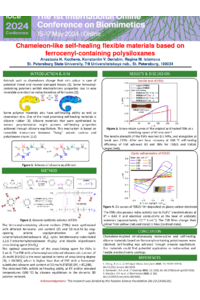
Animals such as chameleons change their skin colour in case of potential threat and recover damaged tissues [1]. Some ferrocenyl-containing polymers are similar to chameleon skin in terms of its colour-changing behaviour. For instance, they exhibit electrochromic properties due to easy reversible one-electron redox transition [2].
Another feature of chameleons represented in polymer materials is their self-healing ability. One of the most promising self-healing materials is silicone rubber [3]. Some silicone materials possess self-healing properties achieved through siloxane equilibrium. This mechanism is based on reversible interactions between “living” anionic centres and polysiloxane chains [2,3].
The siloxane equilibrium discussed above allowed us to prepare unique chameleon-like ferrocenyl-containing silicone rubbers (FSRs) which exhibit both electrochromic and self-healing properties [2]. Thus, FSRs were obtained through ring-opening anionic copolymerisation of cyclic siloxane monomers including octamethylcyclotetrasiloxane (D4), tetraferrocenyl-substituted cyclotetrasiloxane (1,3,5,7-(2-ferrocenylethyl)-1,3,5,7-tetramethylcyclotetrasiloxane, Fc4D4), and bicyclic cross-linking agent (bis-D4). The physicochemical properties of the FSRs were estimated by tensile tests and cyclic voltammetry. As a result, the tensile strength of the FSRs reached 0.1 MPa, and elongation at break was 215%. After one hour, the recovery of FSR self-healing efficiency at 25 and 100 °C reached 98%. The FSRs also possess redox activity (Fc/Fc+ transformations at E0 = 0.43 V) and electrical conductivity at the level of antistatic materials (approximately 10–10 S cm–1). The FSR films change their colour from yellow (reduced state) to blue (oxidised state). Our chameleon-inspired materials could find potential application as redox-active and flexible electrochromic coatings.
This research was funded by the Russian Science Foundation (№ 23-23-00103).
References:
- Zheng, R. et al. // ACS Appl. Mater. Interfaces 2018, 10, 35533–35538, doi:10.1021/acsami.8b13249.
- Rashevskii, A.A. et al. // Coatings 2023, 13, 1282, doi:10.3390/coatings13071282.
- Deriabin, K.V. et al. // Biomimetics 2023, 8, 286, doi:10.3390/biomimetics8030286.
Keywords
self-healing materials
polysiloxanes
ferrocenyl-containing silicone materials
cross-linking
siloxane equilibrium
electrochromic properties
Poster
Kocheva biomimetics poster.pdf
Mimicking the dynamic mechanical ECM using engineered biomaterials to investigate cellular crosstalk
Penetration mechanism of the model based on Legionella gormanii bacterial membranes using the LL-37 peptide