Event submissions
Published
This submission belongs to the session S1. Biomimetics of Materials and Structures of the event The 1st International Online Conference on Biomimetics
Published date
15 May, 2024
Academic Editor
'%3e%3cpath%20d='M12.6657%2010.9104C12.4185%2010.325%2012.0599%209.79327%2011.6097%209.34482C11.1609%208.89508%2010.6293%208.5365%2010.0442%208.28888C10.0389%208.28626%2010.0337%208.28495%2010.0285%208.28233C10.8446%207.69279%2011.3752%206.73249%2011.3752%205.64904C11.3752%203.8542%209.92103%202.39999%208.1262%202.39999C6.33136%202.39999%204.87715%203.8542%204.87715%205.64904C4.87715%206.73249%205.40774%207.69279%206.22393%208.28364C6.21869%208.28626%206.21345%208.28757%206.20821%208.29019C5.62129%208.5378%205.09463%208.89284%204.64265%209.34613C4.1929%209.79493%203.83432%2010.3266%203.58671%2010.9117C3.34345%2011.4845%203.21226%2012.0987%203.20023%2012.7209C3.19988%2012.7349%203.20233%2012.7488%203.20744%2012.7619C3.21255%2012.7749%203.22022%2012.7867%203.22998%2012.7968C3.23975%2012.8068%203.25142%2012.8147%203.26431%2012.8202C3.2772%2012.8256%203.29105%2012.8284%203.30504%2012.8284H4.09109C4.14874%2012.8284%204.19459%2012.7825%204.1959%2012.7262C4.2221%2011.7148%204.62823%2010.7676%205.34617%2010.0497C6.08899%209.30683%207.0755%208.89808%208.1262%208.89808C9.17689%208.89808%2010.1634%209.30683%2010.9062%2010.0497C11.6242%2010.7676%2012.0303%2011.7148%2012.0565%2012.7262C12.0578%2012.7838%2012.1037%2012.8284%2012.1613%2012.8284H12.9474C12.9613%2012.8284%2012.9752%2012.8256%2012.9881%2012.8202C13.001%2012.8147%2013.0126%2012.8068%2013.0224%2012.7968C13.0322%2012.7867%2013.0398%2012.7749%2013.0449%2012.7619C13.0501%2012.7488%2013.0525%2012.7349%2013.0522%2012.7209C13.0391%2012.0947%2012.9094%2011.4855%2012.6657%2010.9104ZM8.1262%207.9024C7.52486%207.9024%206.9589%207.6679%206.53312%207.24211C6.10733%206.81633%205.87283%206.25037%205.87283%205.64904C5.87283%205.0477%206.10733%204.48174%206.53312%204.05596C6.9589%203.63018%207.52486%203.39567%208.1262%203.39567C8.72753%203.39567%209.29349%203.63018%209.71927%204.05596C10.1451%204.48174%2010.3796%205.0477%2010.3796%205.64904C10.3796%206.25037%2010.1451%206.81633%209.71927%207.24211C9.29349%207.6679%208.72753%207.9024%208.1262%207.9024Z'%20fill='%235D1EE1'/%3e%3c/g%3e%3c/svg%3e) Xu Hou
Xu HouCitation
Anna S. Miroshnichenko, Ivan S. Mukhin, Regina M Islamova, Bioinspired self-healing luminescent lanthanide bipyridinedicarboxiamide complexes, in Proceedings of The 1st International Online Conference on Biomimetics, 15 May–17 May 2024, MDPI: Basel, Switzerland
Share
Email
Facebook
Twitter
LinkedIn
Bioinspired self-healing luminescent lanthanide bipyridinedicarboxiamide complexes
'%3e%3cpath%20d='M12.6647%2010.9104C12.4176%2010.325%2012.0589%209.7933%2011.6088%209.34485C11.16%208.89511%2010.6283%208.53653%2010.0432%208.28891C10.038%208.28629%2010.0327%208.28498%2010.0275%208.28236C10.8437%207.69282%2011.3743%206.73252%2011.3743%205.64907C11.3743%203.85423%209.92005%202.40002%208.12522%202.40002C6.33038%202.40002%204.87618%203.85423%204.87618%205.64907C4.87618%206.73252%205.40677%207.69282%206.22296%208.28367C6.21772%208.28629%206.21248%208.2876%206.20724%208.29022C5.62031%208.53783%205.09365%208.89287%204.64167%209.34616C4.19192%209.79496%203.83334%2010.3266%203.58573%2010.9117C3.34247%2011.4846%203.21128%2012.0987%203.19925%2012.721C3.1989%2012.735%203.20135%2012.7489%203.20646%2012.7619C3.21157%2012.7749%203.21924%2012.7868%203.22901%2012.7968C3.23877%2012.8068%203.25045%2012.8148%203.26334%2012.8202C3.27623%2012.8256%203.29007%2012.8284%203.30406%2012.8284H4.09012C4.14776%2012.8284%204.19362%2012.7825%204.19493%2012.7262C4.22113%2011.7148%204.62726%2010.7676%205.34519%2010.0497C6.08802%209.30686%207.07452%208.89811%208.12522%208.89811C9.17592%208.89811%2010.1624%209.30686%2010.9052%2010.0497C11.6232%2010.7676%2012.0293%2011.7148%2012.0555%2012.7262C12.0568%2012.7839%2012.1027%2012.8284%2012.1603%2012.8284H12.9464C12.9604%2012.8284%2012.9742%2012.8256%2012.9871%2012.8202C13%2012.8148%2013.0117%2012.8068%2013.0214%2012.7968C13.0312%2012.7868%2013.0389%2012.7749%2013.044%2012.7619C13.0491%2012.7489%2013.0515%2012.735%2013.0512%2012.721C13.0381%2012.0947%2012.9084%2011.4856%2012.6647%2010.9104ZM8.12522%207.90243C7.52388%207.90243%206.95792%207.66793%206.53214%207.24215C6.10636%206.81636%205.87185%206.2504%205.87185%205.64907C5.87185%205.04773%206.10636%204.48177%206.53214%204.05599C6.95792%203.63021%207.52388%203.3957%208.12522%203.3957C8.72655%203.3957%209.29252%203.63021%209.7183%204.05599C10.1441%204.48177%2010.3786%205.04773%2010.3786%205.64907C10.3786%206.2504%2010.1441%206.81636%209.7183%207.24215C9.29252%207.66793%208.72655%207.90243%208.12522%207.90243Z'%20fill='%235D1EE1'/%3e%3c/g%3e%3c/svg%3e)
Anna S. Miroshnichenko 1,2
Ivan S. Mukhin 2,3
Regina M Islamova 1
1. St. Petersburg University, 7/9 Universitetskaya nab., St. Petersburg 199034, Russia
2. Laboratory of Renewable Energy Sources, St. Petersburg Academic University, 8/3 Khlopina Str., St. Petersburg 194021, Russia
3. High School of Engineering Physics, The Great St. Petersburg Polytechnical University, 29 Polytechnicheskaya Str., St. Petersburg 195251, Russia
Abstract
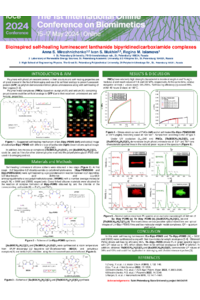
Polymers with photoluminescent centers in their structure are of great interest in the field of bioimaging and could be artificial analogs to green fluorescent protein (GFP) from jellyfish [1]. Along with intrinsic photoluminescence, jellyfish also demonstrate self-healing of their organs, which allow the creatures to survive in aquatic environments [2]. Polymer metal complexes (PMCs) of europium(III) and terbium(III) could be artificial analogs to GFP due to their excellent luminescent properties (Tb3+ and Eu3+) and to the bioinertness of PDMS.
Europium(III) and terbium(III)-containing 2,2'-bipyridine-6,6'-dicarboxamide-co-polydimethylsiloxanes (Eu-Bipy-PDMS and Tb-Bipy-PDMS) [3] and their low-molecular complexes [Tb(BDCA)2(H2O)]Cl3 and [Eu(BDCA)2(H2O)]Cl3 [4] were synthetized by polycondensation and complexation reactions. The structure of the obtained complexes was confirmed by NMR, IR spectroscopy, and XRD analysis. A tensile property study was carried out on a Shimadzu EZ-L-5kN testing machine (RT, constant stretching rate of 10 mm∙min–1, sample shape ISO 37 type 3). Photoluminescence spectra and quantum yields (QYs) were studied using a HORIBA Fluorolog-3 spectrofluorometer with an integrating sphere (101 mm in diameter) at RT.
Eu-Bipy-PDMS and Tb-Bipy-PDMS show QYs of 10.5% and 18.5%. The PMCs' structure enables the formation of coordinatively saturated complexes of lanthanide ions and provides good tensile properties to Eu-Bipy-PDMS (1.55 MPa, 185%) and Tb-Bipy-PDMS (1.48 MPa, 190%). The self-healing efficiency of PMCs exceed 90%. [Tb(BDCA)2(H2O)]Cl3 and [Eu(BDCA)2(H2O)]Cl3 show high QYs of 36.5% and 12.6%, respectively, and can retain them after encapsulation in a semitransparent biocompatible polyethyleneglycol matrix (11.2% and 25.3%, respectively) .
Both obtained self-healing luminescent lanthanide-containing PMCs and their low-molecular analogs could be used in bioimaging and theranostics [5].
Financial support for this study was provided by St. Petersburg State University (project 94124215).
- Zhang, Y. et.al. // J. Mater. Chem. B 2013, 1, 132–148.
- Liu, Y. et.al. // Nat Commun 2022, 13, 1338.
- Miroshnichenko, A.S. et.al. // ACS Appl. Polym. Mater. 2022, 4, 2683–2690.
- Miroshnichenko, A.S. et.al. // Polymers 2022, 14, 5540.
- Ranjan, S. et.al. // Nanomedicine 2015, 10, 1477–1491.
Keywords
lanthanides
photoluminescence
polymer-metal complexes
self-healing
Poster
Miroshnichenko AS.pdf
Penetration mechanism of the model based on Legionella gormanii bacterial membranes using the LL-37 peptide
Bio-inspired Neural Network for Real-time Evasion of Multi-robot Systems in Dynamic Environments