Event submissions
Published
This submission belongs to the session S2. Biomimetic Design, Constructions and Devices of the event The 1st International Online Conference on Biomimetics
Published date
15 May, 2024
Academic Editor
'%3e%3cpath%20d='M12.6657%2010.9104C12.4185%2010.325%2012.0599%209.79327%2011.6097%209.34482C11.1609%208.89508%2010.6293%208.5365%2010.0442%208.28888C10.0389%208.28626%2010.0337%208.28495%2010.0285%208.28233C10.8446%207.69279%2011.3752%206.73249%2011.3752%205.64904C11.3752%203.8542%209.92103%202.39999%208.1262%202.39999C6.33136%202.39999%204.87715%203.8542%204.87715%205.64904C4.87715%206.73249%205.40774%207.69279%206.22393%208.28364C6.21869%208.28626%206.21345%208.28757%206.20821%208.29019C5.62129%208.5378%205.09463%208.89284%204.64265%209.34613C4.1929%209.79493%203.83432%2010.3266%203.58671%2010.9117C3.34345%2011.4845%203.21226%2012.0987%203.20023%2012.7209C3.19988%2012.7349%203.20233%2012.7488%203.20744%2012.7619C3.21255%2012.7749%203.22022%2012.7867%203.22998%2012.7968C3.23975%2012.8068%203.25142%2012.8147%203.26431%2012.8202C3.2772%2012.8256%203.29105%2012.8284%203.30504%2012.8284H4.09109C4.14874%2012.8284%204.19459%2012.7825%204.1959%2012.7262C4.2221%2011.7148%204.62823%2010.7676%205.34617%2010.0497C6.08899%209.30683%207.0755%208.89808%208.1262%208.89808C9.17689%208.89808%2010.1634%209.30683%2010.9062%2010.0497C11.6242%2010.7676%2012.0303%2011.7148%2012.0565%2012.7262C12.0578%2012.7838%2012.1037%2012.8284%2012.1613%2012.8284H12.9474C12.9613%2012.8284%2012.9752%2012.8256%2012.9881%2012.8202C13.001%2012.8147%2013.0126%2012.8068%2013.0224%2012.7968C13.0322%2012.7867%2013.0398%2012.7749%2013.0449%2012.7619C13.0501%2012.7488%2013.0525%2012.7349%2013.0522%2012.7209C13.0391%2012.0947%2012.9094%2011.4855%2012.6657%2010.9104ZM8.1262%207.9024C7.52486%207.9024%206.9589%207.6679%206.53312%207.24211C6.10733%206.81633%205.87283%206.25037%205.87283%205.64904C5.87283%205.0477%206.10733%204.48174%206.53312%204.05596C6.9589%203.63018%207.52486%203.39567%208.1262%203.39567C8.72753%203.39567%209.29349%203.63018%209.71927%204.05596C10.1451%204.48174%2010.3796%205.0477%2010.3796%205.64904C10.3796%206.25037%2010.1451%206.81633%209.71927%207.24211C9.29349%207.6679%208.72753%207.9024%208.1262%207.9024Z'%20fill='%235D1EE1'/%3e%3c/g%3e%3c/svg%3e) Marc Weissburg
Marc WeissburgCitation
Maryam Ghahremani-Nasab, Azizeh Rahmani Del Bakhshayesh, Soraya Babaie, Ahmad Mehdipour, The regenerative potential of biomimetic construct based on hydrogel loaded with biological agents and hypoxic MSCs, in Proceedings of The 1st International Online Conference on Biomimetics, 15 May–17 May 2024, MDPI: Basel, Switzerland
Share
Email
Facebook
Twitter
LinkedIn
The regenerative potential of biomimetic construct based on hydrogel loaded with biological agents and hypoxic MSCs
'%3e%3cpath%20d='M12.6647%2010.9104C12.4176%2010.325%2012.0589%209.7933%2011.6088%209.34485C11.16%208.89511%2010.6283%208.53653%2010.0432%208.28891C10.038%208.28629%2010.0327%208.28498%2010.0275%208.28236C10.8437%207.69282%2011.3743%206.73252%2011.3743%205.64907C11.3743%203.85423%209.92005%202.40002%208.12522%202.40002C6.33038%202.40002%204.87618%203.85423%204.87618%205.64907C4.87618%206.73252%205.40677%207.69282%206.22296%208.28367C6.21772%208.28629%206.21248%208.2876%206.20724%208.29022C5.62031%208.53783%205.09365%208.89287%204.64167%209.34616C4.19192%209.79496%203.83334%2010.3266%203.58573%2010.9117C3.34247%2011.4846%203.21128%2012.0987%203.19925%2012.721C3.1989%2012.735%203.20135%2012.7489%203.20646%2012.7619C3.21157%2012.7749%203.21924%2012.7868%203.22901%2012.7968C3.23877%2012.8068%203.25045%2012.8148%203.26334%2012.8202C3.27623%2012.8256%203.29007%2012.8284%203.30406%2012.8284H4.09012C4.14776%2012.8284%204.19362%2012.7825%204.19493%2012.7262C4.22113%2011.7148%204.62726%2010.7676%205.34519%2010.0497C6.08802%209.30686%207.07452%208.89811%208.12522%208.89811C9.17592%208.89811%2010.1624%209.30686%2010.9052%2010.0497C11.6232%2010.7676%2012.0293%2011.7148%2012.0555%2012.7262C12.0568%2012.7839%2012.1027%2012.8284%2012.1603%2012.8284H12.9464C12.9604%2012.8284%2012.9742%2012.8256%2012.9871%2012.8202C13%2012.8148%2013.0117%2012.8068%2013.0214%2012.7968C13.0312%2012.7868%2013.0389%2012.7749%2013.044%2012.7619C13.0491%2012.7489%2013.0515%2012.735%2013.0512%2012.721C13.0381%2012.0947%2012.9084%2011.4856%2012.6647%2010.9104ZM8.12522%207.90243C7.52388%207.90243%206.95792%207.66793%206.53214%207.24215C6.10636%206.81636%205.87185%206.2504%205.87185%205.64907C5.87185%205.04773%206.10636%204.48177%206.53214%204.05599C6.95792%203.63021%207.52388%203.3957%208.12522%203.3957C8.72655%203.3957%209.29252%203.63021%209.7183%204.05599C10.1441%204.48177%2010.3786%205.04773%2010.3786%205.64907C10.3786%206.2504%2010.1441%206.81636%209.7183%207.24215C9.29252%207.66793%208.72655%207.90243%208.12522%207.90243Z'%20fill='%235D1EE1'/%3e%3c/g%3e%3c/svg%3e)
Maryam Ghahremani-Nasab 1
Azizeh Rahmani Del Bakhshayesh 1
Soraya Babaie 1
Ahmad Mehdipour 1
1. Department of Tissue Engineering, Faculty of Advanced Medical Sciences, Tabriz University of Medical Sciences, Tabriz, Iran
Abstract
Introduction
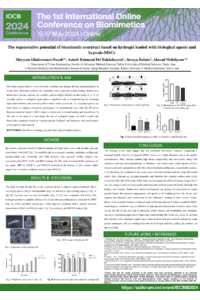
Skin tissue engineering is a novel approach used to treat skin damage that has gained popularity in recent times. Hydrogel scaffolds are commonly used to promote wound healing. Studies have shown that chitosan, alginate, and ascorbic acid are highly effective in this regard [1, 2, 3, 4]. Ascorbic acid, used as a biological agent, plays a significant role in wound healing by increasing repair intermediaries and decreasing inflammation at the wound site [5]. Applying hypoxia has been shown to enhance the therapeutic performance of mesenchymal stem cells [6]. Moreover, hypoxia-inducible factor-1 (HIF-1) plays a crucial role in wound healing and remodeling [7]. The aim of our study is to investigate the role of biological agents and MSCs loaded onto biomimetic constructs based on chitosan—alginate hydrogel and determine their performance under hypoxic conditions.
Methods:
Biomimetic constructs based on chitosan—alginate hydrogel were mixed with ascorbic acid and cross-linked with CaCl2.The scaffold's physicochemical properties, including swelling and biodegradation rates, wettability, and FTIR analysis, were assessed. Further analysis was conducted using MTT, DAPI, and H&E staining. The study investigated the expression of key genes (HIF-1α, VEGF-A, and TGF-β1) involved in the healing of skin wounds under hypoxic and normoxic conditions using real-time PCR.
Results and conclusions
The study revealed that the biomimetic construct based on chitosan—alginate hydrogel was highly porous, biodegradable, and had a high swelling capacity. The hydrogel was not only hydrophilic but also compatible with blood. The hydrogel provided a suitable substrate for cell growth and proliferation, as indicated by MTT, DAPI, and H&E staining tests. Under hypoxic conditions, MSCs showed increased expression levels of VEGF and TGF-β1 genes according to RT-PCR analysis. Based on the results, a biomimetic construct made of chitosan—alginate hydrogel seeded with hypoxic MSCs could be a promising approach to improving wound healing.
Keywords
Skin Wound Healing
Ascorbic Acid
Hypoxia-Induced Factor
Poster
The Last Updated poster-Maryam Ghahremani-nasab.pdf
Effect of vitamin D3 functionalization on osteogenic differentiation of dental pulp stem cells and genotoxicity in bioinspired 3D scaffolds based on marine sponge
Numerical simulation study of airfoil with multiple biomimetic leading-edge protuberances