Event submissions
Published
This submission belongs to the session S2. Biomimetic Design, Constructions and Devices of the event The 1st International Online Conference on Biomimetics
Published date
15 May, 2024
Academic Editor
'%3e%3cpath%20d='M12.6657%2010.9104C12.4185%2010.325%2012.0599%209.79327%2011.6097%209.34482C11.1609%208.89508%2010.6293%208.5365%2010.0442%208.28888C10.0389%208.28626%2010.0337%208.28495%2010.0285%208.28233C10.8446%207.69279%2011.3752%206.73249%2011.3752%205.64904C11.3752%203.8542%209.92103%202.39999%208.1262%202.39999C6.33136%202.39999%204.87715%203.8542%204.87715%205.64904C4.87715%206.73249%205.40774%207.69279%206.22393%208.28364C6.21869%208.28626%206.21345%208.28757%206.20821%208.29019C5.62129%208.5378%205.09463%208.89284%204.64265%209.34613C4.1929%209.79493%203.83432%2010.3266%203.58671%2010.9117C3.34345%2011.4845%203.21226%2012.0987%203.20023%2012.7209C3.19988%2012.7349%203.20233%2012.7488%203.20744%2012.7619C3.21255%2012.7749%203.22022%2012.7867%203.22998%2012.7968C3.23975%2012.8068%203.25142%2012.8147%203.26431%2012.8202C3.2772%2012.8256%203.29105%2012.8284%203.30504%2012.8284H4.09109C4.14874%2012.8284%204.19459%2012.7825%204.1959%2012.7262C4.2221%2011.7148%204.62823%2010.7676%205.34617%2010.0497C6.08899%209.30683%207.0755%208.89808%208.1262%208.89808C9.17689%208.89808%2010.1634%209.30683%2010.9062%2010.0497C11.6242%2010.7676%2012.0303%2011.7148%2012.0565%2012.7262C12.0578%2012.7838%2012.1037%2012.8284%2012.1613%2012.8284H12.9474C12.9613%2012.8284%2012.9752%2012.8256%2012.9881%2012.8202C13.001%2012.8147%2013.0126%2012.8068%2013.0224%2012.7968C13.0322%2012.7867%2013.0398%2012.7749%2013.0449%2012.7619C13.0501%2012.7488%2013.0525%2012.7349%2013.0522%2012.7209C13.0391%2012.0947%2012.9094%2011.4855%2012.6657%2010.9104ZM8.1262%207.9024C7.52486%207.9024%206.9589%207.6679%206.53312%207.24211C6.10733%206.81633%205.87283%206.25037%205.87283%205.64904C5.87283%205.0477%206.10733%204.48174%206.53312%204.05596C6.9589%203.63018%207.52486%203.39567%208.1262%203.39567C8.72753%203.39567%209.29349%203.63018%209.71927%204.05596C10.1451%204.48174%2010.3796%205.0477%2010.3796%205.64904C10.3796%206.25037%2010.1451%206.81633%209.71927%207.24211C9.29349%207.6679%208.72753%207.9024%208.1262%207.9024Z'%20fill='%235D1EE1'/%3e%3c/g%3e%3c/svg%3e) Marc Weissburg
Marc WeissburgCitation
Amit Kumar Jaglan, Shift In Architecture from Bioinspiration to Biomimicry: Trends and Perspectives, in Proceedings of The 1st International Online Conference on Biomimetics, 15 May–17 May 2024, MDPI: Basel, Switzerland
Share
Email
Facebook
Twitter
LinkedIn
Shift In Architecture from Bioinspiration to Biomimicry: Trends and Perspectives

Amit Kumar Jaglan 1
1. Department of Architecture, School of Planning & Architecture, New Delhi,110002, India
Abstract
Though historically this has not always been the case, science and art and architecture frequently go well together. Researchers who investigate the biological principles, structures, and functions of different natural things are engaged in the multidisciplinary area of biomimetics. Architecture contributes to the conversation within the profession, whereas art concentrates on producing visual objects for enjoyment. Bioinspired design is included into all facets of work at all scales through the combination of art, architecture, and biomimetics, or bio architecture. Utilizing biological principles to inform design is a creative process known as bioinspiration. In order to address real-world issues with innovation and sustainable development, the recently emerging multidisciplinary area of "biomimicry" combines scientific and technical aspects of biology with other disciplines. Both the social and natural sciences have an impact on architecture, and design activities often incorporate biological research. Through historical to contemporary bio architectural trends, bioinspiration has changed and moved architectural practices towards inventive ways. The distinction between replicating natural forms and comprehending biological principles is blurred by biomimicry in architecture, which is important for sustainable development. The main obstacle is the disparity between the creative process of architectural design and the deep understanding of biology and associated scientific domains; this calls for interdisciplinary collaboration. In this article, techniques are defined and applied to architectural design through case studies, examining bio architectural motions and their impact on biomimicry. Opportunities, difficulties, and the field's prospects for the future will all be discussed.
Keywords
Architecture
Bioinspiration
Biomimicry
Interdisciplinary
Sustainable Development
Design
Art
Poster
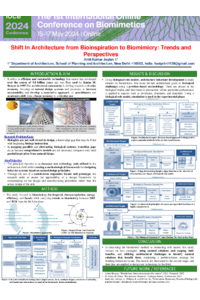
Sciforum_086652_Amit Kumar Jaglan.pdf
Autonomous Aquatic Sentinels: Advancing Water Quality Assessment with Non-Intrusive Biomimetics Approach
Butterfly Wing Scales as Inspiration for Multifunctional Building Surfaces