Event submissions
Published
This submission belongs to the session S3. Biomimetic Surfaces and Interfaces of the event The 1st International Online Conference on Biomimetics
Published date
15 May, 2024
Academic Editor
'%3e%3cpath%20d='M12.6657%2010.9104C12.4185%2010.325%2012.0599%209.79327%2011.6097%209.34482C11.1609%208.89508%2010.6293%208.5365%2010.0442%208.28888C10.0389%208.28626%2010.0337%208.28495%2010.0285%208.28233C10.8446%207.69279%2011.3752%206.73249%2011.3752%205.64904C11.3752%203.8542%209.92103%202.39999%208.1262%202.39999C6.33136%202.39999%204.87715%203.8542%204.87715%205.64904C4.87715%206.73249%205.40774%207.69279%206.22393%208.28364C6.21869%208.28626%206.21345%208.28757%206.20821%208.29019C5.62129%208.5378%205.09463%208.89284%204.64265%209.34613C4.1929%209.79493%203.83432%2010.3266%203.58671%2010.9117C3.34345%2011.4845%203.21226%2012.0987%203.20023%2012.7209C3.19988%2012.7349%203.20233%2012.7488%203.20744%2012.7619C3.21255%2012.7749%203.22022%2012.7867%203.22998%2012.7968C3.23975%2012.8068%203.25142%2012.8147%203.26431%2012.8202C3.2772%2012.8256%203.29105%2012.8284%203.30504%2012.8284H4.09109C4.14874%2012.8284%204.19459%2012.7825%204.1959%2012.7262C4.2221%2011.7148%204.62823%2010.7676%205.34617%2010.0497C6.08899%209.30683%207.0755%208.89808%208.1262%208.89808C9.17689%208.89808%2010.1634%209.30683%2010.9062%2010.0497C11.6242%2010.7676%2012.0303%2011.7148%2012.0565%2012.7262C12.0578%2012.7838%2012.1037%2012.8284%2012.1613%2012.8284H12.9474C12.9613%2012.8284%2012.9752%2012.8256%2012.9881%2012.8202C13.001%2012.8147%2013.0126%2012.8068%2013.0224%2012.7968C13.0322%2012.7867%2013.0398%2012.7749%2013.0449%2012.7619C13.0501%2012.7488%2013.0525%2012.7349%2013.0522%2012.7209C13.0391%2012.0947%2012.9094%2011.4855%2012.6657%2010.9104ZM8.1262%207.9024C7.52486%207.9024%206.9589%207.6679%206.53312%207.24211C6.10733%206.81633%205.87283%206.25037%205.87283%205.64904C5.87283%205.0477%206.10733%204.48174%206.53312%204.05596C6.9589%203.63018%207.52486%203.39567%208.1262%203.39567C8.72753%203.39567%209.29349%203.63018%209.71927%204.05596C10.1451%204.48174%2010.3796%205.0477%2010.3796%205.64904C10.3796%206.25037%2010.1451%206.81633%209.71927%207.24211C9.29349%207.6679%208.72753%207.9024%208.1262%207.9024Z'%20fill='%235D1EE1'/%3e%3c/g%3e%3c/svg%3e) Yongmei Zheng
Yongmei ZhengCitation
Florian Zischka, Viola Kaser, Karin Whitmore, Rupert Kainradl, Harald W. Krenn, Sabine Gaal-Haszler, Ille C. Gebeshuber, Butterfly Wing Scales as Inspiration for Multifunctional Building Surfaces, in Proceedings of The 1st International Online Conference on Biomimetics, 15 May–17 May 2024, MDPI: Basel, Switzerland
Share
Email
Facebook
Twitter
LinkedIn
Butterfly Wing Scales as Inspiration for Multifunctional Building Surfaces

Florian Zischka 1
'%3e%3cpath%20d='M12.6647%2010.9104C12.4176%2010.325%2012.0589%209.7933%2011.6088%209.34485C11.16%208.89511%2010.6283%208.53653%2010.0432%208.28891C10.038%208.28629%2010.0327%208.28498%2010.0275%208.28236C10.8437%207.69282%2011.3743%206.73252%2011.3743%205.64907C11.3743%203.85423%209.92005%202.40002%208.12522%202.40002C6.33038%202.40002%204.87618%203.85423%204.87618%205.64907C4.87618%206.73252%205.40677%207.69282%206.22296%208.28367C6.21772%208.28629%206.21248%208.2876%206.20724%208.29022C5.62031%208.53783%205.09365%208.89287%204.64167%209.34616C4.19192%209.79496%203.83334%2010.3266%203.58573%2010.9117C3.34247%2011.4846%203.21128%2012.0987%203.19925%2012.721C3.1989%2012.735%203.20135%2012.7489%203.20646%2012.7619C3.21157%2012.7749%203.21924%2012.7868%203.22901%2012.7968C3.23877%2012.8068%203.25045%2012.8148%203.26334%2012.8202C3.27623%2012.8256%203.29007%2012.8284%203.30406%2012.8284H4.09012C4.14776%2012.8284%204.19362%2012.7825%204.19493%2012.7262C4.22113%2011.7148%204.62726%2010.7676%205.34519%2010.0497C6.08802%209.30686%207.07452%208.89811%208.12522%208.89811C9.17592%208.89811%2010.1624%209.30686%2010.9052%2010.0497C11.6232%2010.7676%2012.0293%2011.7148%2012.0555%2012.7262C12.0568%2012.7839%2012.1027%2012.8284%2012.1603%2012.8284H12.9464C12.9604%2012.8284%2012.9742%2012.8256%2012.9871%2012.8202C13%2012.8148%2013.0117%2012.8068%2013.0214%2012.7968C13.0312%2012.7868%2013.0389%2012.7749%2013.044%2012.7619C13.0491%2012.7489%2013.0515%2012.735%2013.0512%2012.721C13.0381%2012.0947%2012.9084%2011.4856%2012.6647%2010.9104ZM8.12522%207.90243C7.52388%207.90243%206.95792%207.66793%206.53214%207.24215C6.10636%206.81636%205.87185%206.2504%205.87185%205.64907C5.87185%205.04773%206.10636%204.48177%206.53214%204.05599C6.95792%203.63021%207.52388%203.3957%208.12522%203.3957C8.72655%203.3957%209.29252%203.63021%209.7183%204.05599C10.1441%204.48177%2010.3786%205.04773%2010.3786%205.64907C10.3786%206.2504%2010.1441%206.81636%209.7183%207.24215C9.29252%207.66793%208.72655%207.90243%208.12522%207.90243Z'%20fill='%235D1EE1'/%3e%3c/g%3e%3c/svg%3e)
Viola Kaser 2
Karin Whitmore 3
Rupert Kainradl 4

Harald W. Krenn 5
Sabine Gaal-Haszler 6

Ille C. Gebeshuber 1
1. Institute of Applied Physics, TU Wien, Vienna, Austria
2. TU Graz, Austria
3. University Service Center for Transmission Electron Microscopy, TU Wien, Vienna, Austria
4. Schönbrunn Zoo, Vienna, Austria
5. Department of Evolutionary Biology, Unit Integrative Zoology, University of Vienna, Austria
6. Lepidoptera Collection, Natural History Museum, Vienna, Austria
Abstract
Global warming advances and urban areas are plagued by increasingly intense heat waves every summer, pressing a dire need to cool down cities.
Butterflies can inspire us in this matter, as they benefit from various multifunctional nanostructures on their wing scales. The properties range from structural coloring, hydrophobicity and self-cleaning properties to structural integrity and passive thermoregulation. Recent research on scent scales - special scales, used by butterflies to distribute pheromones - indicates that they exhibit interesting thermal properties, especially within the atmospheric window (the wavelength spectrum from
7.5 μm - 13 μm, where our atmosphere is transparent for radiation within that range).
This work aims to investigate different kinds of butterfly scales on a micrometer and nanometer scale for potential application in the thermoregulation of buildings.
With Scanning electron microscopy (SEM) and Focused ion beam (FIB) techniques it is managed to cut into single scales, to analyze the cross-section of these structures and to provide first expert guesses about structure-function relationships. Color scales, scent scales and reflective scales from various butterfly species (both tropical and native to the temperate zone of Middle Europe) are compared, to determine, whether specific nanostructures could be responsible for thermal features such as passive radiative cooling.
Keywords
Biomimetics
Nanostructures
Butterflies
Scent scales
Building facades
Passive radiative cooling
Poster
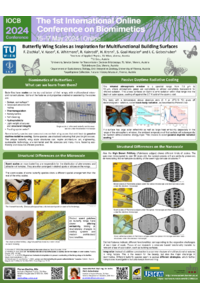
2024_ButterflyWingScales_Zischka_biomim_vfinal.pdf
Shift In Architecture from Bioinspiration to Biomimicry: Trends and Perspectives
Modularity in the insect world as a strategy for bio-inspired and sustainable design